
Researchers are continually conducting studies to learn more about the causes of dyslexia, early identification of dyslexia, and the most effective treatments for dyslexia.
Developmental dyslexia is associated with difficulty in processing the orthography (the written form) and phonology (the sound structure) of language. As a way to understand the origin of these problems, neuroimaging studies have examined brain anatomy and function of people with and without dyslexia. These studies are also contributing to our understanding of the role of the brain in dyslexia, which can provide useful information for developing successful reading interventions and pinpointing certain genes that may also be involved.
What is brain imaging?
A number of techniques are available to visualize brain anatomy and function. A commonly used tool is magnetic resonance imaging (MRI), which creates images that can reveal information about brain anatomy (e.g., the amount of gray and white matter, the integrity of white matter), brain metabolites (chemicals used in the brain for communication between brain cells), and brain function (where large pools of neurons are active). Functional MRI (fMRI) is based on the physiological principle that activity in the brain (where neurons are “firing”) is associated with an increase of blood flow to that specific part of the brain. The MRI signal bears indirect information about increases in blood flow. From this signal, researchers infer the location and amount of activity that is associated with a task, such as reading single words, that the research participants are performing in the scanner. Data from these studies are typically collected on groups of people rather than individuals for research purposes only—not to diagnose individuals with dyslexia.
Which brain areas are involved in reading?
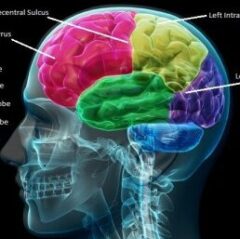
Since reading is a cultural invention that arose after the evolution of modern humans, no single location within the brain serves as a reading center. Instead, brain regions that sub serve other functions, such as spoken language and object recognition, are redirected (rather than innately specified) for the purpose of reading (Dehaene & Cohen, 2007). Reading involves multiple cognitive processes, two of which have been of particular interest to researchers: 1) grapheme-phoneme mapping in which combinations of letters (graphemes) are mapped onto their corresponding sounds (phonemes) and the words are thus “decoded,” and 2) visual word form recognition for mapping of familiar words onto their mental representations. Together, these processes allow us to pronounce words and gain access to meaning. In accordance with these cognitive processes, studies in adults and children have demonstrated that reading is supported by a network of regions in the left hemisphere (Price, 2012), including the occipito-temporal, temporo-parietal, and inferior frontal cortices. The occipito-temporal cortex holds the “visual word form area.” Both the temporo-parietal and inferior frontal cortices play a role in phonological and semantic processing of words, with inferior frontal cortex also involved in the formation of speech sounds. These areas have been shown to change as we age (Turkeltaub, et al., 2003) and are altered in people with dyslexia (Richlan et al., 2011).
What have brain images revealed about brain structure in dyslexia?
Evidence of a connection between dyslexia and the structure of the brain was first discovered by examining the anatomy of brains of deceased adults who had dyslexia during their lifetimes. The left-greater-than-right asymmetry typically seen in the left hemisphere temporal lobe (planum temporale) was not found in these brains (Galaburda & Kemper, 1979), and ectopias (a displacement of brain tissue to the surface of the brain) were noted (Galaburda, et al., 1985). Then investigators began to use MRI to search for structural images in the brains of research volunteers with and without dyslexia. Current imaging techniques have revealed less gray and white matter volume and altered white matter integrity in left hemisphere occipito-temporal and temporo-parietal areas. Researchers are still investigating how these findings are influenced by a person’s language and writing systems.
What have brain images revealed about brain function in dyslexia?
Early functional studies were limited to adults because they employed invasive techniques that require radioactive materials. The field of human brain mapping greatly benefited from the invention of fMRI. fMRI does not require the use of radioactive tracers, so it is safe for children and adults and can be used repeatedly which facilitates longitudinal studies of development and intervention. First used to study dyslexia in 1996 (Eden et al., 1996), fMRI has since been widely used to study the brain’s role in reading and its components (phonology, orthography, and semantics). Studies from different countries have converged in findings of altered left-hemisphere areas (Richlan et al., 2011), including ventral occipito-temporal, temporo-parietal, and inferior frontal cortices (and their connections). Results of these studies confirm the universality of dyslexia across different world languages.
Continue reading article: https://dyslexiaida.org/dyslexia-and-the-brain-fact-sheet/

