Tag: AFS-Test Series

  • Inside the AFS-Test, Week 15 of 25: Errors Are Information

    Inside the AFS-Test, Week 15 of 25: Errors Are Information

    Every Wednesday, we take you inside the AFS-Test, the standardized assessment that allows Certified Dyslexia Trainers to definitively diagnose and categorize dyslexia and dyscalculia. This is week 15 of 25.

    This week: Errors Are Information

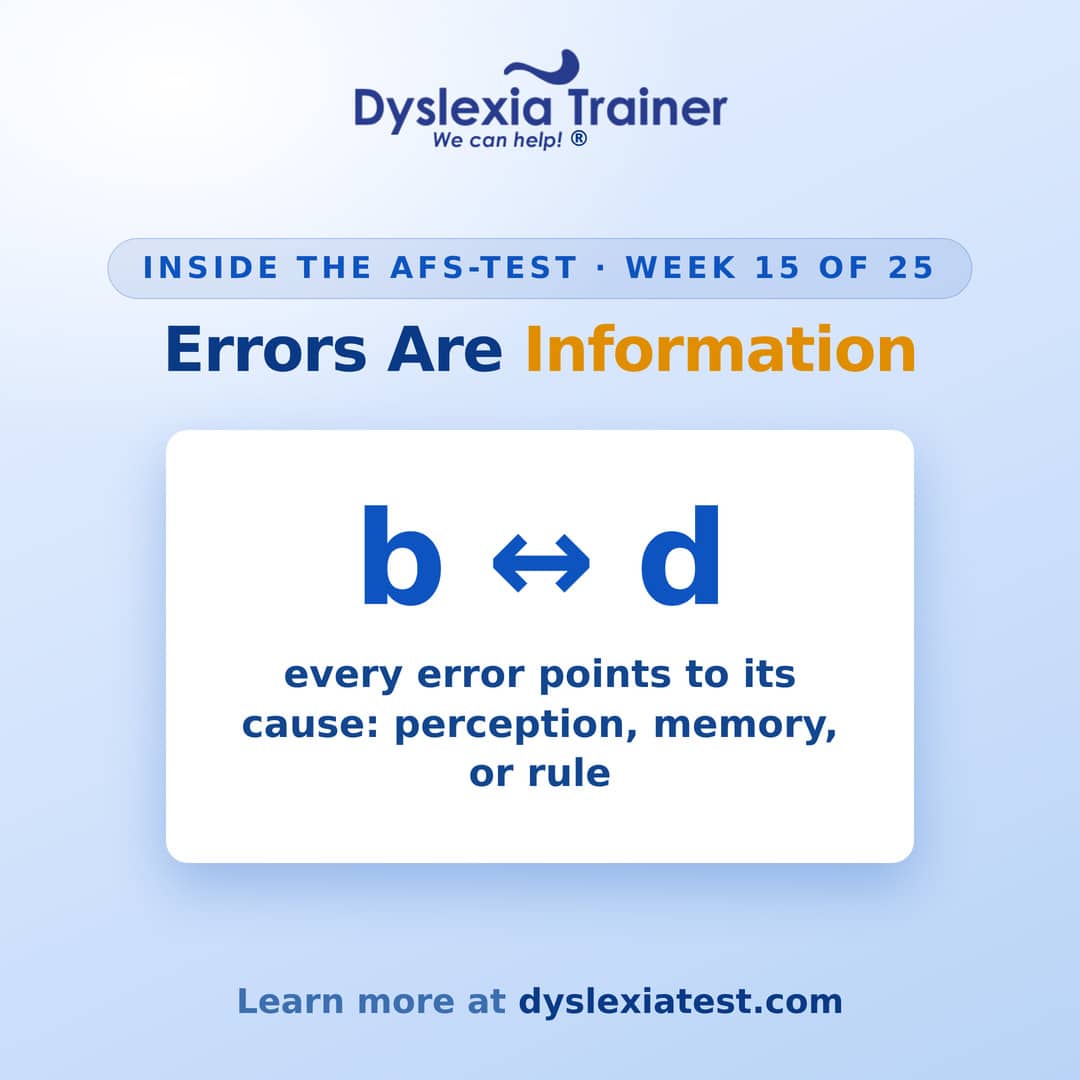
    Every error a child makes in reading or writing is a window into how their brain processes language. Error analysis, the S in the standardized AFS-Test, distinguishes perceptual errors from rule errors: did the child mishear the word, misremember its image, or simply not know the spelling rule? Each error type points to a different cause and calls for different training. This is why counting errors says so little, and analyzing them says almost everything.

    About the AFS-Test

    The standardized Attention-Function-Symptom Test has been used worldwide for more than 25 years. It examines the attention span, the sensory perceptions, and the error symptoms of a child, and turns the results into an individualized training plan following the AFS-Method.

    Find a Certified Trainer

    Certified Dyslexia Trainers conduct the standardized AFS-Test in your area or remotely. Learn more and find a Certified Trainer near you: dyslexiatest.com

    You can find all published articles of this series under the tag AFS-Test Series.
  • Inside the AFS-Test, Week 14 of 25: Body Perception

    Inside the AFS-Test, Week 14 of 25: Body Perception

    Every Wednesday, we take you inside the AFS-Test, the standardized assessment that allows Certified Dyslexia Trainers to definitively diagnose and categorize dyslexia and dyscalculia. This is week 14 of 25.

    This week: Body Perception

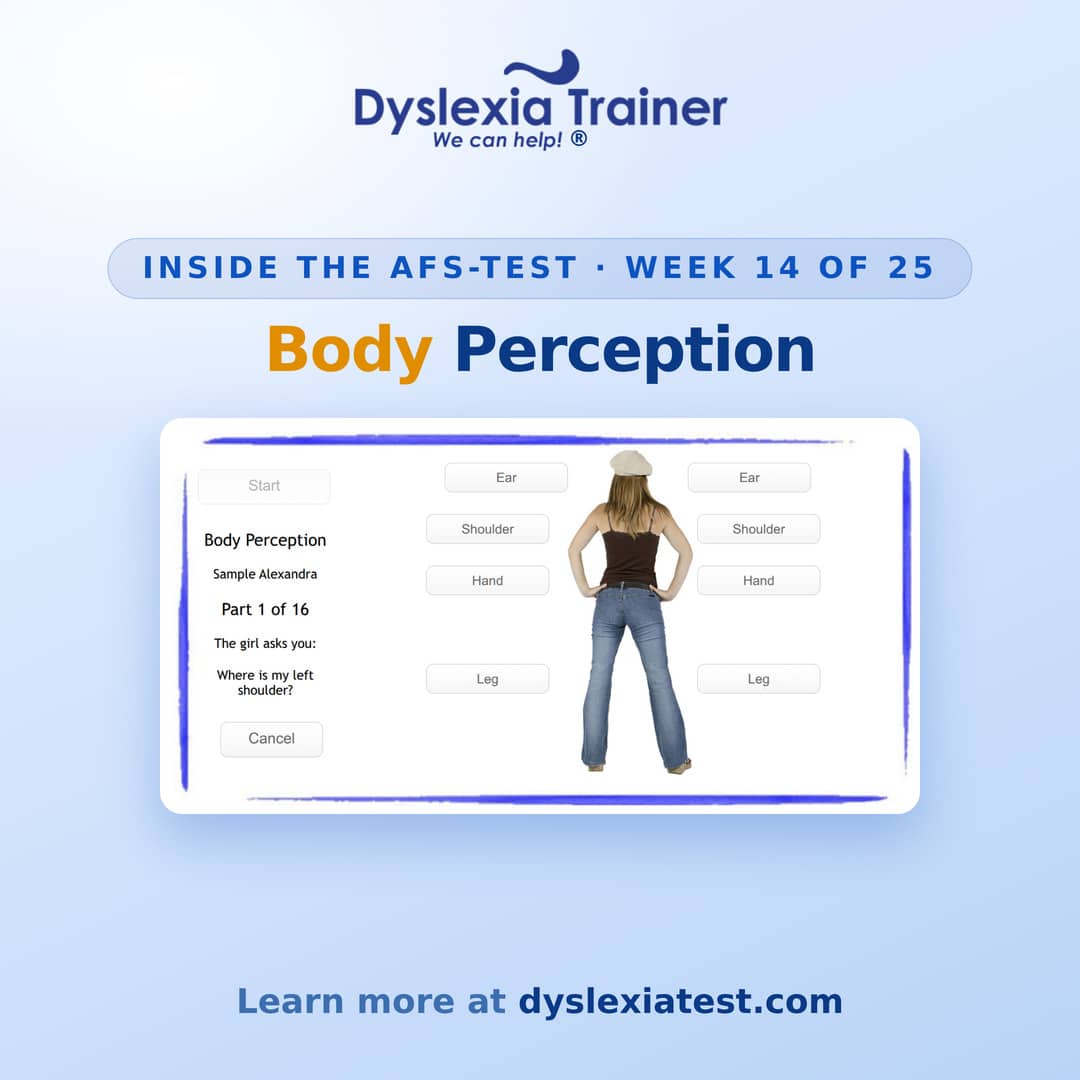
    Body perception is the most overlooked foundation of learning: knowing one’s own body, feeling left and right without thinking, sensing where you are. It is the reference system all other orientation builds on. Children with underdeveloped body perception often appear clumsy, tire quickly when writing, and mix up directions. The standardized AFS-Test includes body perception for exactly this reason, completing the picture that allows trainers to definitively diagnose and categorize what a child needs.

    Week 14 in under a minute. Watch more on our YouTube channel American Dyslexia Association.

    About the AFS-Test

    The standardized Attention-Function-Symptom Test has been used worldwide for more than 25 years. It examines the attention span, the sensory perceptions, and the error symptoms of a child, and turns the results into an individualized training plan following the AFS-Method.

    Find a Certified Trainer

    Certified Dyslexia Trainers conduct the standardized AFS-Test in your area or remotely. Learn more and find a Certified Trainer near you: dyslexiatest.com

    You can find all published articles of this series under the tag AFS-Test Series.
  • Inside the AFS-Test, Week 13 of 25: Spatial Orientation

    Inside the AFS-Test, Week 13 of 25: Spatial Orientation

    Every Wednesday, we take you inside the AFS-Test, the standardized assessment that allows Certified Dyslexia Trainers to definitively diagnose and categorize dyslexia and dyscalculia. This is week 13 of 25.

    This week: Spatial Orientation

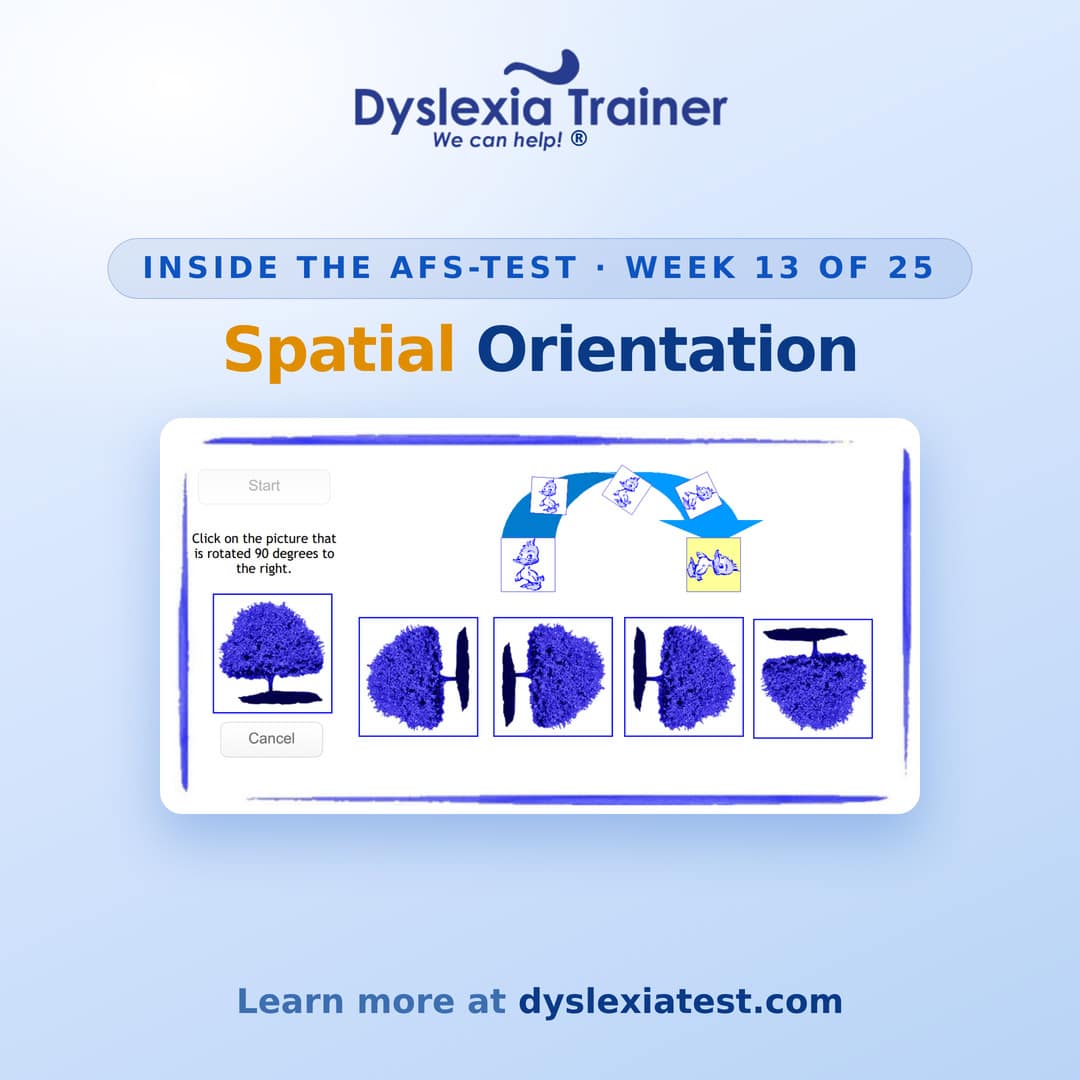
    Letters and numbers live in space: b and d differ only by direction, 12 and 21 only by position, and writing itself moves from left to right. Spatial orientation also includes time: yesterday and tomorrow, before and after. A child with underdeveloped spatial orientation confuses directions, loses their place on the page, and struggles with place value in math. The standardized AFS-Test measures this area precisely, so that training can build stable spatial and temporal anchors.

    Week 13 in under a minute. Watch more on our YouTube channel American Dyslexia Association.

    About the AFS-Test

    The standardized Attention-Function-Symptom Test has been used worldwide for more than 25 years. It examines the attention span, the sensory perceptions, and the error symptoms of a child, and turns the results into an individualized training plan following the AFS-Method.

    Find a Certified Trainer

    Certified Dyslexia Trainers conduct the standardized AFS-Test in your area or remotely. Learn more and find a Certified Trainer near you: dyslexiatest.com

    You can find all published articles of this series under the tag AFS-Test Series.
  • Inside the AFS-Test, Week 12 of 25: Auditory Sequencing

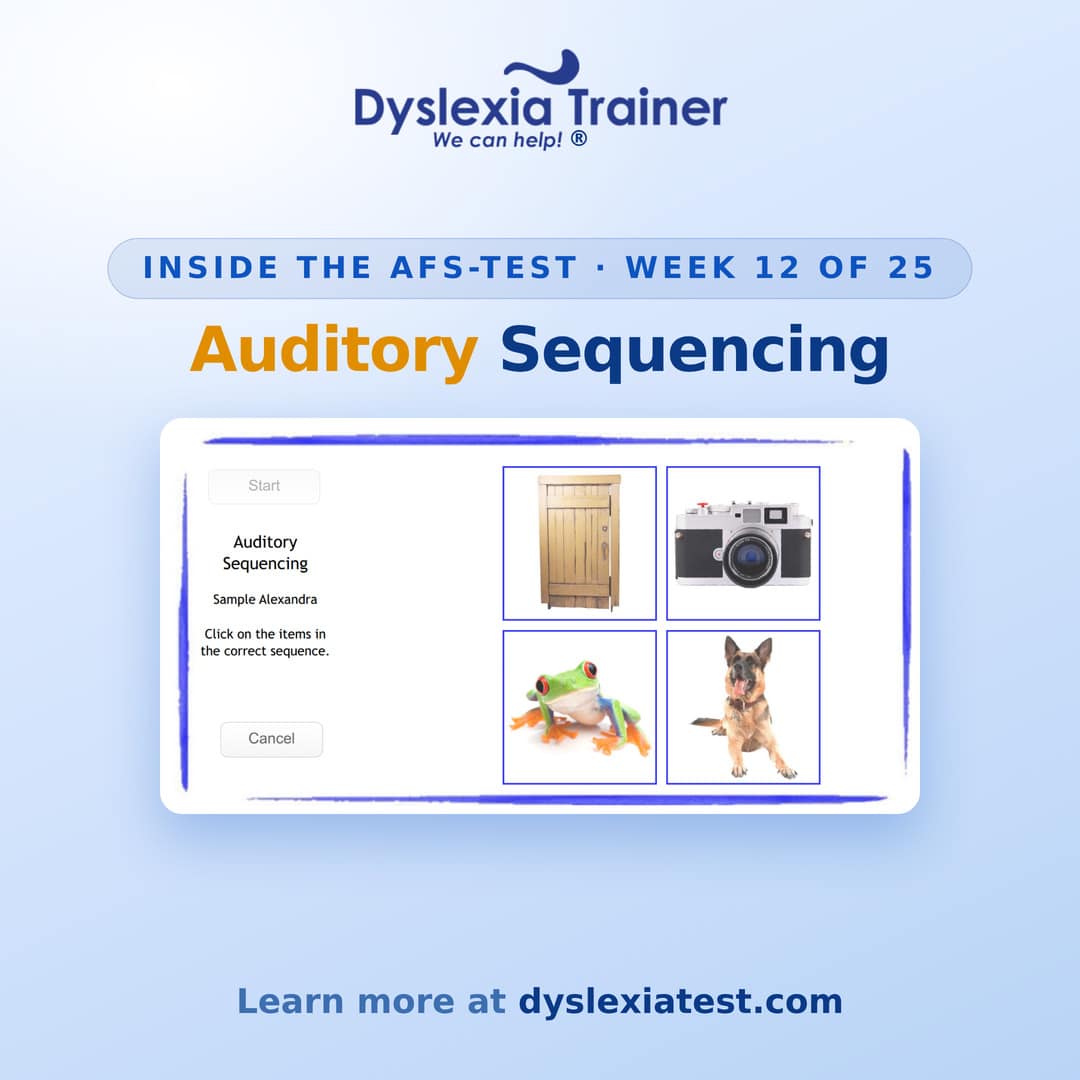
    Inside the AFS-Test, Week 12 of 25: Auditory Sequencing

    Every Wednesday, we take you inside the AFS-Test, the standardized assessment that allows Certified Dyslexia Trainers to definitively diagnose and categorize dyslexia and dyscalculia. This is week 12 of 25.

    This week: Auditory Sequencing

    Auditory sequencing keeps sounds in the right order within a word. When it is underdeveloped, a child hears all the sounds of a word but assembles them differently: letters get swapped, syllables disappear, endings change. The standardized AFS-Test checks auditory sequencing with exercises built around sound order. Identifying and categorizing this area correctly matters, because sequencing errors look like carelessness but respond only to targeted function training.

    Week 12 in under a minute. Watch more on our YouTube channel American Dyslexia Association.

    About the AFS-Test

    The standardized Attention-Function-Symptom Test has been used worldwide for more than 25 years. It examines the attention span, the sensory perceptions, and the error symptoms of a child, and turns the results into an individualized training plan following the AFS-Method.

    Find a Certified Trainer

    Certified Dyslexia Trainers conduct the standardized AFS-Test in your area or remotely. Learn more and find a Certified Trainer near you: dyslexiatest.com

    You can find all published articles of this series under the tag AFS-Test Series.
  • Inside the AFS-Test, Week 11 of 25: Auditory Memory

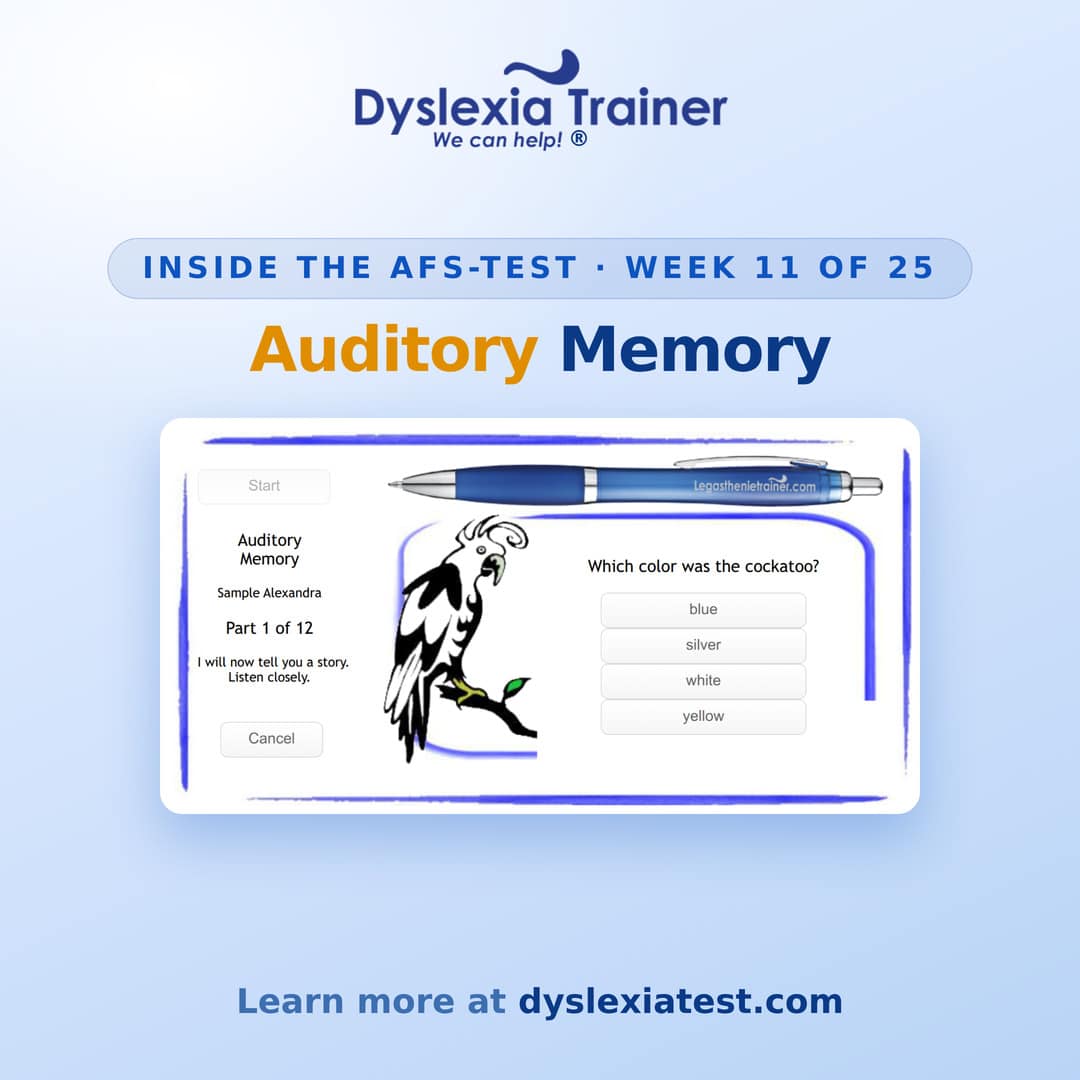
    Inside the AFS-Test, Week 11 of 25: Auditory Memory

    Every Wednesday, we take you inside the AFS-Test, the standardized assessment that allows Certified Dyslexia Trainers to definitively diagnose and categorize dyslexia and dyscalculia. This is week 11 of 25.

    This week: Auditory Memory

    Auditory memory stores what we hear: instructions, dictated sentences, the sound of words. A child with underdeveloped auditory memory loses parts of a dictation on the way to the paper, forgets multi-step instructions, and struggles to hold new vocabulary. This has nothing to do with effort or intelligence. The standardized AFS-Test measures auditory memory precisely, so that training can strengthen exactly this storage system with daily, playful exercises.

    Week 11 in under a minute. Watch more on our YouTube channel American Dyslexia Association.

    About the AFS-Test

    The standardized Attention-Function-Symptom Test has been used worldwide for more than 25 years. It examines the attention span, the sensory perceptions, and the error symptoms of a child, and turns the results into an individualized training plan following the AFS-Method.

    Find a Certified Trainer

    Certified Dyslexia Trainers conduct the standardized AFS-Test in your area or remotely. Learn more and find a Certified Trainer near you: dyslexiatest.com

    You can find all published articles of this series under the tag AFS-Test Series.
  • Inside the AFS-Test, Week 10 of 25: Auditory Recognition

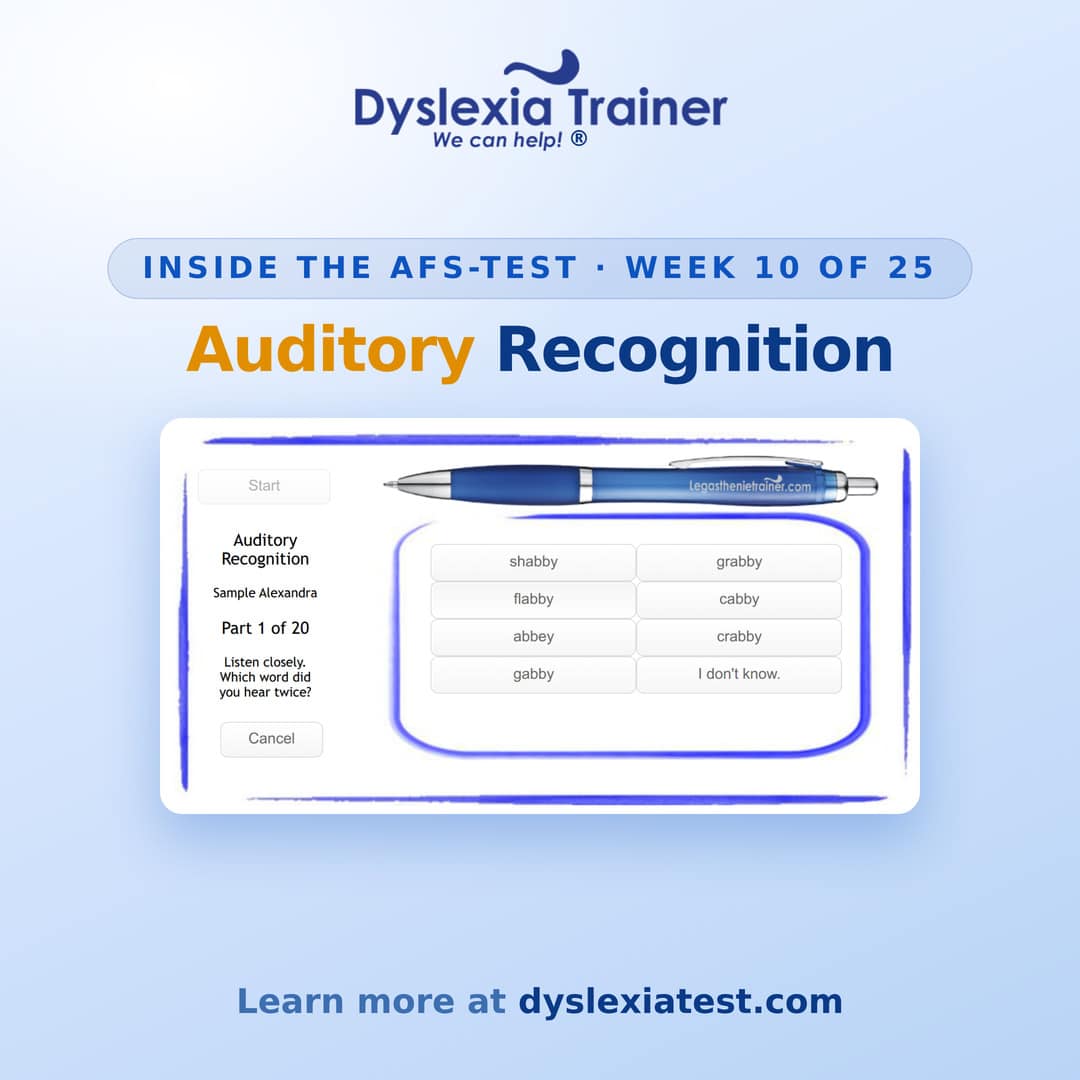
    Inside the AFS-Test, Week 10 of 25: Auditory Recognition

    Every Wednesday, we take you inside the AFS-Test, the standardized assessment that allows Certified Dyslexia Trainers to definitively diagnose and categorize dyslexia and dyscalculia. This is week 10 of 25.

    This week: Auditory Recognition

    Auditory recognition lets a child pick the important sound out of everything they hear, and tell similar sounds apart: d and t, g and k, m and n. If these distinctions are not reliable, spelling by sound becomes a guessing game. The standardized AFS-Test checks auditory recognition with listening exercises that show whether the child truly hears the difference between similar sounds. Where it is needed, targeted hearing exercises build this foundation before spelling rules can do their work.

    Week 10 in under a minute. Watch more on our YouTube channel American Dyslexia Association.

    About the AFS-Test

    The standardized Attention-Function-Symptom Test has been used worldwide for more than 25 years. It examines the attention span, the sensory perceptions, and the error symptoms of a child, and turns the results into an individualized training plan following the AFS-Method.

    Find a Certified Trainer

    Certified Dyslexia Trainers conduct the standardized AFS-Test in your area or remotely. Learn more and find a Certified Trainer near you: dyslexiatest.com

    You can find all published articles of this series under the tag AFS-Test Series.
  • Inside the AFS-Test, Week 9 of 25: Visual Sequencing

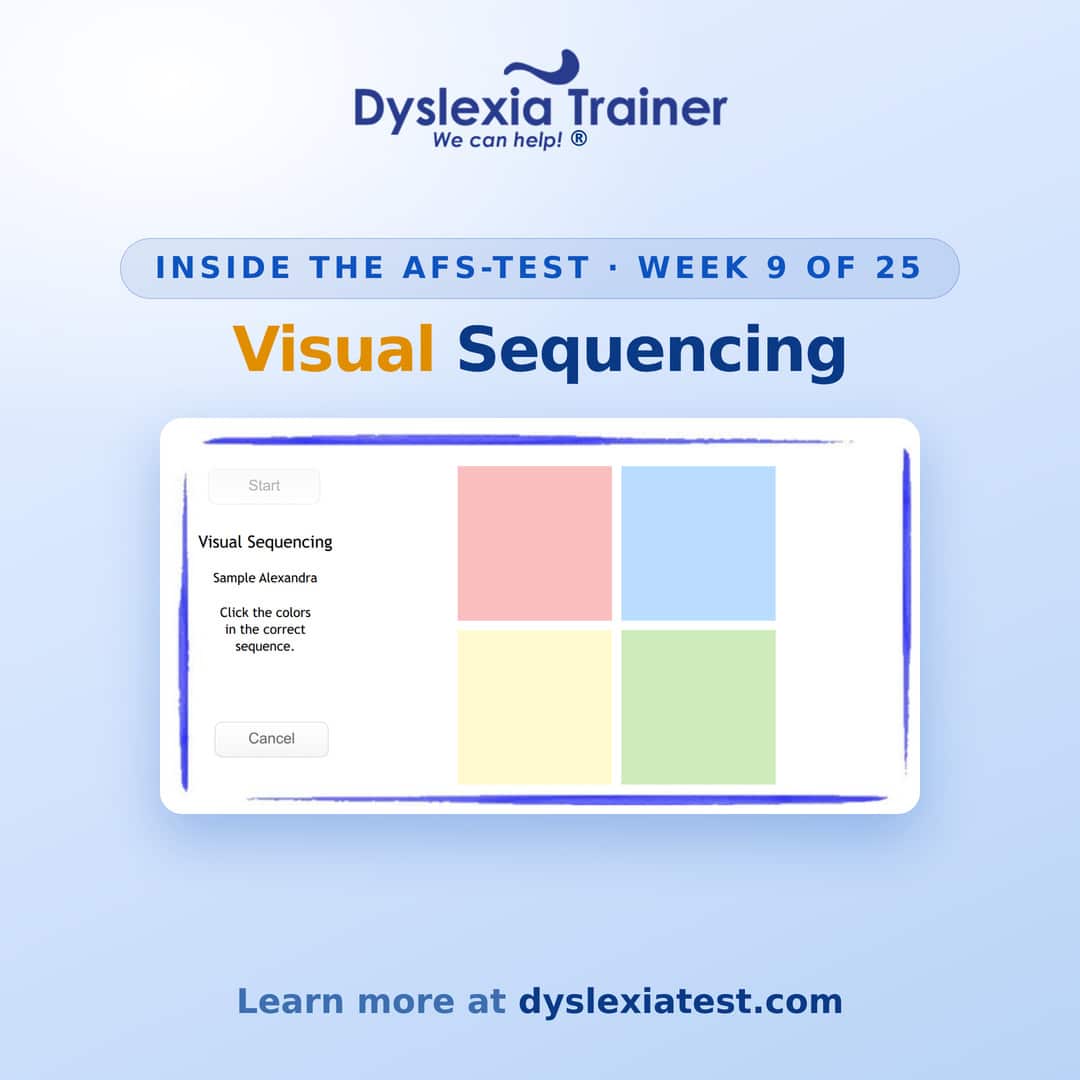
    Inside the AFS-Test, Week 9 of 25: Visual Sequencing

    Every Wednesday, we take you inside the AFS-Test, the standardized assessment that allows Certified Dyslexia Trainers to definitively diagnose and categorize dyslexia and dyscalculia. This is week 9 of 25.

    This week: Visual Sequencing

    Visual sequencing keeps things in order: the sequence of letters in a word, of digits in a number, of words in a line. When it is underdeveloped, letters swap places and ‘was’ becomes ‘saw’. The child is not careless: their processing of order is simply different. The standardized AFS-Test checks visual sequencing with exercises where order is everything. Once the cause is identified and categorized, sequencing can be trained systematically, and reading becomes noticeably more stable.

    Week 9 in under a minute. Watch more on our YouTube channel American Dyslexia Association.

    About the AFS-Test

    The standardized Attention-Function-Symptom Test has been used worldwide for more than 25 years. It examines the attention span, the sensory perceptions, and the error symptoms of a child, and turns the results into an individualized training plan following the AFS-Method.

    Find a Certified Trainer

    Certified Dyslexia Trainers conduct the standardized AFS-Test in your area or remotely. Learn more and find a Certified Trainer near you: dyslexiatest.com

    You can find all published articles of this series under the tag AFS-Test Series.
  • Inside the AFS-Test, Week 8 of 25: Visual Memory

    Inside the AFS-Test, Week 8 of 25: Visual Memory

    Every Wednesday, we take you inside the AFS-Test, the standardized assessment that allows Certified Dyslexia Trainers to definitively diagnose and categorize dyslexia and dyscalculia. This is week 8 of 25.

    This week: Visual Memory

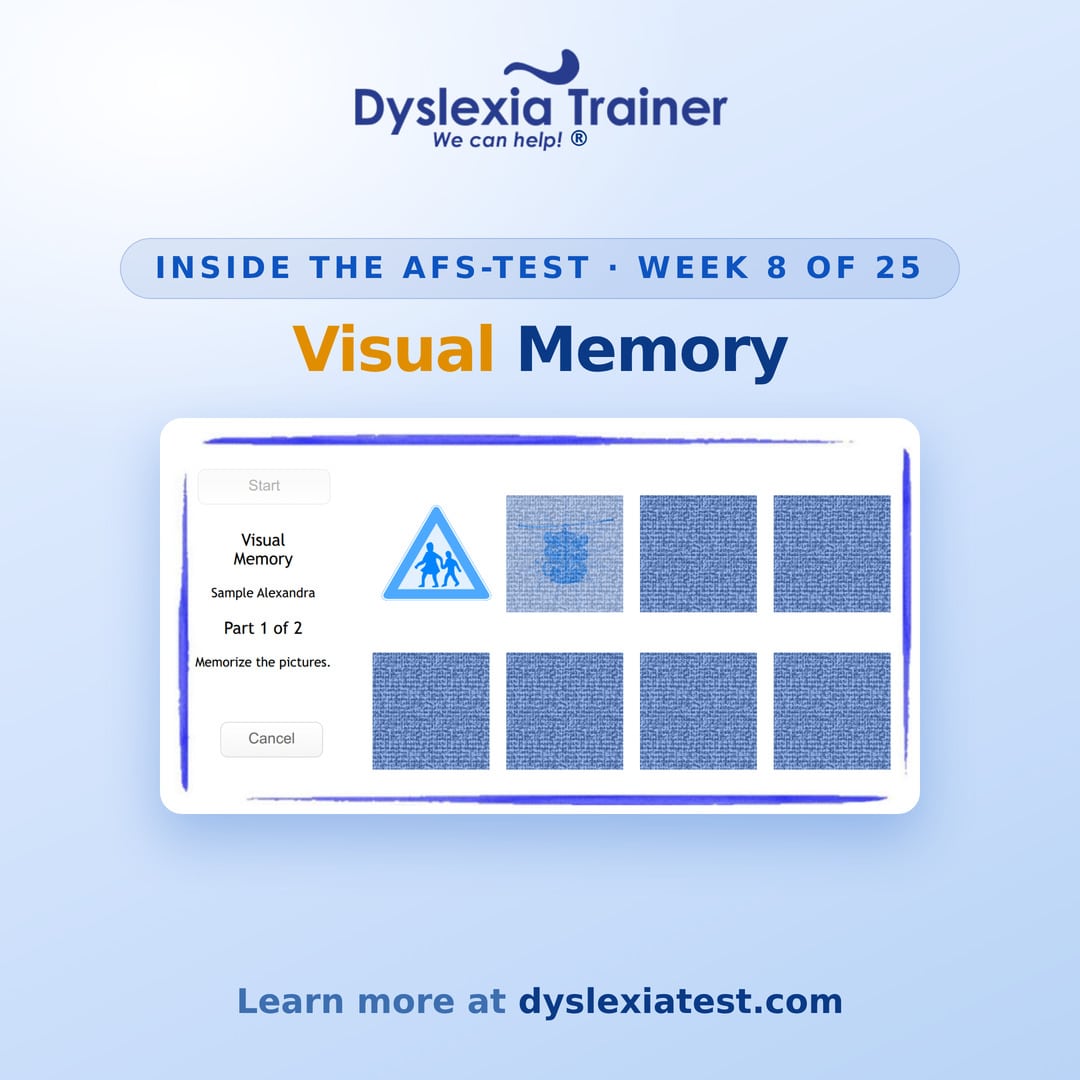
    Visual memory stores what we have seen: the image of a word, the shape of a letter, the look of a number. Spelling depends on it heavily, because writers constantly compare what they write against the stored images of words. A child with underdeveloped visual memory can read a word ten times and still write it differently the eleventh time. The standardized AFS-Test measures visual memory with matching exercises, and the result shows exactly whether this storage system needs targeted training.

    Week 8 in under a minute. Watch more on our YouTube channel American Dyslexia Association.

    About the AFS-Test

    The standardized Attention-Function-Symptom Test has been used worldwide for more than 25 years. It examines the attention span, the sensory perceptions, and the error symptoms of a child, and turns the results into an individualized training plan following the AFS-Method.

    Find a Certified Trainer

    Certified Dyslexia Trainers conduct the standardized AFS-Test in your area or remotely. Learn more and find a Certified Trainer near you: dyslexiatest.com

    You can find all published articles of this series under the tag AFS-Test Series.
  • Inside the AFS-Test, Week 7 of 25: Visual Recognition

    Inside the AFS-Test, Week 7 of 25: Visual Recognition

    Every Wednesday, we take you inside the AFS-Test, the standardized assessment that allows Certified Dyslexia Trainers to definitively diagnose and categorize dyslexia and dyscalculia. This is week 7 of 25.

    This week: Visual Recognition

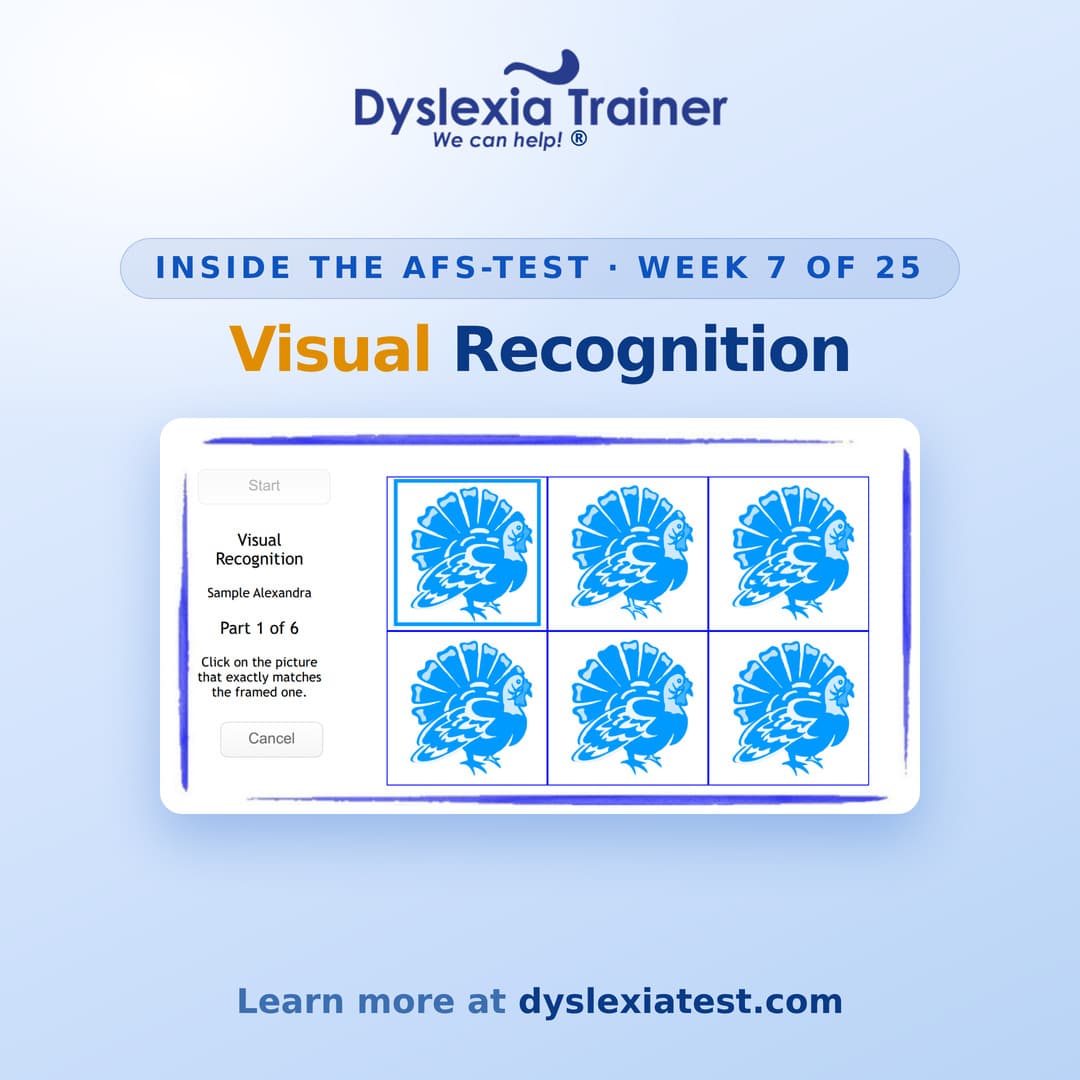
    Visual recognition is the ability to spot the essential detail and tell similar shapes apart: b and d, ie and ei, 6 and 9. A child with underdeveloped visual recognition sees perfectly well, but sorting what they see takes longer and costs more effort. In the standardized AFS-Test, the child works through playful exercises that show precisely how reliably they differentiate optical patterns. If this area needs support, targeted training strengthens it step by step, before letters are even involved.

    Week 7 in under a minute. Watch more on our YouTube channel American Dyslexia Association.

    About the AFS-Test

    The standardized Attention-Function-Symptom Test has been used worldwide for more than 25 years. It examines the attention span, the sensory perceptions, and the error symptoms of a child, and turns the results into an individualized training plan following the AFS-Method.

    Find a Certified Trainer

    Certified Dyslexia Trainers conduct the standardized AFS-Test in your area or remotely. Learn more and find a Certified Trainer near you: dyslexiatest.com

    You can find all published articles of this series under the tag AFS-Test Series.