Tag: assistance

  • Dyscalculia and Brain Activity-The Connection,  by Shradha Kalyani Kabra

    Dyscalculia and Brain Activity-The Connection, by Shradha Kalyani Kabra

    The fear of Mathematics and numbers is called Dyscalculia, which is a learning disability, also termed as number blindness. Extensive studies have recorded that nearly 7% of the population with average intelligence have the problem. The innate number sense of the human brain is not in sync in dyscalculics, as numerical ability relies on special brain networks.

    The theory that separates Dyscalculia from other deficiencies of memory and language is that the approximate number sense gets severely affected. A common symptom that defines the problem is the inability to recognize the place value system. The mathematical ability of people who are unable to grasp the recognition pattern of small numbers is impaired significantly.

    Brain Function In Dyscalculia Sufferers

    The inability to properly estimate and grasp quantifiable figures is the hallmark of Dyscalculia. The disability signifies the inability or impaired ability to recognize small numbers. The brain scans of persons suffering from this issue show that the intraparietal sulci show less activity and are less connected with the greater brain when dealing with numbers.

    Other learning disabilities like dyslexia and aligned problems like ADHD and autism spectrum disorder are also common in dyscalculics.  The treatment becomes a little complex as it is difficult to separate the issues. These comorbidities often make the diagnosis difficult.  The neuronal basis of Dyscalculia is not widely studied due to this phenomenon. Several neuroimaging studies have detailed the representation and processing of numerical information, but no comprehensive and conclusive findings are available. There are many forms of Dyscalculia, and some of them are associated with demonstrated alterations in metabolism, brain structure, and function.

    dyscalculia brain scan

    Image Source: dyscalculiamathdisability.weebly.com

    Developmental Dyscalculia

    Developmental Dyscalculia tends to present as abnormalities in the parietal cortex and involves the cortical and subcortical regions. Recent studies have given clarity on brain activity during number processing as well as calculation. The IPS or intraparietal sulcus is known to be the centre for numerical processing. Research has illustrated that the IPS is activated when mathematical tasks and even simple counting exercises are carried out.

    Memory, perceptual, spatial and motor functions are also involved in the process. Attention is also a key factor. The cognitive processes that are involved in calculation tasks add to the complexity. Developmental Dyscalculia (DD) demonstrates deficits in core brain regions associated with number processing. The brain activation pattern is also not adequate in children afflicted with DD. The gap is bridged with the child resorting to finger counting and memory to compensate.

    The need for remediation measures and education for children with special needs is the need of the hour. There are some steps taken in this direction by experts, but the gap is much more significant than the remedy. Urgent intervention is needed to collate research findings and create practical special education resources to help children suffering from DD.

    Practical Application of Research in Educational Processes for Special Needs

    The first step is to recognize that the child has a problem. Unfortunately, the children suffering from Developmental Dyscalculia are not even diagnosed in time to help them. They are often labelled as slow or below average and are left to fend on their own. The need of the hour is to educate parents and educationists alike about the existence of DD and how it affects the child.

    Academic and emotional negligence often tortures the otherwise intelligent child. They are special and hence need proper guidance and help, more than the other children. They may be subjected to bullying and rampant ignoring in the classroom. Teachers need to be sensitized about the occurrence and issues related to Dyscalculia as they are prone to dismiss the condition as a lack of general intelligence. There are few practical steps that can be taken to ensure that the child finds a way to cope with the problem and even overcome it to a certain extent.

    Continue reading here: https://numberdyslexia.com/dyscalculia-and-brain-activity-the-connection/

  • 50 Popular iPad Apps For Struggling Readers & Writers

    50 Popular iPad Apps For Struggling Readers & Writers

    Teachthought has collected 50 iPad apps that help struggling readers and writers. You will find helpful tools, fundamentals, and apps for reading, writing, and spelling. Check it out.

    While we’re at it, also have a look at 15 Of The Best Educational Apps For Improved Reading Comprehension.

  • “Ready, Set, Action!”

    “Ready, Set, Action!”


    An Entertainment Fun Book for Parents of Dyslexic Pre-teens
    David Carlson
    Linda Davis-Kyle, Editor

    Foreword by Dr. Astrid Kopp-Duller, President of the Austrian Dyslexia Association

    “Ready, Set, Action! is destined to become not only a loyal friend to the parents of preteens challenged with dyslexia, but also, that it will be a boon to their young learners. This fun book is brimming with an abundance of writing and performing exercises that reveal the world as an exciting learning laboratory.

    (more…)
  • Equine Therapy at the Big Heart Ranch in Malibu

    Equine Therapy at the Big Heart Ranch in Malibu

    Equine Therapy is an experiential, evidence-based therapy involving horses. The client works with the horses, along with a certified horse specialist and therapist, to help achieve the client’s goals. EAP is appropriate for individuals of all ages, as well as groups, families, and couples.

    Ideal for kids and families struggling with:

    • Addiction
    • ADHD
    • Autism
    • Eating Disorders
    • Family Conflict
    • Learning Disabilities
    • Social Anxieties


    Through a series of activities, participants identify with the horses and learn how to better communicate with others. Participants work on problem-solving games, such as moving the horse through an obstacle course. Activities help clients learn to trust their thought processes as well as work in a team to think and act outside their comfort zone.

    Equine Therapy increases empathy through grooming activities and caring for the horses. The horses keep the participants in the moment, focused on a task, and completely honest. All EAP sessions are facilitated by a licensed therapist or a Marriage and Family Therapist Intern under the supervision of a BBS licensed supervisor.

    Big Heart Ranch

    BIG Heart Ranch in Malibu, California, is a facility specializing in healing youth and adults struggling with mental health and everyday issues through Equine Assisted Psychotherapy (EAP) and Equine Assisted Growth and Learning (EAGL). Cofounder Suzi Landolphi is certified in EAP, and cofounder and Program Director Brian Goldberg is a Certified Equine Specialist. Together with their staff and animals, they provide various animal-assisted therapies.


    [email protected]

    http://www.bigheartranch.org/


  • Easy Reading Card

    We recieved a lot of Emails about the Easy Reading Card. The best way to show you how it works is a short video. After years of research, the card was developed 12 years ago and is used by more than 20.000 students worldwide.

    Dyslexia Online Shop

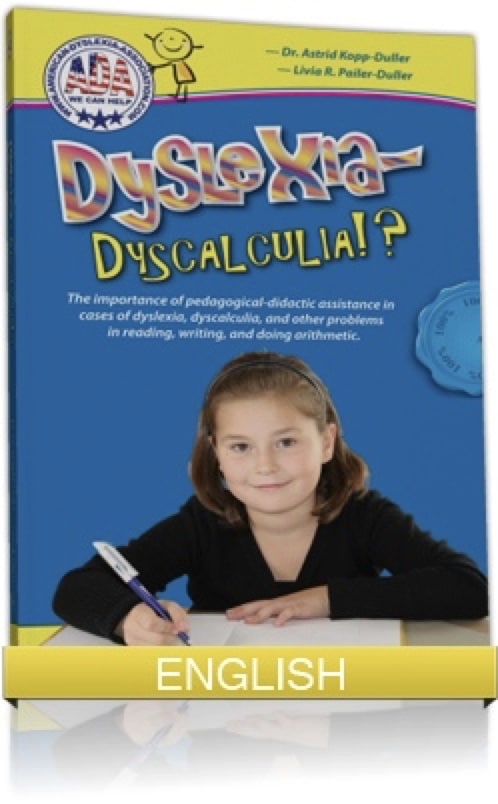
  • Dyslexia – Dyscalulia !? Now available!

    Available in english, spanish and german.

    For those enveloped in a world of chaos, confusion and misunderstanding, Dyslexia Dyscalculia ?! is the new “iconic” global position system for minds that aspire for a better understanding to guide those suffering from dyslexia.

    In this awe-inspiring publication, renowned authors, Dr. Astrid Kopp-Duller and Livia R. Pailer-Duller, perpetuate their title as the authority on the subject as they delineate the necessity of intervention with incredible insight at the educational-didactic level. Which, is of preeminent importance for success in the training of those who have difficulties with reading, writing or calculating.

    Infused with the key ingredients for successful training, the authors’ erudition of the most complex aspects of the pedagogic processes have been simplified in an epicurean recipe for the successful teachings of a misunderstood and somewhat unchartered methodology.

    “We’re entering a new era of learning and this publication is without a doubt at the forefront of modern teachings.” — K. Cole

    “A benvolent addition to any serious literary resource collecton.”
    — B. Dalton