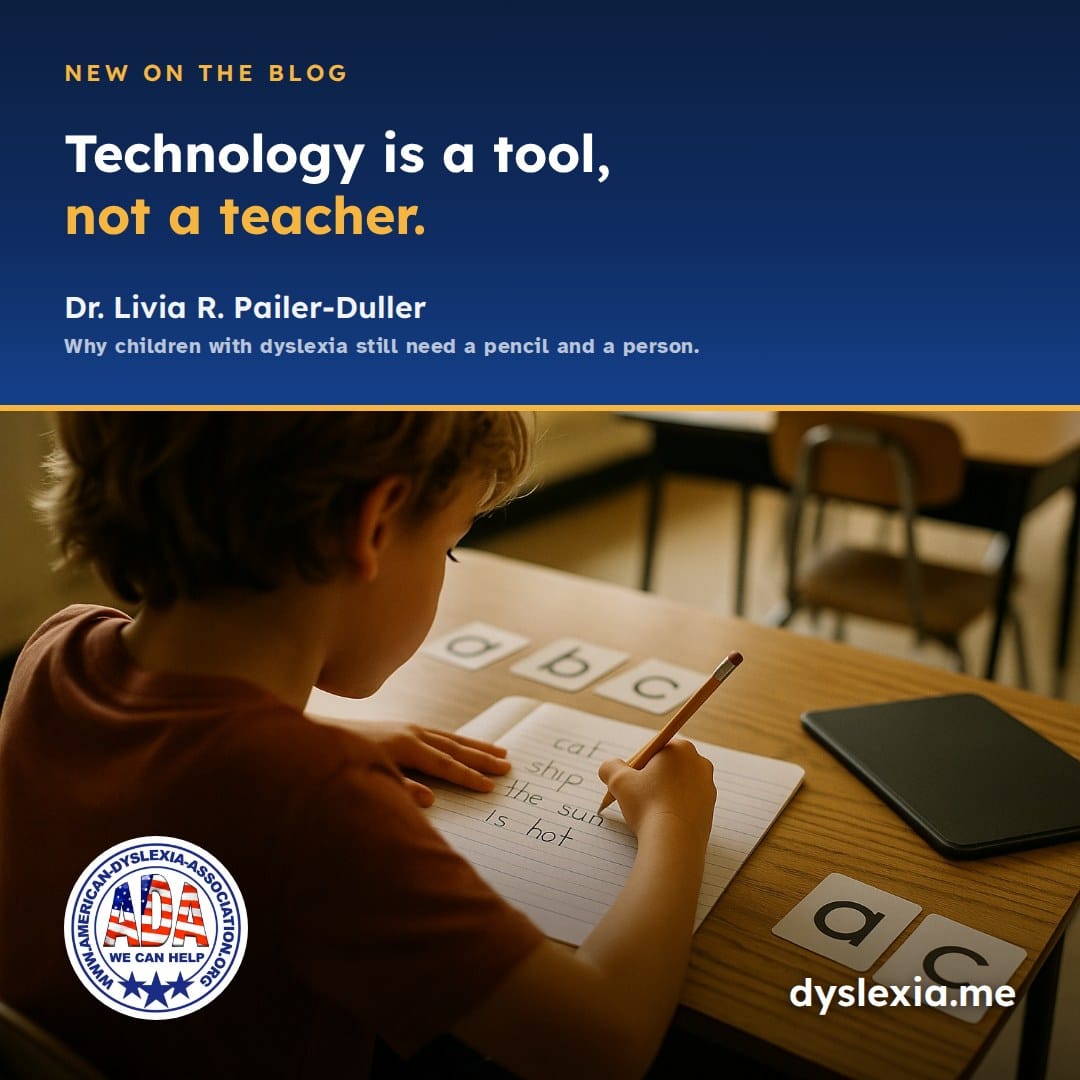
Technology helps children with dyslexia learn, and the research says so clearly. What it cannot do is notice why a child is stuck and decide what to try next. That job still belongs to a trained person. A new paper by Dr. Livia R. Pailer-Duller, originally written for Liberty University, looks at what the research says about screens, apps, handwriting, and the role of the educator. Here is what parents and teachers can take from it.
In short
- Technology works. A review of 85 studies with 9,157 students found positive effects of mobile technology on learning.
- Text-to-speech helps many readers, not all of them. The average effect on reading comprehension is positive, but results vary a lot from child to child.
- Children with dyslexia need explicit, systematic instruction from a person, one-to-one or in small groups. 14 meta-analyses and systematic reviews point the same way.
- The pencil still matters. Writing letters by hand activates the brain differently than typing them.
- Use both. The best plan for a child often mixes a tablet, a pencil, and a trained dyslexia trainer.
Yes, technology really does help
Digital tools improve learning when they are used well. Wang and colleagues (2023) reviewed 85 studies involving 9,157 students in primary and secondary school. They found positive effects of mobile technology on what students know, how they feel about learning, and how they behave in class.
For children with dyslexia, technology can remove barriers that have nothing to do with what they actually know. Think of text-to-speech, speech-to-text, audiobooks, spelling support, word processing, and larger or reformatted text. A child who understands a science chapter perfectly well should not fail the test only because decoding the words takes all their energy.
Wood and colleagues (2018) pooled the research on text-to-speech and read-aloud tools for students with reading difficulties. The overall effect on reading comprehension was positive, but outcomes varied across students and studies. In plain words: the tool helps, it just does not help every child the same way. Someone still has to find out whether it helps this child.
What children with dyslexia need: a person who notices
Children with dyslexia learn best with explicit, systematic instruction, given one-to-one or in small groups. Al Otaiba and colleagues (2023) looked across 14 meta-analyses and systematic reviews of literacy research. They found support for direct teaching, a planned sequence of skills, attention to both the sound code and the meaning of words, and enough time and intensity. Hall and colleagues (2023) reviewed 40 years of reading research for elementary students with or at risk for dyslexia and found that more training time went along with stronger results.
Explicit means the skill is taught directly instead of hoping the child will discover it alone. The trainer shows how it works, the child practices, and the trainer gives feedback right away. Systematic means one step builds on the next, and someone decides when the child is ready to move on.
A good dyslexia trainer looks at much more than right or wrong. They ask questions like these:
- What kind of mistake was this?
- Does the child understand the idea behind the task?
- Is the child using the strategy we practiced, or guessing?
- Does the child need more practice, or should we go back a step?
- Would a different way of showing the material help?
A computer can record answers and even spot patterns. Only a person can put those patterns into the context of the whole child, including tiredness, frustration, motivation, and what happened last week.
Why the pencil still matters
Forming a letter by hand is a different learning experience than pressing a key. Over a hundred years ago, Maria Montessori (1912) described children who saw and touched sandpaper letters while hearing their sounds at the same time. She wanted learning to move “from sensations to ideas, from the concrete to the abstract.”
Brain research has since backed up the idea. James and Engelhardt (2012) worked with five-year-olds who could not yet read. The children printed, typed, or traced letters. Afterward, a reading-related network in the brain responded to the letters after handwriting practice, but not in the same way after typing or tracing. Askvik and colleagues (2020) used high-density EEG with 12-year-olds and young adults and also found different brain activity for handwriting and drawing compared with typing.
That matters for dyslexia, because good training often combines seeing a letter, saying its sound, and writing it. If schools drop handwriting only because typing is faster, children may lose one of their most useful ways to learn. Looking for practice pages? Try our Handwriting Worksheet Wizard or read When the “Different” Learner Meets Cursive.
Handwritten or typed notes? The honest answer
The research on note-taking is mixed, and that is worth knowing. In a well-known study, Mueller and Oppenheimer (2014) found that students who typed their notes wrote more and copied lectures word for word, while students who wrote by hand did better on conceptual questions. Their explanation: handwriting is slower, so you have to choose, summarize, and rephrase.
Then Urry and colleagues (2021) repeated the study and combined it with similar ones. Laptop users again wrote more and copied more word for word. But this time, handwritten notes did not lead to better immediate learning.
So handwriting does not always win, and laptops do not ruin learning. Handwriting and typing are simply different ways of working with information. For one child with dyslexia, writing by hand is the right practice. For another, typing or speech-to-text removes a barrier so they can show what they know. The method should follow the learning goal and the child, not the other way around.
Personalization is not the same as automation
An adaptive app personalizes by following programmed rules. A trainer personalizes by watching the child. Here are situations a dyslexia trainer sees every week:
- A child keeps mixing up the same letters.
- A child gives correct answers but is actually guessing.
- Performance drops because the child is tired.
- A child understands a story when it is read aloud but cannot decode it alone.
- A pattern the child had mastered suddenly falls apart in a longer text.
Software may log every one of these. A person asks why it happened and decides what to do next. That is why the paper argues for professional and technology, not professional versus technology. Let the tablet handle repetition and access. Let the trained adult keep the responsibility for teaching decisions.
Questions parents and teachers can ask
Judge a learning program by what the child actually learns, not by minutes logged or exercises completed. Finishing an online activity does not prove that learning happened. Before adding another app, it helps to ask:
- What learning problem are we trying to solve?
- What does this technology do well for this child?
- What still needs a trained person?
- Is the child still writing by hand, working with real materials, and getting direct instruction?
- Do grades and tests show what the child knows, or only how fast they read and write?
A realistic plan can use everything at once: text-to-speech for grade-level content, a pencil for practicing letter and word patterns, an app for extra repetition, and regular sessions with a trained dyslexia trainer. There is no contradiction in that. If you want to become that trained person yourself, take a look at the ADA-accredited dyslexia trainer certification program at dyslexiacertificate.com. For free practice material, see our free dyslexia resources for parents and teachers.
Want to read the whole scientific paper?
This article is a short, reader-friendly version. Want to read the whole scientific paper, with every study and all references? Go here: Technology as a Tool, Not a Teacher: Meeting the Learning Needs of Students with Dyslexia in the 21st-Century by Dr. Livia R. Pailer-Duller on pailer-duller.com.
Frequently asked questions
No. Apps are good at repetition, feedback, and access, but research on dyslexia points to explicit, systematic instruction given one-to-one or in small groups by a trained person. The best results come from combining both.
Yes, in most cases. Studies by James and Engelhardt (2012) and Askvik and colleagues (2020) show that handwriting activates the brain differently than typing. For some children, typing or speech-to-text is the right accommodation for showing what they know, while handwriting stays part of their practice.
The complete paper by Dr. Livia R. Pailer-Duller, including all references, is published on pailer-duller.com.
Sources
- Al Otaiba, S., McMaster, K., Wanzek, J., & Zaru, M. W. (2023). What we know and need to know about literacy interventions for elementary students with reading difficulties and disabilities, including dyslexia. Reading Research Quarterly, 58(2), 313–332. https://doi.org/10.1002/rrq.458
- Askvik, E. O., van der Weel, F. R. R., & van der Meer, A. L. H. (2020). The importance of cursive handwriting over typewriting for learning in the classroom: A high-density EEG study of 12-year-old children and young adults. Frontiers in Psychology, 11, 1810. https://doi.org/10.3389/fpsyg.2020.01810
- Hall, C., Dahl-Leonard, K., Cho, E., Solari, E. J., Capin, P., Conner, C. L., Henry, A. R., Cook, L., Hayes, L., Vargas, I., Richmond, C. L., & Kehoe, K. F. (2023). Forty years of reading intervention research for elementary students with or at risk for dyslexia: A systematic review and meta-analysis. Reading Research Quarterly, 58(2), 285–312. https://doi.org/10.1002/rrq.477
- James, K. H., & Engelhardt, L. (2012). The effects of handwriting experience on functional brain development in pre-literate children. Trends in Neuroscience and Education, 1(1), 32–42. https://doi.org/10.1016/j.tine.2012.08.001
- Montessori, M. (1912). The Montessori method: Scientific pedagogy as applied to child education in “The Children’s Houses” (A. E. George, Trans.). Frederick A. Stokes Company.
- Mueller, P. A., & Oppenheimer, D. M. (2014). The pen is mightier than the keyboard: Advantages of longhand over laptop note taking. Psychological Science, 25(6), 1159–1168. https://doi.org/10.1177/0956797614524581
- Pailer-Duller, L. R. (2026). Technology as a tool, not a teacher: Meeting the learning needs of students with dyslexia in the 21st-century. Originally written for Liberty University, School of Education. https://www.pailer-duller.com/technology-as-a-tool-not-a-teacher/
- Urry, H. L., et al. (2021). Don’t ditch the laptop just yet: A direct replication of Mueller and Oppenheimer’s (2014) Study 1 plus mini meta-analyses across similar studies. Psychological Science, 32(3), 326–339. https://doi.org/10.1177/0956797620965541
- Wang, J., Tigelaar, D. E. H., Zhou, T., & Admiraal, W. (2023). The effects of mobile technology usage on cognitive, affective, and behavioural learning outcomes in primary and secondary education: A systematic review with meta-analysis. Journal of Computer Assisted Learning, 39(2), 301–328. https://doi.org/10.1111/jcal.12759
- Wood, S. G., Moxley, J. H., Tighe, E. L., & Wagner, R. K. (2018). Does use of text-to-speech and related read-aloud tools improve reading comprehension for students with reading disabilities? A meta-analysis. Journal of Learning Disabilities, 51(1), 73–84. https://doi.org/10.1177/0022219416688170