No record shows that Princess Diana was ever assessed for dyslexia. What exists is one sentence her younger brother said out loud on September 21, 2026: “I think Diana suffered from dyslexia. She found spelling and word orders and letter orders quite tricky.”
He said it to PEOPLE, one day before his memoir went on sale, and within hours the Princess Diana dyslexia question was in newsrooms on four continents. At the American Dyslexia Association we hear the same two questions every time a famous name gets attached to dyslexia. Does the claim hold up? And what is a parent, or an adult who recognizes something of themselves in it, supposed to do with it? Here is the record, separated from the headline.
In short
- Princess Diana was never assessed for dyslexia, and nothing from her lifetime records a reading or spelling assessment.
- The claim comes from her brother Charles Spencer, made on September 21, 2026, one day before his memoir was published.
- No source published before 2026 calls Diana dyslexic, and none describes a reading or spelling problem.
- What has been documented since 1992: her family called her the thick one, and she failed every O-level examination twice.
- Against the claim: as a teenager she read romance novels heavily, and after her wedding she answered many of the 47,000 letters of congratulation by hand.
- Dyslexia can only be identified by testing a person’s reading and writing. A family account is testimony, and testimony is not an assessment.
What Charles Spencer actually said
Charles Spencer, the 9th Earl Spencer and Diana’s only brother, made the claim in an interview with Michelle Tauber for PEOPLE on September 21, 2026, the day before the publication of his memoir Swan Song: Diana, My Sister (Michael Joseph, September 22, 2026). His words on dyslexia were brief: “I think Diana suffered from dyslexia. She found spelling and word orders and letter orders quite tricky.”
The dyslexia remark sits inside a larger argument about attention. Spencer told PEOPLE: “I was only found out to have very severe ADHD late in life, and I know it’s exactly what Diana had. It’s so similar.” He added a piece of context that matters: “Diana was born in 1961, and certainly the private school system in England was not tuned into children’s needs as they are today.”
Spencer was careful about his own framing. “This isn’t a criticism,” he said. “It’s a recognition that she was struggling with a condition that was totally undiagnosed.” What he did not offer was a school report, a reading or spelling assessment, or a second family member who agrees. The claim rests on his memory and on his own experience late in life.
Had anyone suggested this before 2026?
No published source before September 2026 uses the word dyslexia about Princess Diana, but the pattern her brother describes has been on the record, in her own voice, for more than thirty years. The Princess Diana dyslexia claim is new. The evidence behind it is old.
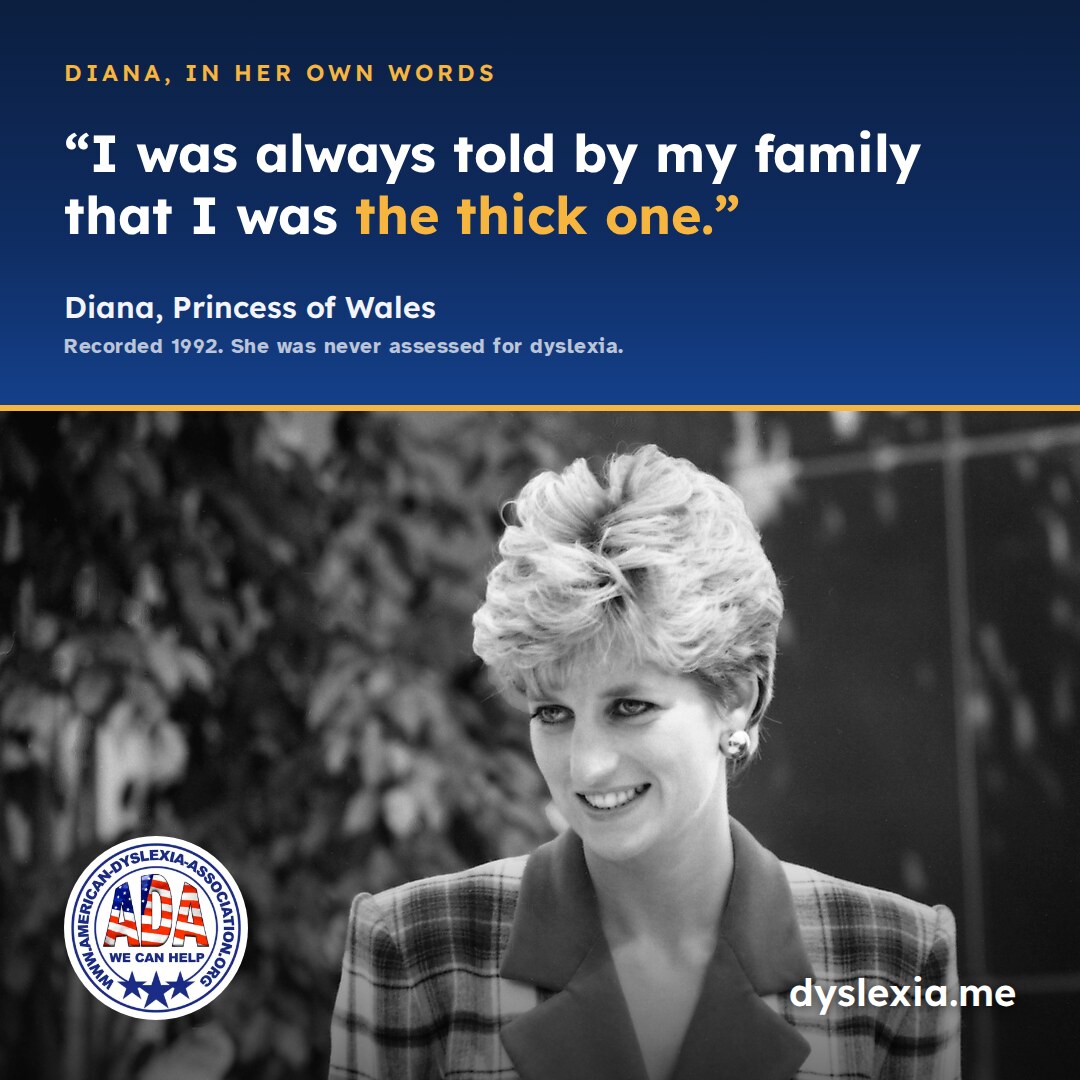
Diana recorded a set of tapes with her voice coach Peter Settelen in 1992 and 1993, broadcast in the documentary Diana: In Her Own Words in 2017. On them she says: “I was always told by my family that I was the thick one. That I was stupid and my brother was the clever one.” She goes on: “I used to go to the headmistress crying saying I wish I wasn’t so stupid and thick, and wished my family felt a bit more of me. I remember doing that a lot.”
She returned to the subject in her BBC Panorama interview on November 20, 1995: “I was portrayed in the media at that time, if I remember rightly, as someone, because I hadn’t passed any O-levels and taken any A-levels, I was stupid. And I made the grave mistake once of saying to a child I was thick as a plank, in order to ease the child’s nervousness, which it did. But that headline went all round the world, and I rather regret saying it.”
What the earlier sources never describe is a reading or spelling problem. Her biographers and her schoolfellows call her a poor student, not academic, frustrated by lessons. The strongest concrete fact anyone recorded is that she attempted all of her O-level examinations twice and passed none of them, which is a written-examination failure across every subject rather than a difficulty anyone traced to literacy. Charles Spencer in 2026 is the first person on the public record to name spelling and letter order as the reason.
The school record backs the outline. Diana sat her O-level examinations twice at West Heath School in Kent and left at sixteen without passing them, in the same years that the school recognized her for helpfulness and she stood out in swimming, dance and domestic science. Strong in some areas, stuck in others, and written off as slow: that shape is familiar to every dyslexia trainer. Nobody in 1977 gave it a name.
Why “she found spelling tricky” is a clue, not an answer
Weak spelling is one of the most recognizable signs of dyslexia and one of the weakest pieces of evidence on its own. The International Dyslexia Association puts it plainly: as many as 15 to 20 percent of the population as a whole show some of the signs of dyslexia, including slow or inaccurate reading, poor spelling, poor writing, or mixing up similar words. Spencer’s description of his sister would fit a large share of the adult population.
A real dyslexia assessment is an educational one. It looks at how a person reads and writes: accuracy, decoding of unfamiliar words, reading fluency and spelling, the kinds of errors they make, and how their attention and sensory perceptions hold up during the task, all weighed against their age and schooling. This is also why a short screening is not enough to settle the question in a living child, let alone in a historical figure. None of that exists for Diana. Two details cut the other way and rarely make the coverage. The first is that she read for pleasure as a teenager, and heavily. Tina Brown records in The Diana Chronicles that Diana devoured Barbara Cartland’s romance novels, with an endless and steady supply, and Cartland herself said later that the only books Diana ever read were hers. The second is that she wrote constantly. After her 1981 wedding she chose to answer many of the 47,000 letters of congratulation herself, by hand, and her handwritten correspondence now fills auction catalogs. Those letters may offer a clue of their own. One of the wedding thank-you notes, sent in October 1981 to a couple who worked at Althorp and later sold by Julien’s Auctions, reads in the auction house’s transcription: “Enclosed is a small momento of our wedding day, which I do you’ll like.” That is a misspelled word and a missing word in one short sentence. A single note proves nothing, and “momento” is one of the most common misspellings in English, but a careful look at her letters as a whole would tell a dyslexia trainer more than any headline. Neither her reading nor her letter-writing rules dyslexia out. Cartland’s novels are short, formulaic and written at a reading level a weak decoder can manage, and plenty of dyslexic adults write for a living. But a real assessment weighs both, and a headline skips both.
Can dyslexia be identified after someone has died?
No. Dyslexia shows itself in how a person reads and writes, and the only way to see that is to sit down with them and watch them do it. Labels given to historical figures after the fact are guesses, and scholars who study them, among them Osamu Muramoto in a 2014 paper, warn that they should describe the pattern people observed rather than name a cause.
For Diana there is no school assessment on file, no reading or spelling sample, and no teacher’s report that names the problem. So the accurate sentence is the one Spencer nearly said: his sister showed a pattern consistent with dyslexia, as described by the person who grew up in the same house. That is family testimony, and it is worth something. It is not an assessment, and no amount of repetition in the press turns the Princess Diana dyslexia story into one.
What English schools knew about dyslexia when Diana was a pupil
Dyslexia entered British law for the first time nine years after Diana was born. Section 27 of the Chronically Sick and Disabled Persons Act 1970 required local education authorities to arrange special educational treatment for children “suffering from acute dyslexia” within schools they maintained or assisted. It was the first statutory use of the word in the United Kingdom, and it framed dyslexia as a matter for schools and teaching.
Diana was born on July 1, 1961, went to boarding school at about nine, and left West Heath in 1977. The 1970 provision applied to the state sector, not to the independent schools she attended, and teachers were not trained to recognize the signs of dyslexia in either system. A girl who could not spell reliably in that era was described as lazy, dreamy, or not academic. Spencer’s framing of the period is fair, and it is the least contested part of his claim.
Why a family claim still matters, even without an assessment
Dyslexia has a genetic component and runs in families, which is why a sibling saying “this is what I have, and I think she had it too” is one of the most common ways a family discovers it at all. A child with a dyslexic parent has a 40 to 60 percent chance of being dyslexic, and roughly 40 percent of the siblings of a child with dyslexia have reading difficulties of their own.
The attention side of Spencer’s account fits as well. Attention problems and dyslexia turn up together far more often than chance would predict: Boada, Willcutt and Pennington found that 25 to 40 percent of children with one also show the other. This is why good dyslexia training starts with attention. A brother who struggled to focus and a sister who could not spell is not an odd pairing. Teachers see it every day.
The most useful fact in the whole story is the one about Charles Spencer himself. He reached his sixties before anyone gave his difficulties a name. That is not a royal anomaly. Adults recognize themselves late every week, usually when a child’s assessment report lands on the kitchen table and a parent reads their own childhood in it. Being underestimated at school is also a pattern with a long history: several American presidents struggled in the classroom before anyone had a word for why.
The royals who have spoken about their own dyslexia
Diana’s is a claim made after her death, while several living royals have spoken about their own dyslexia. Princess Beatrice of York was identified as dyslexic at the age of seven, spoke publicly about it from 2005, and has become one of Britain’s most visible advocates. Her husband is dyslexic as well. In Sweden, King Carl XVI Gustaf, Crown Princess Victoria and Prince Carl Philip have all spoken about dyslexia, and Prince Carl Philip has described what being asked to read aloud in class actually felt like.
One correction worth making while the story circulates: Diana was a patron of the British Deaf Association, which shares its initials with a dyslexia organization. She held no dyslexia patronage and, on the public record, never discussed reading or spelling difficulties as anything other than a source of embarrassment.
If this story sounds like your own
If a headline about Princess Diana dyslexia made you think about your own child, or about yourself at sixteen, the useful next step is a proper assessment and training rather than a label. In an older child or an adult the pattern usually looks like this: spelling that stays unreliable long after reading has improved, slow and effortful reading, a strong dislike of reading aloud, letters and word order slipping under time pressure, and effort that is wildly out of proportion to the result.
What changes that pattern is targeted training rather than more of the same schoolwork. The AFS Method works in a fixed order, attention first, then the sensory functions involved in reading and writing, then the symptom itself. It is set out in Dyslexia – Training Using the AFS-Method by Dr. Astrid Kopp-Duller, 3rd revised edition, 2021. The American Dyslexia Association publishes free worksheets for practice at home, an introduction to the AFS Method, and a certification program for teachers and parents who want to train others. If you want the myths cleared out first, start with Debunking the Myths about Dyslexia, and see everything we give away for free in one place. For what a full evaluation actually measures, read about more than 25 years of the AFS-Test.
Frequently asked questions
Was Princess Diana ever assessed for dyslexia? No. There is no record of any dyslexia assessment during her lifetime. The claim was made by her brother Charles Spencer in September 2026, twenty-nine years after her death, and is his personal view rather than the result of an assessment.
Did Princess Diana have ADHD? Charles Spencer believes she did, based on his own experience with ADHD late in life and on the similarities he sees in her. Diana was never assessed for it, so this too is a family view looking back, not a finding.
Does failing exams mean a child is dyslexic? No. Exam results alone say nothing about the cause. Dyslexia is identified through an educational assessment of how a child reads and writes, measured against their age and schooling. Poor results in a bright, capable child are a reason to ask for that assessment, not an answer in themselves.
Sources
- Michelle Tauber, “Princess Diana’s Brother, Charles Spencer, Addresses Conspiracy Theories, Her Neurodivergence and More,” PEOPLE, September 21, 2026. Interview
- Charles Spencer, Swan Song: Diana, My Sister, Michael Joseph, September 22, 2026. Publisher page · Available on Amazon
- Diana, Princess of Wales, BBC Panorama interview with Martin Bashir, November 20, 1995. Full transcript, PBS Frontline
- Diana: In Her Own Words (2017), based on tapes recorded with Peter Settelen in 1992 and 1993. Documentary background
- International Dyslexia Association, Dyslexia Basics: as many as 15 to 20 percent of the population show some signs of dyslexia. Fact sheet
- Understood.org, “Is dyslexia genetic?”: 40 to 60 percent chance for a child with a dyslexic parent. Article
- R. Boada, E. G. Willcutt and B. F. Pennington, “Understanding the Comorbidity Between Dyslexia and Attention-Deficit/Hyperactivity Disorder,” Topics in Language Disorders, 2012: 25 to 40 percent of children with one also show the other. Full text, PDF
- Osamu Muramoto, “Retrospective diagnosis of a famous historical figure: ontological, epistemic, and ethical considerations,” Philosophy, Ethics, and Humanities in Medicine, 2014. Paper
- Chronically Sick and Disabled Persons Act 1970, Section 27, “acute dyslexia.” Statute text
- Julien’s Auctions, handwritten letter from Diana to Mr. and Mrs. Pendrey, October 21, 1981. Lot description
- Tina Brown, The Diana Chronicles, 2007, on Diana’s reading as a teenager. Book excerpt, ABC News · Available on Amazon
- Prince Carl Philip of Sweden on growing up dyslexic. Interview
Photo: Diana, Princess of Wales, by John MacIntyre for Paisley Scotland, via Wikimedia Commons, licensed CC BY 2.0. Card design by the American Dyslexia Association.