Every Tuesday, we open up one lesson of the Dyslexia Trainer Certification Program here on the blog, all 48 of them, one week at a time. Whether you are a teacher, a parent, or an education professional, this series shows you exactly what certified dyslexia trainers learn, and how the program works from the inside.
This week: Understanding Dyslexia Diagnostics: Levels, Procedures, and Case Histories
When a child struggles in school, parents often face a confusing journey between teachers, psychologists, and doctors, each looking at the problem from a different angle. This lesson brings order to that confusion: it explains the three diagnostic levels, what each one can and cannot tell you, and why the pedagogical-didactic level is so often the missing piece. Trainers learn to read case histories and to recognize when behavior is a consequence of years of being overwhelmed, not the cause of the problem.
What this lesson is about
When a child struggles with reading, writing, or arithmetic, parents often feel overwhelmed and unsure where to turn. As a result, their first point of contact may be a teacher, a psychologist, or a medical doctor, each of whom approaches the problem from a different angle. This can lead to confusion, conflicting explanations, and long diagnostic journeys that may overlook the most important level of support: the pedagogical-didactic level. To understand the child’s real needs, certified dyslexia trainers must be familiar with all three diagnostic levels and the role each one plays in assessing learning difficulties.
In many cases, behavioral symptoms such as restlessness, avoidance, frustration, or inattentiveness are interpreted as the cause of school difficulties, when in reality these behaviors often emerge only after years of being overwhelmed. Misinterpretation can lead to unnecessary psychiatric labels or medical treatments while the child’s underlying difficulties with sensory perception, attention, and symbol processing remain unaddressed. This lesson helps trainers distinguish between symptoms rooted in genetic predisposition (primary dyslexia/dyscalculia), symptoms caused by lack of recognition and repeated failure (secondary dyslexia/dyscalculia), and acquired reading/spelling or arithmetic differences caused by external life events.
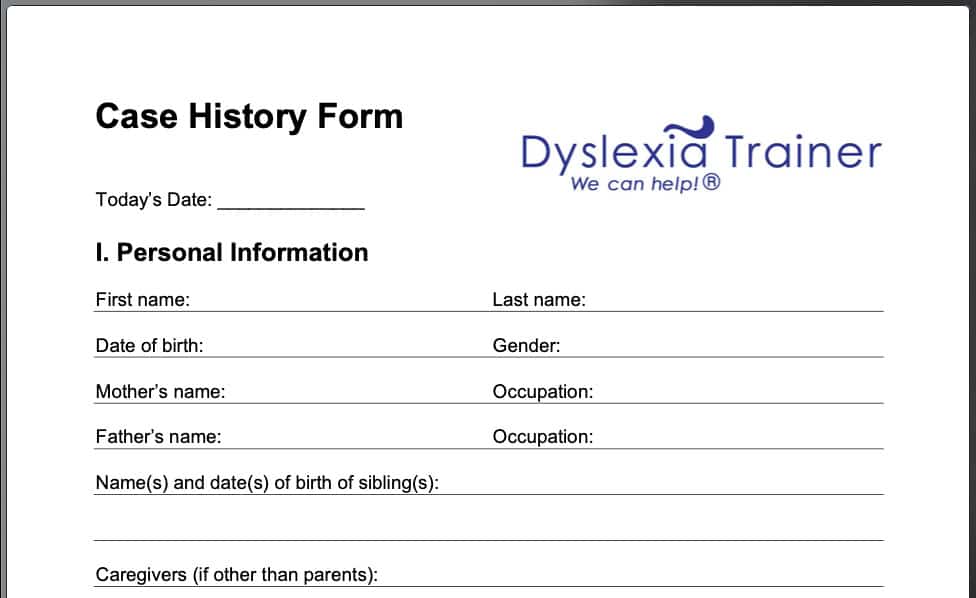
To support families effectively, trainers must know how to conduct a proper case history interview, interpret testing results, and communicate findings clearly and compassionately. Starting with this lesson 4 and continuing with lessons 5 through 7, the focus is to equip trainers with a complete diagnostic roadmap: from the first conversation with parents, to testing, to analysis, to planning targeted interventions. By understanding the three diagnostic levels, and by staying anchored in the educational-didactic perspective, you can guide families toward the right support while avoiding unnecessary detours.
What you will learn in Lesson 4
- The three diagnostic levels and what each one can tell you
- How to work with case histories
- Why behavior problems are often the consequence of school struggles, not the cause
- When to involve teachers, psychologists, or physicians
About the Dyslexia Trainer Certification Program
Since 1997, more than 17,000 dyslexia trainers in 64 countries have been certified. The certification gives you more than knowledge: all the tools you need to actually work with dyslexic children are included as well. Worksheets, training programs, assessment materials, everything ready to use in your practice. You get the whole package.
The program is accredited by the American Dyslexia Association (ADA) and follows the training standards of the International Federation of Dyslexia and Dyscalculia Associations (IFDDA).
Catch up and start free
Lesson 1 is free for everyone. Register in a minute and see the program from the inside: dyslexiacertificate.com
You can find all published lessons of this series under the tag Lesson Series.