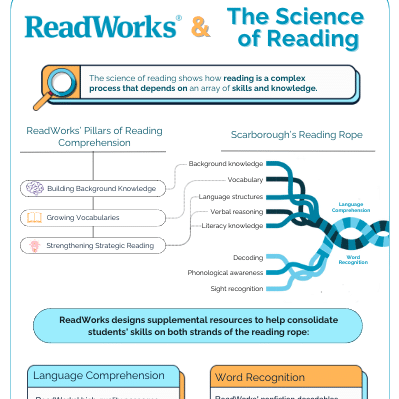
Can children learn reading comprehension? Of course, they can. Thanks to ReadWorks, this is not even expensive. In fact, it is completely free. This non-profit site offers research-proven tools so that students can improve their academic achievement.
ReadWorks provides research-based units, lessons, and authentic, leveled non-fiction and literary passages online, for free, to be shared broadly. The curriculum is aligned to the Common Core State Standards and the standards of all 50 states. Most importantly, ReadWorks is faithful to the most effective research-proven instructional practices in reading comprehension.
ReadWorks is completely free. You only need to register to access all the resources.
What does being a dyslexic mean to someone learning he is one at age 42? Very little, and I am speaking with the exclusive authority of being me. What does it mean to a lad having so much trouble learning to read that a private school kicked him out, but then a public school teacher provided him with patient attention? Life-changing good! In this case, I am speaking of my younger brother, a wide-ranging, avid reader, with an unconventional problem-solving mind.
I became a dyslexic at the age of 42, the result of running into my senior year high school English teacher. She was an exceptional teacher. In the course of our conversation, she told me that I was the most dyslexic student she ever had. I asked why hadn’t she told me? Obviously, she understood I was asking why hadn’t she helped me? She said she’d told my parents at a teacher conference, “and that didn’t go well.” She figured smart, affable me would acquire a secretary and I would be fine.
I had been married three years when my wife announced, as revelation, “You know all those (Odd? Crazy? Funny? Sad?) stories you’ve told – they are true!” I’m still married, so I cannot divulge how downhill that conversation went. My teacher encounter ten years later was no revelation to my wife; she had been telling me I was dyslexic forever.
Shortly after I had the teacher encounter, my wife and I picked up my older brother at the airport. We stopped for lunch. In the course of our what’s-going-on-in-our-lives conversation, I told the story of learning I am dyslexic. That factoid revision was angrily scoffed at by older brother. No good comes (later in life) from opening the dyslexic closet.
I think my brother assumed dyslexia was synonymous with illiteracy. I think he also took it as criticism, since I had asked him and others for help when I was a kid, and was blown off. They had their lives; I wasn’t their job. I am a middle child; what can I tell ya.
So how does a kid go from being the dumbest kid in class in grades 2 through 7, and graduate from a good university? Seventh grade in public school was brutal, too, but there I had friends. I knew in 7th grade that the school was seriously considering holding me back, but I tested way above their expectations on a battery of tests.
The best class I ever had was University Freshman English. The teacher, a middle-aged woman, announced, “All writing assignments will be about a subject of your choosing. If you lack a fascination, you will neither be a good writer nor a good thinker.” She was an enthusiastic delight, visiting each student asking the same question, “What are you trying to say?”
I have written an Apple iBook, “Renvyle Revisited, an Irish Odyssey,” that neatly provides text and audio together. It also can be had at Amazon on Kindle and Audible.
A central theme of the book is story telling. The stories are not respectful of authority and ideologies – or what might be described as conventions. The book is a celebration of a youth finding his way from where he came.
If you know a dyslexic, have them read the blog stories and then hopefully the book.
By Chris Stanton
Please subscribe to my blog – it’s free: https://irishodyssey.wordpress.com Scroll down to the earliest blog entries; they concern dyslexia.
It’s a beautiful, clear spring day, and soon the cherry blossoms will fall from the trees and blanket the ground like snow. This season promises to be extraordinary, but it won’t be the same without Da, who passed away at Christmastime. Finn O’Brine stares out the window, taking it all in. He can’t believe his father will never spend time with him again. And he can’t believe there’s a bat at his window—talking to him.
Before his death, Mr. O’Brine told Finn many stories about colossal dragons, sorcery, and the magic of Wickum Mannor in Ireland—but they couldn’t possibly be real, right? Wrong! Magic runs in the O’Brine family; it’s part of their heritage.
Now thirteen, Finn will begin to show signs of his magical inheritance any day now. It’s time for Finn, his twin sister, Neave, his younger brother, Jack, and his mother, Ailish, to leave the comfort of their home in America and journey to Wickum Manor themselves. They expect a summer-long adventure, but the O’Brine children may not be as ready as they think. With all the fantastic things to experience and discover on the four-hundred-acre estate, will Finn want to enroll at the magical Wickum Academy, or will he choose to return to his friends and classes in America at summer’s end?
Deirdre M. Silvestri, author of children’s and YA books, was born in Sarsfield Barracks, Limerick City, Ireland. Because of dyslexia, her lifelong dream of becoming an author seemed dim. However, as her children grew, Silvestri often told them they could do anything. If the Walls Could Speak is Silvestri’s first book, the first installment of the realization of her dream.
The study summarizes the available evidence on the forms of teaching, support, and adjustment that students with dyslexia find useful for their inclusion in Higher Education.
Why did we do this study?
The number of students with disabilities and learning difficulties enrolled in Higher Education is on the rise. Universities have a duty to become inclusive environments for an increasingly diverse student population. Several researchers have conducted small-scale studies on forms of teaching, support, and adjustment that can enhance dyslexic students’ opportunities to succeed in Higher Education. However, to date, no attempt has been made to bring together all this evidence and answer the question: what does research say about how we can effectively foster dyslexic students’ inclusion in Higher Education?
How did we do the study?
We did a systematic review, a type of study that allows one to retrieve, critically appraise, and synthesize the available evidence on a type of intervention, teaching approach, or form of support. We searched databases, journals, and websites to retrieve all published research focusing on the inclusion of students with dyslexia in Higher Education. We appraised each study for the quality of the evidence produced therein, and then generated a summary.
What did we find?
We identified 15 studies dealing with the inclusion of students with dyslexia in Higher Education. The majority of them consisted of qualitative interview studies in which students had been asked about their experience of inclusion at the university. The results indicate that students with dyslexia develop many study skills and coping strategies to independently overcome the difficulties and barriers that they come across in their learning journey. Help from others (including fellow students, family, and friends) is often very important. Awareness of one’s own strengths, weaknesses, and preferred learning styles helps students to develop effective study strategies. Many of them report that becoming aware of their own dyslexia was the first important step in this direction.
For the students, it was important to meet teachers who were sensitive to their learning needs and ready to provide adjustments in teaching and assessment. Some teachers’ lack of dyslexia awareness had a significantly negative impact on the students’ learning experience. Useful teaching approaches were those that took into account learners’ differences (student-centered approach) and sought their active contribution (interactive teaching approach). The provision of study materials in multiple formats enhanced course accessibility. Teaching modalities that partly or totally relied on Information and Communication Technologies helped the students gain control over their learning process. For instance, electronic learning environments allowed students to access content at their own pace, hence reducing the gap with non-dyslexic students. Finally, there is some evidence that Universal Design for Learning can be used to simultaneously accommodate the needs of students with diverse needs (including those with and without dyslexia) and thus foster learning environments that are inclusive for all.
Sue Ryder Care Centre for the Study of Supportive, Palliative and End of Life Care
School of Health Sciences
The University of Nottingham
Room B58, Queen’s Medical Centre
Nottingham NG7 2UH
t: +44 (0)115 8230494 https://www.researchgate.net/profile/Marco_Pino
Reading to children has been repeatedly shown to improve their reading, writing, and communication skills, logical thinking, concentration, and general academic aptitude… as well as inspire a love of reading. The Screen Actors Guild Foundation records well-known actors reading children’s books and makes graphically dynamic videos so that children around the world can be read to with just the click of a Storyline Online video book image. The videos are free, and there is no need to register. Enjoy!
How many emails did you send today? What about Facebook updates or tweets?
Online communication is more important than ever. According to research by the email management company AWeber, over 90 percent of teens today prefer to communicate via email, text, and Facebook. Texting and social networking are increasingly our primary modes of talking to each other; in fact, a 2012 study found that 40 percent of Americans would rather text than call, while 30 percent prefer to connect with friends online instead of face-to-face.
Unfortunately, typical spelling and grammar checker tools aren’t available to you where you write most—online. Here are 5 tips for helping people with dyslexia to write better on the Web.
1) Create a short proofreading checklist for yourself. What kinds of errors do you most want to find and fix? Typically, people struggle with a few areas of grammar and spelling more than others. Maybe homonyms (they’re/their/there) trip you up, or maybe you have trouble remembering when to use a comma. Understanding your strengths and weaknesses as a writer is the first step to improving your prose.
2) Look for one kind of error at a time. Trying to fix everything all at once is a great way…to make yourself feel overwhelmed and frustrated. Instead of proofreading for all errors at once, break the task down into more manageable chunks. Start with end punctuation first (periods, exclamation points, and question marks), then move on to other punctuation (commas, semicolons, apostrophes, etc.), and finally tackle spelling. Pay closest attention to the problem areas you identified in step one.
3) Read aloud (or use text-to-speech to read aloud) to locate misspelled or missing words. Reading your emails or tweets out loud may make you feel a little sill, but according to the Writing Center at UNC-Chapel Hill, it’s one of the best ways to catch errors that you might otherwise miss. “Most people have far more experience listening to and speaking English than they do reading and editing it on the printed page. When you read your draft out loud or listen to someone else read it, your brain gets the information in a new way, and you may notice things that you didn’t see before.” If you’d rather have someone else read your text, there are a number of free text-to-speech programs available such as Natural Reader.
4) Step away and look again later. After you’ve proofread a piece of writing, take a break, step away, and then come back to it with fresh eyes. The longer the work, the more time you should take between passes. Shorter pieces of writing, such as tweets or status updates, may only require a coffee break, but important emails, blog posts, and other documents may need to rest overnight.
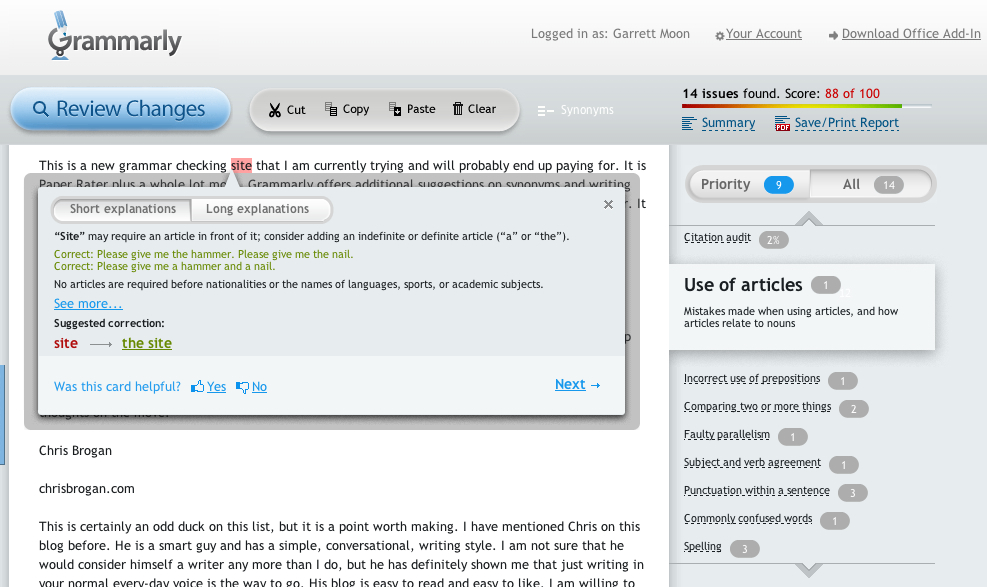
5) Use online grammar checking tools. American Wordspeller is a phonetic dictionary that allows users to look up words based on how they sound, not how they’re spelled. Another great tool is Grammarly Lite, a free browser extension for Chrome, Firefox 4+ and Safari browsers that alerts you to potential grammar mistakes before you post or hit “send.” It also catches contextual spelling errors (typing “horse” when you meant “house,” for example) and has a built-in thesaurus for those times when the right word eludes you.
Without non-verbal cues like tone of voice or facial expressions, text-based communications rely entirely on the quality of your writing. Put your best text forward!
Blog Post provided by Grammarly.comGrammarly improves communication among the world’s 2+ billion native and non-native English writers. Our flagship product, the Grammarly® Editor, corrects contextual spelling mistakes, checks for more than 250 common grammar errors, enhances vocabulary usage, and provides citation suggestions. More than 4 million registered users worldwide trust Grammarly’s products, which are also licensed by more than 350 leading universities and corporations. Grammarly is a privately-held company with offices in San Francisco and Kiev.
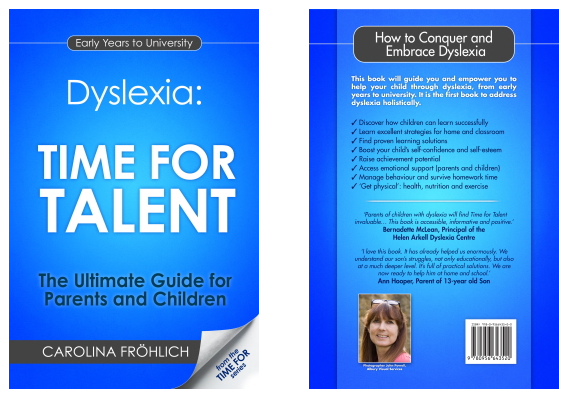
An inspirational book about empowering children and adults to deal with dyslexia has been hailed with numerous accolades since its launch earlier this year – and it’s now been awarded an Honorable Mention in the Readers’ Favorite International Book Awards 2014. Dyslexia: Time For Talent (The Ultimate Guide for Parents and Children) received glowing reviews and excellent endorsements from education and publishing experts when it was released, and has now cemented its status as one of the premier books on youth dyslexia currently on the market with the highly coveted award.
Debut author Carolina Fröhlich, who wrote the book after many years working as an educational consultant, is thrilled that her helpful and moving guide has been received so well by readers and critics alike. After suffering from dyslexia herself throughout her life, Fröhlich has dedicated much of her career to helping parents and children deal with the difficult ‘condition’, and is now reaping the rewards of her commitment.
Fröhlich says, “I’m over the moon to have received an Honorable Mention at the Reader’s Favorite Book Awards – hearing that critics and readers have been moved and affected by my book is the biggest prize of all. The book was originally intended to empower children and parents suffering as a result of dyslexia in the family, and to hear that it’s now winning awards after the fantastic reviews it initially received is wonderful.”
She adds, “My own experiences with dyslexia moved me to write the book, and it’s a real thrill to hear that my work in the field is being recognized by experts as well as by those who are confronting the challenging ‘condition’ head-on.”
The book set itself immediately apart from the crowd by helping readers to emphasize the talent of a child, rather than focusing on any shortcomings or perceived failures that occur as a result of their dyslexia. Rather than viewing dyslexia as something which needs to be cured, Dyslexia: Time For Talent encourages everyone to see it as a different way of learning. The book promotes positive attitudes in children, parents and teachers, and is equal parts informative and encouraging in the fight to overcome the challenges that having dyslexia presents for millions across the world.
The book also goes above and beyond the level set by many similar books, by emphasizing that dyslexia doesn’t stop at pre-school or infant level. With advice on how to handle the condition in later years, even stretching as far as career advice and learning to drive, the book has been rightly hailed as one of the most comprehensive and essential books on the condition.
For more information about Carolina Fröhlich and to buy her celebrated dyslexia book, visit the book’s Amazon listing.
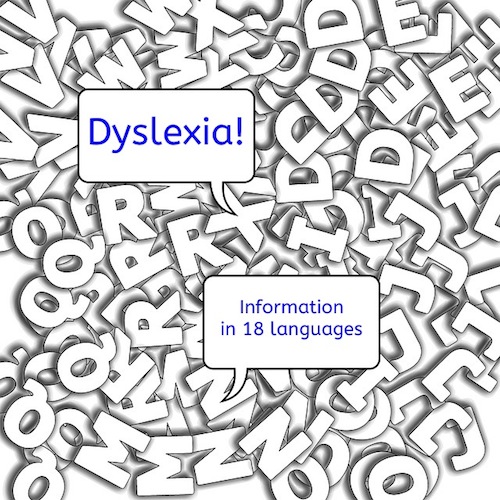
The American Dyslexia Association promotes the interests of people with dyslexia and dyscalculia. It is important to inform people about these themes. Dr. Astrid Kopp-Duller, president of ADA, always stresses how important it is to help children with dyslexia and dyscalculia on a pedagogical-didactic level. Because it needs to be said time and again: THESE CHILDREN ARE NOT ILL OR DISABLED, they simply need another method to learn how to read, write, and calculate.
To reach as many people as possible, some basic information about dyslexia and dyscalculia is now available in 18 languages:
Do you know an adult, a child, a family who may be interested? Please, hand them this information. The more people are informed and the earlier children are helped, the better!
Mistakes in spelling and punctuation in emails are forgiven every day. This is no problem if the message is about being late for dinner. It is different if the message is to persuade someone to sign a purchase order or grant a job interview. eAngel.me is a new online service for business or personal use which offers to proofread and correct email punctuation and grammar in any language. It is not a translation service and will not change the meaning of the text in any way. The corrections are made by humans and the service is available in all countries.
Users of email know that the software on their computers, no matter how advanced, cannot catch all errors because it cannot automatically put the meanings of a word which may sound the same but be spelled differently in the proper context. Professionally qualified humans can do that; and this is the premise on which eAngel.me was founded. Those who may find this unique service valuable include global businesses which have teams of salesmen in different countries, students seeking jobs or admission to schools in different countries, people with Dyslexia, technology experts who paid more attention to the technology professor than the English teacher but still need to communicate well with non-techs, and anyone studying or writing in languages other than their mother tongue.
eAngel.me has a free trial available so prospects can experience how the service works; and it supports any type of email and any type of browser. This comment from one customer illustrates its ability to save time: “Today my emails are much more professional. I can do more with my time because I don’t need to worry about reading the email over and over again before I send it”.
For information on how eAngel.me works and for a free trial, go to eAngel.me.
As an Amazon Associate I earn from qualifying purchases.