Category: Dyslexia

  • Delightful Dyslexia: Alphamusic

    Delightful Dyslexia: Alphamusic

    Cher? Tom Cruise? Salma Hayek? Anthony Hopkins? Jamie Oliver? Albert Einstein? Agatha Christie? Alexander Graham Bell? Robin Williams? Danny Glover? John Lennon? and Muhammad Ali?

    What do these famous people all have in common? As you might have guessed from the title yes it is that they are all Dyslexic.

    Dyslexia is a specific learning difficulty which makes it hard for you to learn to read, write and spell correctly. We do know that developmental dyslexia is inherited, so that, thanks to our DNA, we can be born with it. Dyslexia affects around 8% to 10% of the Irish population. The National Institute of Health reports that up to 15% of the U.S. population have learning challenges.

    If you have dyslexia you may have trouble with reading, writing, spelling, maths, and sometimes even music. Dyslexia can occur at any level of intelligence, and has many disguises so that teachers and parents may instead erroneously observe children lacking motivation or “not trying hard enough”.

    A dyslexic brain shows very little activity in areas known to be of high importance to connecting the written form of words with their phonetic components. Thus to read, people with dyslexia must create new neurological pathways. Compensation is made by using more use of a front-brain section called Broca’s area, commonly connected with other types of language speech and processing.

    How might I know if I or my child has Dyslexia?

    Here are a few of the main symptoms:
    • Delayed speech development
    • Speech problems, such as not being able to pronounce long words properly
    • Problems expressing themselves using spoken language
    • Little understanding or appreciation of rhyming words
    • Spelling that is unpredictable and inconsistent
    • Putting letters and figures the wrong way

    A Sound Solution?

    Alphamusic composer John Bram Levine believes that if you can slow the brain waves down to the Alpha state, then the useless mind chatter and negative self-talk of doubt and fear may vanish, whilst the left and right brain communicate more effectively, allowing information to be more easily absorbed, processed, and remembered. Levine studied electronics, graduating with a degree in Music Composition from Sydney University, following which he learnt meditation. He challenged himself to formulate music that could induce the same Alpha brainwave state achieved during meditation. A new genre was born: ‘Alphamusic’.

    Alphamusic

    Does it work?

    Stewart Holmes, a dyslexic, hated studying. ‘It was all too hard and frustrating until by accident I played ‘Silence of Peace’, an Alphamusic album, whilst revising. I felt as if a curtain surrounded the words on the page, allowing me to absorb the words and meaning freely and easily. I was astonished as no other music, whether it was new age, relaxation, classical, rock, or jazz, has ever had this effect on me.

    Amy Turner-Monk was determined that her dyslexia was not going to stop her from realizing her dreams, so she applied to the Open University and asked for assistance with her learning difficulties. The dyslexia assessor recommended she use Levine’s Alphamusic whilst studying. Until her discovery, Amy could only read for 10 minutes before being tired and distracted and needing to take 30 minutes to rest before continuing, ‘it all was quite draining’. ‘Using this brain wave transforming album ‘Silence of Peace’, I found I could study for more than an hour at a time without any exhaustion.’

    Although such testimonials and Cambridge University studies have shown a positive link between Levine’s Alphamusic and enhanced learning, more research needs to be done in this area, to investigate if music truly could be the golden key to solving the dyslexic puzzle. Levine is interested in hearing from anyone who would be interested in engaging in such research.

    For more information, please contact
    John Levine
    [email protected]

    Free samples of Silence of Peace CD: http://www.silenceofmusic.com

  • Understanding dyslexia: Learn how to best help your child

    Understanding dyslexia: Learn how to best help your child

    Just what is dyslexia?

    There are many misconceptions out there.

    familymagazineletters

    “Dyslexia is a type of specific learning disorder that impacts reading,” said Dr. Sheldon H. Horowitz, director of learning disability resources at the National Center for Learning Disabilities. “It is not a disease, nor is it contagious. It is not something that goes away — you don’t outgrow it — and it is not the result of watching too much TV, laziness, vision or
    hearing problems, or low intelligence.

    “The medical community refers to it as a disorder, and the educational community refers to it as a specific learning disability. Others are dyscalculia if the area of weakness is math, dysgraphia if the problem is writing and written expression.”

    Because dyslexia is not a disease, there is not “one treatment for dyslexia. It can’t be cured, especially because dyslexia is not a medical or psychological problem,” said Livia R. Pailer-Duller, executive director of the American Dyslexia Association. “It needs to be addressed through training of the attention span, of sensory perceptions, and the practice of reading and spelling on the educational level.”

    Rather, “dyslexia is a genetic disposition, which means that dyslexia is inherited,” she said. “Dyslexic individuals have different sensory perceptions. These different sensory perceptions are the reason why the attention of dyslexic people diminishes when they come in contact with letters, which in turn causes them to make errors in reading and spelling.”

    What it is

    There is no one profile of dyslexia, but typically, people have trouble sounding out words, blending letter sounds into words while reading, mastering the rules of spelling and grammar, and expressing what they know in written formats, Horowitz said.
    “Some people with dyslexia are accurate readers at a slower pace but struggle to understand what they have read because they expend all of their mental resources figuring out what the words are and keeping track of what they are reading,” he said. “Others are slow, labored readers, but do OK with comprehension.

    “People with dyslexia do not have vision problems that are causing them to struggle in reading. The problem stems from the way that printed text and the sounds of the language are processed in their brains. It’s not that their brains can’t do this processing; it’s that it is done in ways that are inefficient.”

    Also, dyslexia is not intelligence-related.

    “Dyslexics are not less intelligent than non-dyslexics — quite the opposite is often true,” Pailer-Duller said. “However, dyslexics often score low on intelligence tests because these tests attempt to measure intelligence by measuring sensory perceptions. But these are different in dyslexic individuals, which does not make them stupid, just that the test is inadequate.”

    How to help

    For people with dyslexia, “parents are absolutely critical and family support is hugely important,” Horowitz said. “Remember: dyslexia is what the child has, not who they are. They have areas of strength and interest just like everyone else, and in some cases, because they work so hard to compensate for their areas of challenge, they can be very high achievers and role models for their peers and for the general community.
    Parents need to understand as much as they can about dyslexia, abandon any feelings of guilt, and help their child to become a strong and effective self-advocate.”

    Schools are not required to give dyslexics extra help, but in some states, an individualized education plan is possible where dyslexic students receive help on standardized testing, Pailer-Duller said.

    As an example, “a dyslexic child with reading problems can receive additional assistance for reading instructions to solve math problems.
    However, dyslexic students have to do the reading portion of the standardized test themselves — without help.
    So this partial help does not go a long way,” she said.

    Teachers who are knowledgeable about dyslexia can do a lot within the school setting to help a dyslexic child.

    “Examples are that grading focuses on content and expression, and not on spelling. Teachers should avoid calling on dyslexic children to read aloud in front of the whole class if the child is not comfortable with it,” Pailer-Duller said. “It is very important to understand that the schoolteacher can only do so much. A dyslexic child will always need additional individualized training, either with a specialist or with parents.”

    Written by Melissa Erickson from Family Magazine, April 2014 issue, Gatehouse Media

  • Movie: The Big Picture – Rethinking Dyslexia

    Movie: The Big Picture – Rethinking Dyslexia

    THE BIG PICTURE: RETHINKING DYSLEXIA provides personal and uplifting accounts of the dyslexic experience from children, experts, and iconic leaders, such as Sir Richard Branson and financier Charles Schwab. Directed by James Redford, the film not only clears up the misconceptions about the condition, but also paints a picture of hope for all who struggle with it. Proving that dyslexia is a neurological issue and not a character flaw, THE BIG PICTURE beautifully illustrates that while the condition is an obstacle, it also carries some unique advantages, and ultimately can be overcome.

    The fascinating documentary The Big Picture: Rethinking Dyslexia examines the disorder by looking at unique advantages, personal experiences and accounts from today’s leaders while offering hope for those suffering.

    Facebook Page: https://www.facebook.com/TheBigPictureRethinkingDyslexia

  • Debunking the Myths about Dyslexia

    Debunking the Myths about Dyslexia

    There are many signs or clues to dyslexia, which are discussed in depth on this website; however, it is also important to be aware of the misconceptions and myths surrounding the disorder. There are several myths regarding dyslexia. We have highlighted some of the more common ones.

    Myth: Smart people cannot be dyslexic or have a learning disability.
    Fact: Dyslexia and intelligence are NOT connected. Many dyslexic individuals are very bright and creative, and they will accomplish amazing things as adults.
    Myth: Dyslexia does not exist.
    Fact: There has been 30 years of documented, scientific evidence and research proving the existence of dyslexia. It is one of the most common learning disabilities to affect children.
    Myth: Dyslexia is rare.
    Fact: In the United States, NIH research has shown that dyslexia affects 20%, or 1 in every 5 people. Some people may have milder forms, while others may experience it more severely. Dyslexia is one of the most common causes of reading difficulties in elementary school children because only 1 in 10 dyslexics will qualify for an IEP and special education that will allow them to get the help in reading that they need.

    CONTINUE READING

  • Early signs of dyslexia

    Early signs of dyslexia

    While browsing the web we came across this story:

    A DYSLEXIA STORY – Early signs of dyslexia

    I looked forward to reading with my daughter. We would cuddle together with a stack of books, and she would say, “Again, again, again,” and we would lose ourselves in our favorite stories.

    I was shocked when that never happened. What is it about reading to children, I thought, that’s so complicated? Reading together is overrated.

    Because, with her, she had only a passing interest in books. When we did sit together, she pulled the book out of my hands to flip through pages at random. Beginning, end, middle. Whatever. Done.

    We were most successful with books filled with random words and images, such as cat, dog, horse, and cow. Why did so many books have stories?

    CONTINUE READING

  • Embracing dyslexia

    Embracing dyslexia

    Embracing Dyslexia is a thoughtful and moving exploration of dyslexia from an insider’s perspective, weaving together interviews with parents, adult dyslexics, researchers, educators, and experts to provide an accurate portrayal of a learning difference that affects between 15 and 20% of the population.

    Parents share emotional stories of their frustration over failing to understand why their children were struggling with reading, writing, and spelling, and the life-altering impact the word dyslexia had on their lives.

    Adult dyslexics courageously open up and speak candidly about their dyslexia, sharing their struggles and successes they had in school and in their adult lives.

    Experts and educators define what dyslexia is and illustrate why early dyslexia screening for all children is vital. They also share how effective tutoring, classroom accommodations, and recognizing and fostering the natural gifts and abilities of a child with dyslexia can take them from feeling stupid and experiencing failure on a daily basis to believing in themselves and knowing that they can be successful.

    Watch the complete movie at www.embracingdyslexia.com

    Embracing Dyslexia – The trailer:


  • Camp RSA! Ready, Set, Action!

    Camp RSA! Ready, Set, Action!

    Camp RSA! Ready, Set, Action! A Camp Leader’s Guide ~ Adventures in Writing & Performing promises to be a time-saving teacher’s treasure brimming with both stimulating and calming fun-learning activities. Whether summer, autumn, or mid-winter camps during some of the lengthier school holidays, after school programs, or during the regular school year, educators may love the convenience this book of supplemental materials can offer.

    Camp RSA! serves busy teachers with abundant strategies and exercises to encourage young learners to act as if…, to practice teacher-student role reversal, and to role play in a positive fashion to foster higher self-esteem, greater self-confidence, and a better self- image for happier, more successful lives.

    Helping youngsters of differing levels of ability in various areas to understand each other better by helping them to see from a different viewpoint to gain perspective and to encourage tolerance, acceptance, and kindness is a quiet underlying objective.

    All the activities, exercises, and games are presented with the utmost desire to give young learners, whether dyslexic or not, the opportunity to learn in the spirit of joy and to believe in themselves to make their own dreams come true. ~ Linda Davis-Kyle, Editor and Contributor

    The Creators of Camp RSA! Ready, Set, Action! A Camp Leader’s Guide ~ Adventures in Writing & Performing

    David Carlson, dyslexic originator and publisher of Ready, Set, Action! An Entertainment Fun Book for Parents of Dyslexic Pre-Teens~Adventures in Writing & Performing and its extension Camp RSA! Ready, Set, Action! A Camp Leader’s Guide and its companion Camp RSA! Ready, Set, Action! Journal ~ Adventures in Writing & Performing for pre-teens, has held a lifelong dream to publish books to help dyslexic and non-dyslexic students alike.

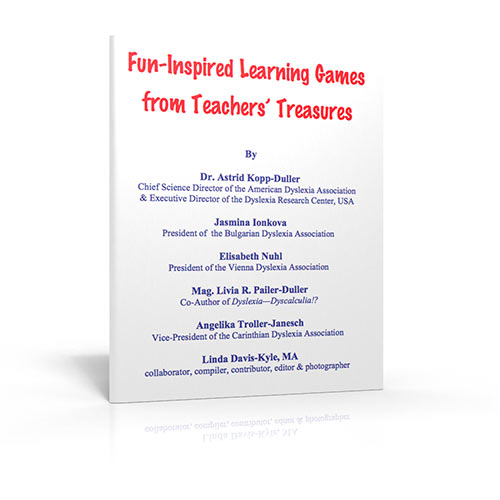
    Linda Davis-Kyle, MA, in English, ACCET certified to instruct English as a Foreign Language, and an internationally published professional writer, has worked some magic to make Carlson’s publishing dreams come true. Through editing, teaching, and writing, Davis-Kyle encourages writers around the world. In August 2013, she collaborated with five international dyslexia authorities — Dr. Astrid Kopp-Duller, Jasmina Ionkova, Elisabeth Nuhl, Mag. Livia R. Pailer-Duller, and Angelika Troller- Janesch — to compose “Fun-Inspired Learning Games from Teachers’ Treasures”www.dyslexia.me.

  • What to do when kids don’t read fluently

    What to do when kids don’t read fluently

    Fluent readers are readers who not only sound good while they’re reading, but who also understand what they’re reading. And by “good,” I mean that when they read, they sound natural and conversational, not choppy or disconnected. We all know how hard it is to listen to non-fluent reading, and we all know how fluent reading should sound. But how do we help them get from non-fluent to fluent? What should parents do when their kids are not fluent readers? And more importantly, what can parents do to help their children read more fluently? CONTINUE READING

  • Fun-Inspired Learning Games from Teachers’ Treasures

    Fun-Inspired Learning Games from Teachers’ Treasures

    Tyron Edwards said, “To waken interest and kindle enthusiasm is the sure way to teach easily and successfully.”
    Educators around the world have found that incorporating fun learning games into their lesson plans not only wakes interest when a class of new students meets for the first time, but also for a group already familiar with each other. Both time-tested games, such as dominoes, new ones that are created somewhere each day, and spur-of-the-moment games that pop into the minds of seasoned teachers—just when they need them—have a way of grabbing and holding attention, strengthening concentration, and stirring emotion among the players. Plato said, “All learning has an emotional base.” If the games are intriguing enough to invite and rivet attention, boost concentration, and create a healthy passion for participation, the likelihood of retaining the information presented is high.

    It is no secret that young learners who can relax can pay attention and maintain concentration on any task at hand with greater ease than those who may feel nervous or anxious. In addition, whatever is learned in a more relaxed state enhances retention of the information. In turn, remembering what has been learned fosters self-esteem, which furthers motivation. So, at the heart and soul of many learning philosophies, instructing strategies, and teaching systems, relaxation is held in high regard.

    Combining a Passion for Participation with Relaxation
    It seems that one wonderful combination to help children learn is by teaming a passion for participation with relaxation. The handful of multi-sensory games shared here are favorites from Austria, Bulgaria, and the United States that invite participation and foster relaxation. Even further, the activities are organized incrementally to support confident learning.