In short
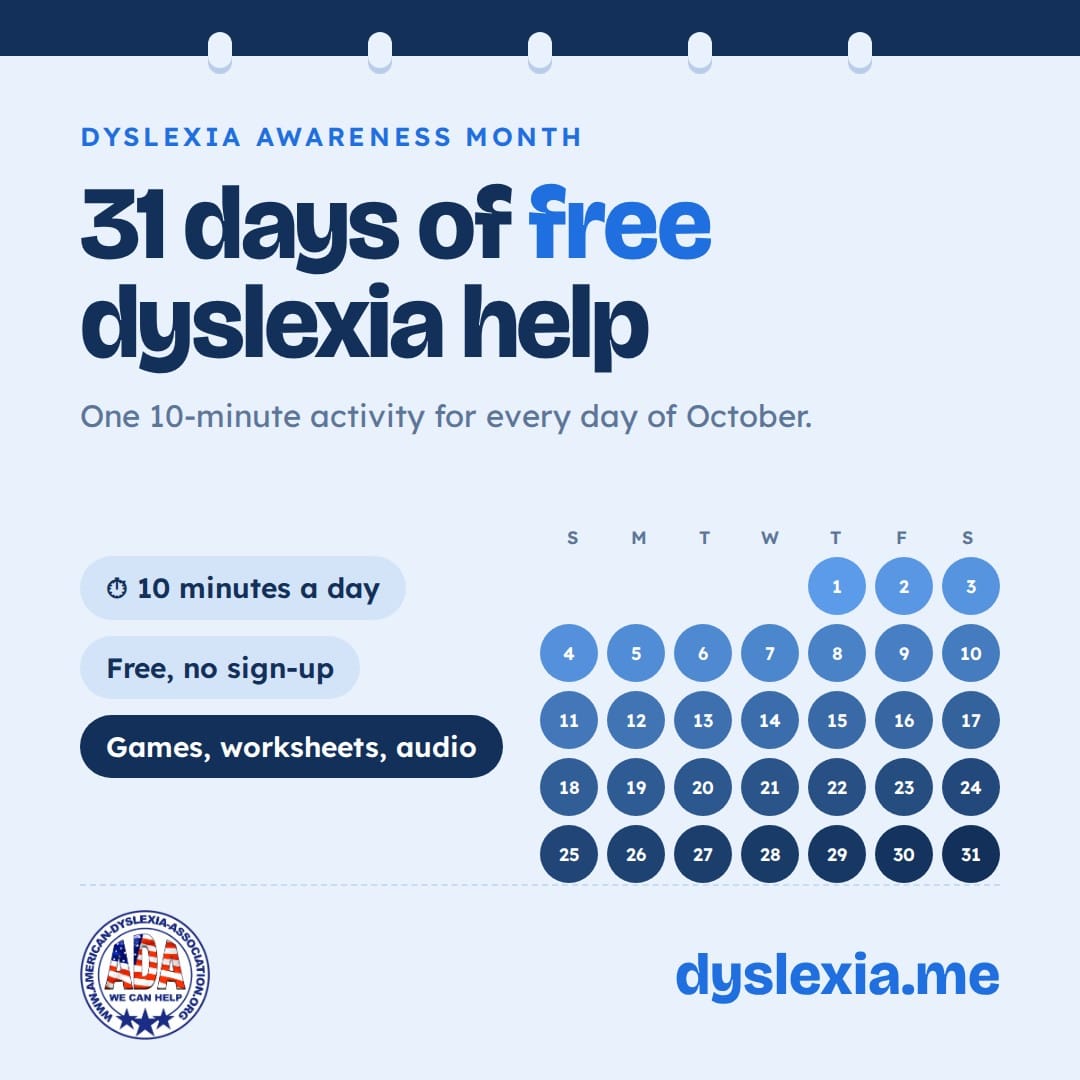
- October is Dyslexia Awareness Month. This plan gives you one free activity for each of its 31 days.
- Each activity takes about ten minutes. You need no account, no app purchase, and no special training.
- The order follows the AFS-Method: attention first, then seeing, hearing, space and body, then words and numbers.
- Sundays are family days: you read aloud or play together, so your child gets one calm day each week.
- You can start on any day. Missed a day? Skip it or move it. Consistency matters more than the calendar.
As many as 1 in 5 people have dyslexia, according to the U.S. Senate resolution that designated October 2025 as National Dyslexia Awareness Month [1]. The same resolution notes that the gap between typical readers and dyslexic readers appears as early as first grade. So this Dyslexia Awareness Month, we did not want to give you another list of facts. We wanted to give you something to do, every day of October, for free.
Below is your 31-day plan. Every day has one short activity from the free resources of the American Dyslexia Association (ADA) and its partners: brain-training games, printable worksheets, audio training, a word of the day, and learning apps. Bookmark this page, or print it and put it on the fridge.
How does the 31-day Dyslexia Awareness Month plan work?
You spend about ten minutes a day on one activity, and you follow the order of the weeks. The plan is built on the AFS-Method, which works in three steps: Attention, Function (the sensory perceptions of seeing, hearing, and spatial orientation), and Symptom (reading, writing, and math). Most children with dyslexia do not need more of the same spelling drill. They need their perception trained first, so that the letters and numbers they practice later can actually stick.
That is why the plan starts with two attention games and moves on, week by week, to seeing, hearing, space, and body. Only in the last week do words and numbers come in. Three simple rules make it work:
- Same time, every day. After an afternoon snack or before dinner works well. Ten minutes, then stop, even if it is going well.
- Praise the effort, not the score. Children with dyslexia hear a lot about their mistakes at school. At home, they should hear what went well.
- Stay calm on hard days. If an activity frustrates your child, switch to an easier level or yesterday’s game. Nothing in this plan is a test.
Most games in the plan come from the Easy Training Program, a free collection of brain-training games sorted by sensory area. They run in any browser, on a tablet or a computer, with no sign-up.
Week 1, October 1 to 7: Attention and looking closely
The first week trains attention and visual recognition, because a child who cannot hold attention for a few minutes cannot use any other exercise. Background: Attention Training: Building Focus for Learning Success and Inside the AFS-Test: Visual Recognition.
| Day | Your 10 minutes | What it trains |
|---|---|---|
| Day 1 Oct 1 (Thu) | Play Arrow Stroop: click the direction of the middle arrow and ignore the others. | Attention |
| Day 2 Oct 2 (Fri) | Play Count Stroop: count how many digits you see, not which digit it is. | Attention |
| Day 3 Oct 3 (Sat) | Solve today’s Picture of the Day on spot-differences.com, online or printed. | Visual recognition |
| Day 4 Oct 4 (Sun) | Read-aloud Sunday: you read, your child listens and looks at the pictures. Why this matters: The Book Lady. | Joy in stories |
| Day 5 Oct 5 (Mon) | Play Dot to Number: match the dots to the right number. | Visual recognition |
| Day 6 Oct 6 (Tue) | Play Shape Matcher: shape, fill, and outline must all match. | Visual recognition |
| Day 7 Oct 7 (Wed) | Print one page from the Visual Recognition set in the ADA FREE Worksheets (276 pages). | Visual recognition |
Week 2, October 8 to 14: Remembering what you see
The second week trains visual memory and visual sequencing, the skills a child needs to keep the order of letters in a word. Background: Inside the AFS-Test: Visual Memory and Visual Sequencing.
| Day | Your 10 minutes | What it trains |
|---|---|---|
| Day 8 Oct 8 (Thu) | Play Memory 4×4: memorize the cards, then find the 8 pairs. | Visual memory |
| Day 9 Oct 9 (Fri) | Play Color Recall: which color was in the highlighted square? | Visual memory |
| Day 10 Oct 10 (Sat) | Play Picture Sequence: watch the pictures, then repeat them in order. | Visual sequencing |
| Day 11 Oct 11 (Sun) | Read-aloud Sunday, plus one printed puzzle from Spot the 10 Differences. | Visual recognition |
| Day 12 Oct 12 (Mon) | Play Number Chain: the chain of numbers grows each round. | Visual sequencing |
| Day 13 Oct 13 (Tue) | Play Simon Visual: repeat the growing color sequence. | Visual sequencing |
| Day 14 Oct 14 (Wed) | Print one Visual Memory or Visual Sequencing page from the ADA FREE Worksheets. | Visual memory and sequencing |
Week 3, October 15 to 21: Listening carefully
The third week trains auditory perception, because a child who cannot hear the difference between two sounds will struggle to write them. Background: Sensory Perception Training: Visual, Auditory, and Spatial Foundations.
| Day | Your 10 minutes | What it trains |
|---|---|---|
| Day 15 Oct 15 (Thu) | Listen to Track 1 of Ears Open!, ADA’s free audio training, and name every sound you hear. | Auditory recognition |
| Day 16 Oct 16 (Fri) | Play Tone Match: are the two tones the same or different? | Auditory recognition |
| Day 17 Oct 17 (Sat) | Play Rhyme Detective: do the two words rhyme? | Auditory sequencing |
| Day 18 Oct 18 (Sun) | Read-aloud Sunday with a rhyming book. Then try a harder track of Ears Open! (there are 12). | Listening |
| Day 19 Oct 19 (Mon) | Play Sound Sequence: repeat the sounds in the right order. | Auditory memory |
| Day 20 Oct 20 (Tue) | Play Missing Sound: which sound was left out? | Auditory recognition |
| Day 21 Oct 21 (Wed) | Play Beat Pattern: copy the pattern of high and low beats. | Auditory sequencing |
Week 4, October 22 to 28: Space, body, and the first words
The fourth week trains spatial orientation and body perception, then moves to words, the point where perception training turns into reading and writing. Background: Symptom Training in Language Arts.
| Day | Your 10 minutes | What it trains |
|---|---|---|
| Day 22 Oct 22 (Thu) | Play Turn Me Right: find the picture turned 90 degrees. | Spatial orientation |
| Day 23 Oct 23 (Fri) | Play Mirror Me: find the mirrored picture. Think of b and d. | Spatial orientation |
| Day 24 Oct 24 (Sat) | Play Left or Right?: tap the right body part, fast. | Body perception |
| Day 25 Oct 25 (Sun) | Family Sunday: build three figures together in Tangramthrum, free in the browser. | Spatial orientation |
| Day 26 Oct 26 (Mon) | Take today’s Word of the Day: look at it, say it, explain what it means. | Reading and spelling |
| Day 27 Oct 27 (Tue) | Make a sheet with the Word of the Day in the Handwriting Worksheet Wizard and write it five times. | Writing |
| Day 28 Oct 28 (Wed) | Do one puzzle on Find the Words, starting at Level 1. | Reading |
October 29 to 31: Reading, numbers, and a look back
The last three days bring reading and math together and end the month with praise.
| Day | Your 10 minutes | What it trains |
|---|---|---|
| Day 29 Oct 29 (Thu) | Fill in one cloze text on cloze-test.com: read the sentence, find the missing word. | Reading comprehension |
| Day 30 Oct 30 (Fri) | Play Twenty Zone or Math Bingo on AFS5.com, then print one sheet from the Math Worksheet Wizard. | Math |
| Day 31 Oct 31 (Sat) | Let your child pick the favorite game of the month and play it once more. Then tell your child three things that got easier. | Confidence |
What if we start in the middle of October?
Start today with the day that matches today’s date, or start with Day 1. Both work. If your child has never trained attention, Day 1 is the better start, because the later weeks build on it. If you start late, simply carry the plan into November. A child who trains ten minutes a day for 31 days has done the plan, no matter which month it ends in.
If your child is younger than six, pick the easiest level of each game and do it together. If your child is older, let them choose the order inside each week. A choice turns practice into something they own.
Why ten minutes a day instead of one long session?
Short daily practice works better than one long session on the weekend, because perception is trained by repetition, not by effort. In the AFS-Method, parents practice with their child for ten to fifteen minutes a day, and a trained Dyslexia Trainer guides the plan about once a week [3]. Ten minutes is short enough that a tired child can still do it, and long enough to make a difference over a month.
Our free lesson series explains how trainers turn this into a home routine: From Session Design to Home Practice. The lesson is written for trainers, but many parents find it helpful.
What a free plan can do, and what it cannot
This plan can show you where your child finds things easy and where they find them hard. It cannot replace a test or a trained Dyslexia Trainer. Watch which weeks go smoothly and which ones are a struggle. A child who flies through the visual games but cannot hear the difference between two tones in Week 3 is telling you something useful.
If you notice that pattern, the next step is a closer look. The AFS-Test checks attention and each sensory perception one by one and turns the result into an individual training plan. To find a Certified Dyslexia Trainer near you or online, use dyslexiatrainer.com.
Teachers and parents who want to go further can train as a Certified Dyslexia Trainer themselves. The 48-lesson Dyslexia Trainer Certification Program is 50% off this October for the first 50 sign-ups, and Lesson 1 is free.
Where to find more free dyslexia resources
This plan uses only a part of what we give away. The full list is in our post Free Dyslexia Resources for Parents and Teachers. You will also find 1,500 free worksheets on this blog, the Freebies section, and more than 1,500 printable pages in the ADA FREE Worksheets library. Our free learning apps are listed on appsthrum.com.
All of this stays free because the American Dyslexia Association is a nonprofit. Read what ADA’s 501(c)(3) dyslexia charity status means for donors and members.
Frequently asked questions
Dyslexia Awareness Month is in October. The U.S. Senate designated October 2025 as National Dyslexia Awareness Month in S. Res. 471, and a resolution for October 2026 was introduced on September 30, 2026.
Yes. Every game, worksheet, audio track, and app in the plan is free and needs no account. The games are on easy-training-program.com, the worksheets on american-dyslexia-association.org.
Then a closer look helps. The AFS-Test shows which sensory perceptions need training, and dyslexiatrainer.com lists Certified Dyslexia Trainers who work in person and online.
Sources
- U.S. Senate, S. Res. 471, 119th Congress, agreed to October 28, 2025: designating October 2025 as National Dyslexia Awareness Month. govinfo.gov
- U.S. Senate, S. Res. 933, 119th Congress, introduced September 30, 2026: support for October 2026 as National Dyslexia Awareness Month. congress.gov
- Kopp-Duller, A. (2021). Dyslexia – Training Using the AFS-Method (3rd revised ed.). Background: afs-method.com
- Easy Training Program, free brain-training games by sensory area. easy-training-program.com
- American Dyslexia Association, FREE Worksheets and Ears Open! audio training. american-dyslexia-association.org