Tag: free worksheets

  • 10 Free Halloween Worksheets for Kids: Spooky-Fun Practice for Seeing, Hearing, Counting, and Reading

    10 Free Halloween Worksheets for Kids: Spooky-Fun Practice for Seeing, Hearing, Counting, and Reading

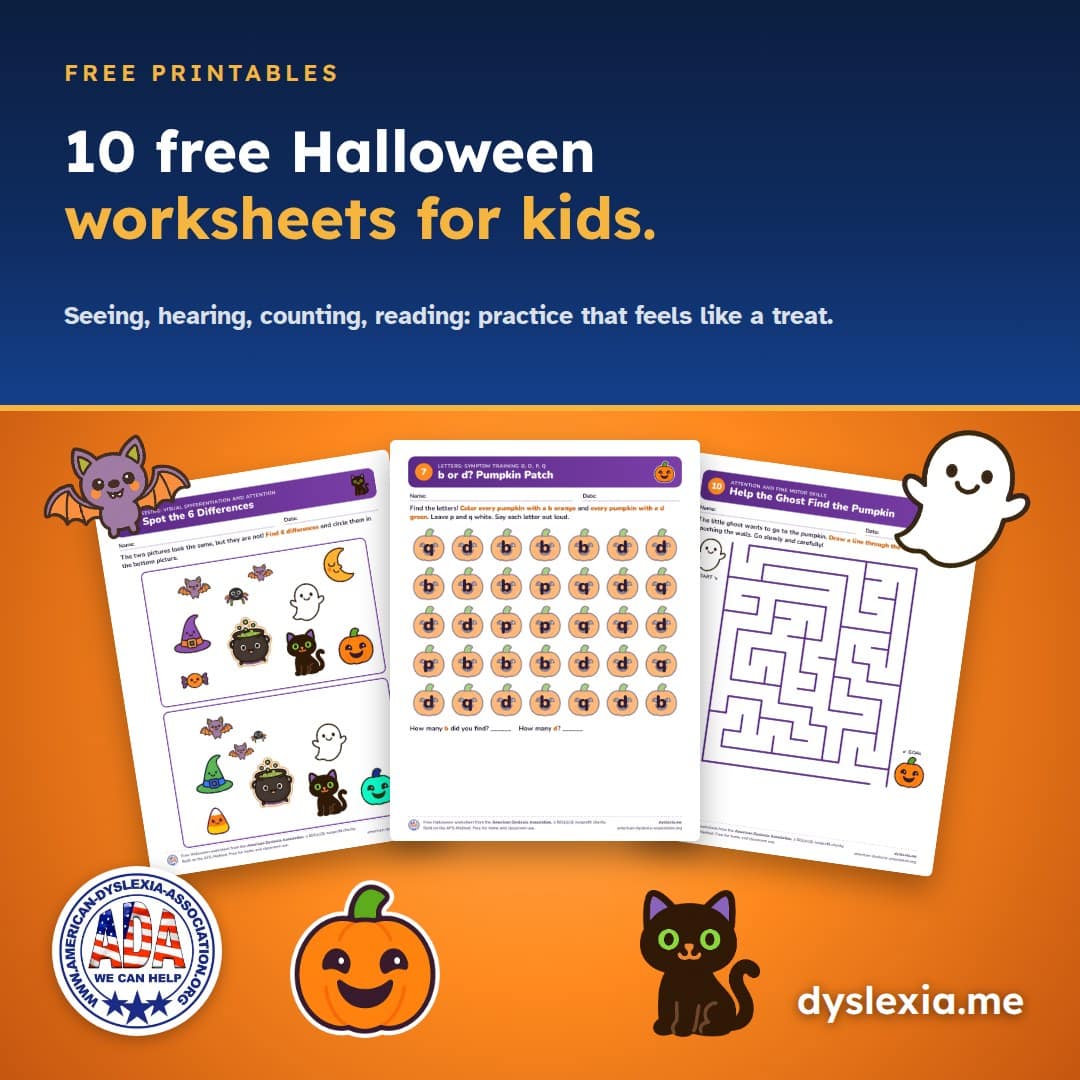
    Halloween is a week away, and we made something for it: 10 free Halloween worksheets for kids, ready to print as one PDF. Each sheet trains one skill that reading, spelling, writing, and/or calculating are built on, from looking closely and remembering to listening, counting, and telling b from d. The figures are friendly, not scary, so even the youngest can join in.

    In short

    • 10 free Halloween worksheets plus an answer key, 11 pages in one PDF, US Letter.
    • Every sheet trains one area of the AFS-Method: seeing, remembering, sequence, space, hearing, quantities, letters, and words.
    • About ten minutes per sheet. One sheet a day fits nicely into the week before Halloween.
    • No sign-up, no email, free for home and classroom use.
    • Want to play too? Our free Halloween memory game runs in any browser.

    What is in the free Halloween worksheet pack?

    The pack has ten worksheets and one page with answers for parents and teachers. Each worksheet names the skill it trains in the purple header, so you can pick the sheets your child needs most. Click a picture to see the sheet in full size.
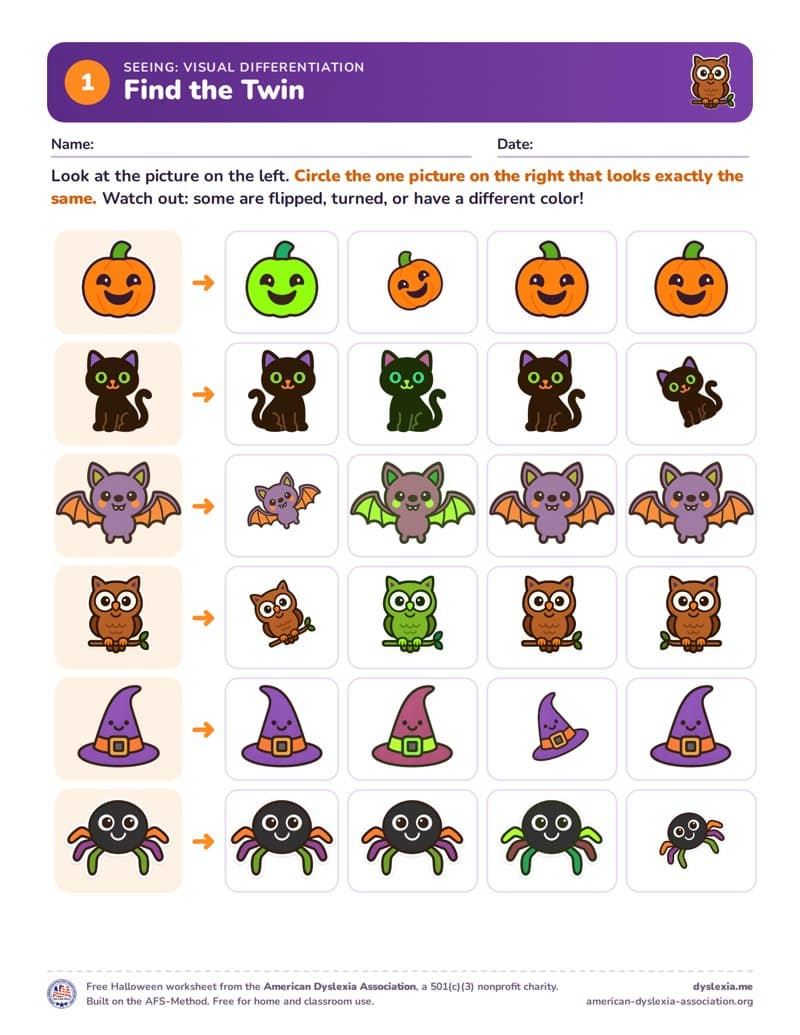
    Free Halloween worksheet 1: Find the Twin (Seeing: visual differentiation)
    1. Find the Twin
    Seeing: visual differentiation. Circle the one picture that looks exactly like the sample. The others are flipped, turned, or have a different color.
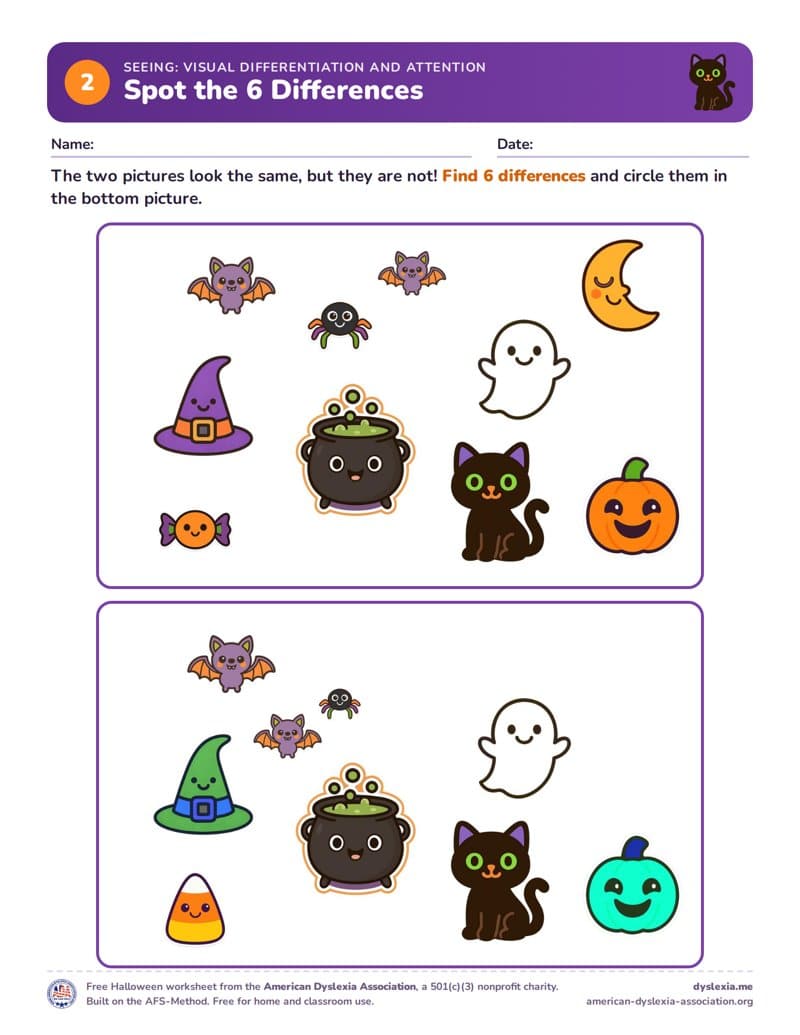
    Free Halloween worksheet 2: Spot the 6 Differences (Seeing and attention)
    2. Spot the 6 Differences
    Seeing and attention. Two Halloween scenes that look the same, but six details changed.
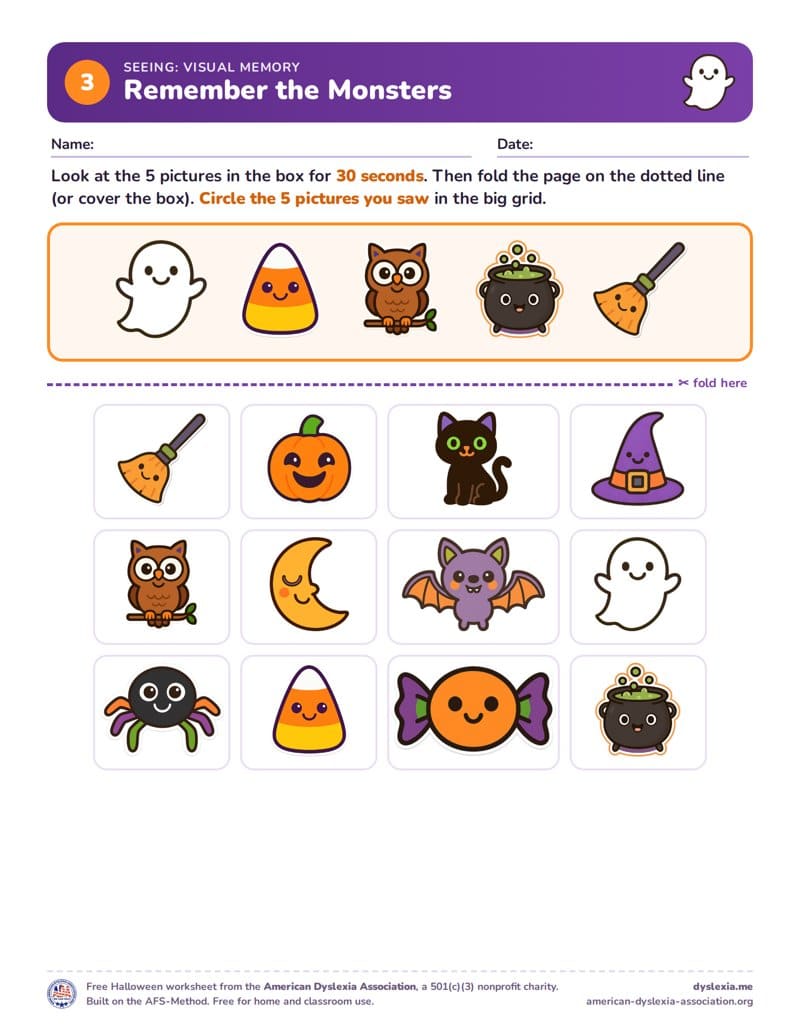
    Free Halloween worksheet 3: Remember the Monsters (Visual memory)
    3. Remember the Monsters
    Visual memory. Look at five pictures for 30 seconds, fold the page, then find them again in a grid of twelve.
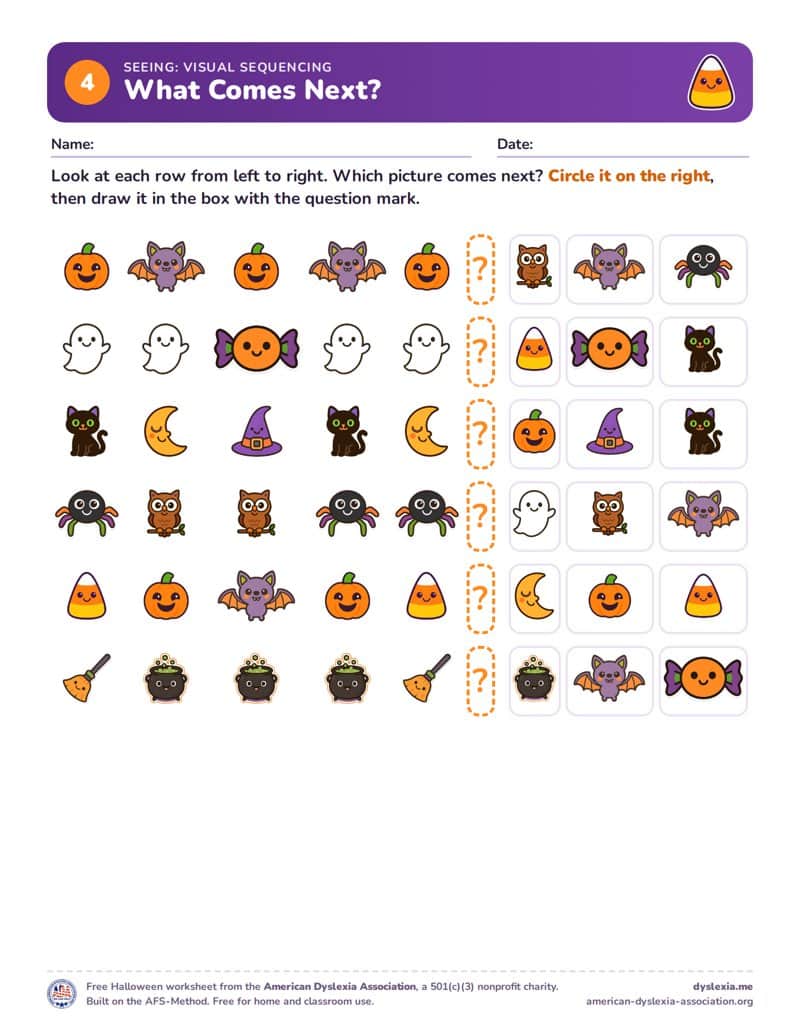
    Free Halloween worksheet 4: What Comes Next? (Visual sequencing)
    4. What Comes Next?
    Visual sequencing. Continue six picture patterns, from easy (pumpkin, bat, pumpkin) to tricky.
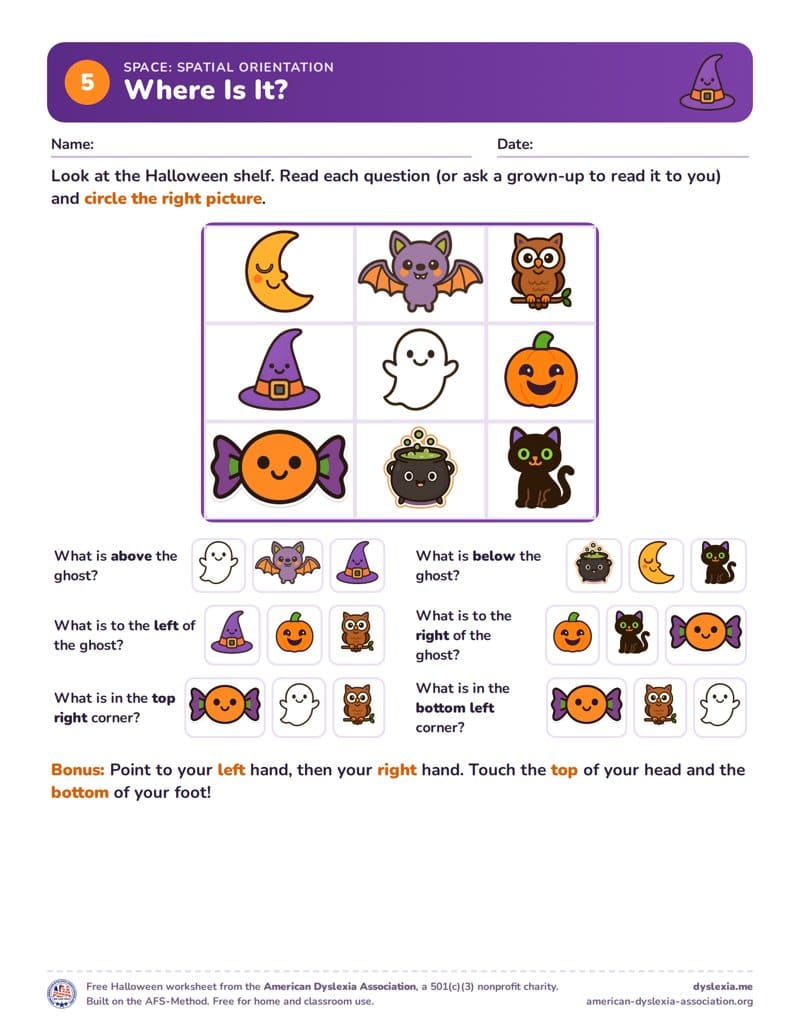
    Free Halloween worksheet 5: Where Is It? (Spatial orientation)
    5. Where Is It?
    Spatial orientation. Above, below, left, right: answer six questions about the Halloween shelf.
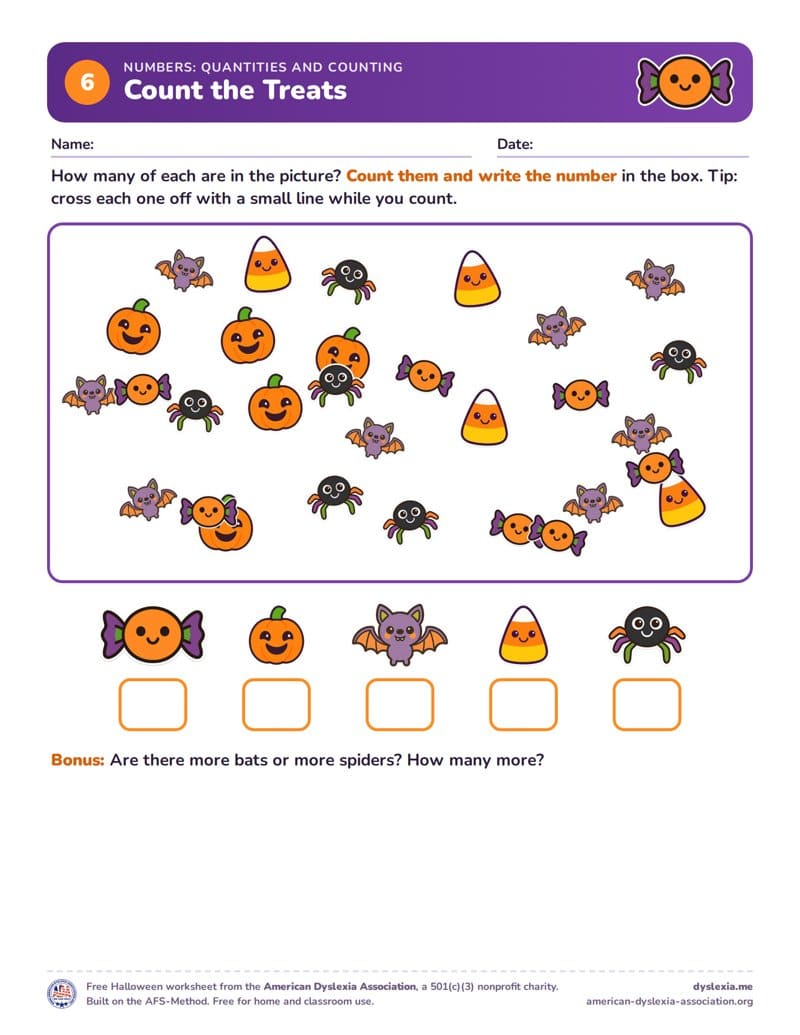
    Free Halloween worksheet 6: Count the Treats (Numbers and quantities)
    6. Count the Treats
    Numbers and quantities. Count candy, pumpkins, bats, candy corn, and spiders, then compare: how many more?
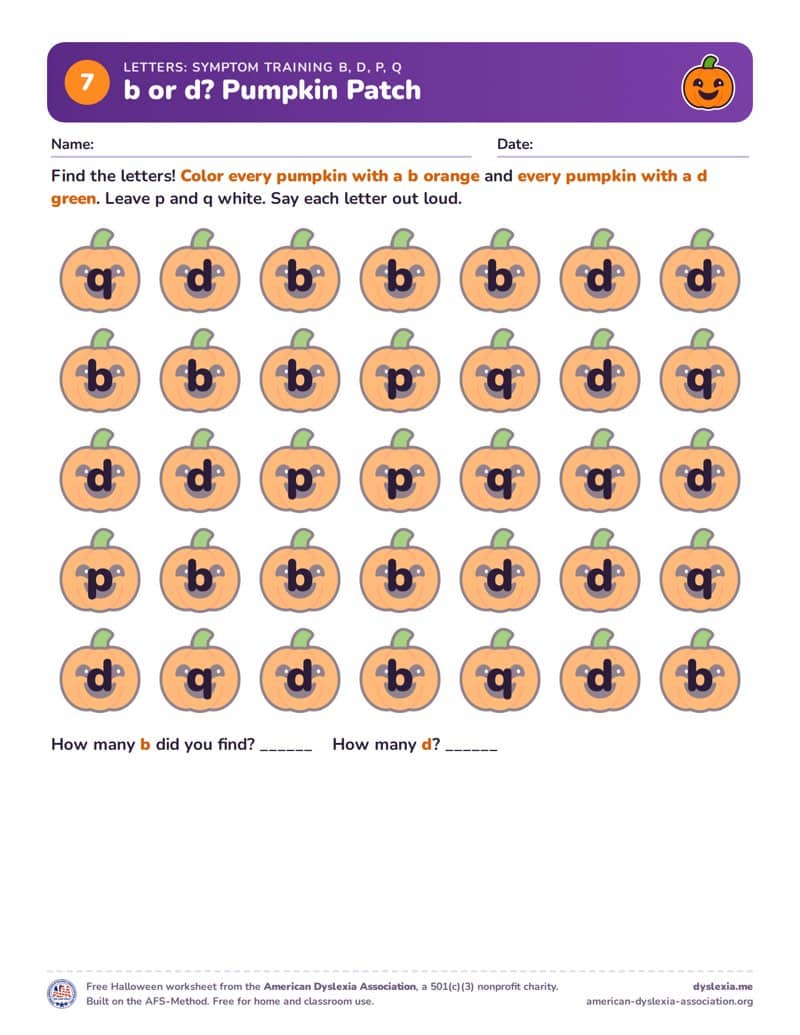
    Free Halloween worksheet 7: b or d? Pumpkin Patch (Symptom training: letters)
    7. b or d? Pumpkin Patch
    Symptom training: letters. Color the b pumpkins orange and the d pumpkins green. p and q stay white.
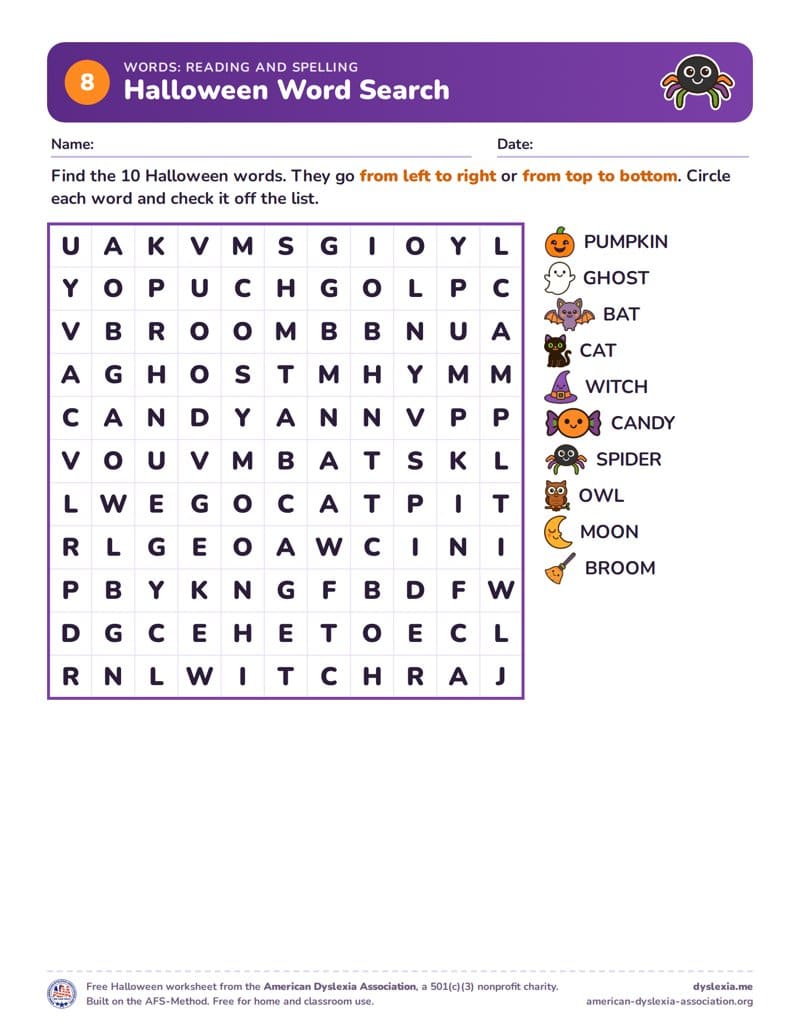
    Free Halloween worksheet 8: Halloween Word Search (Reading and spelling)
    8. Halloween Word Search
    Reading and spelling. Ten Halloween words, only across and down, with a picture next to every word.
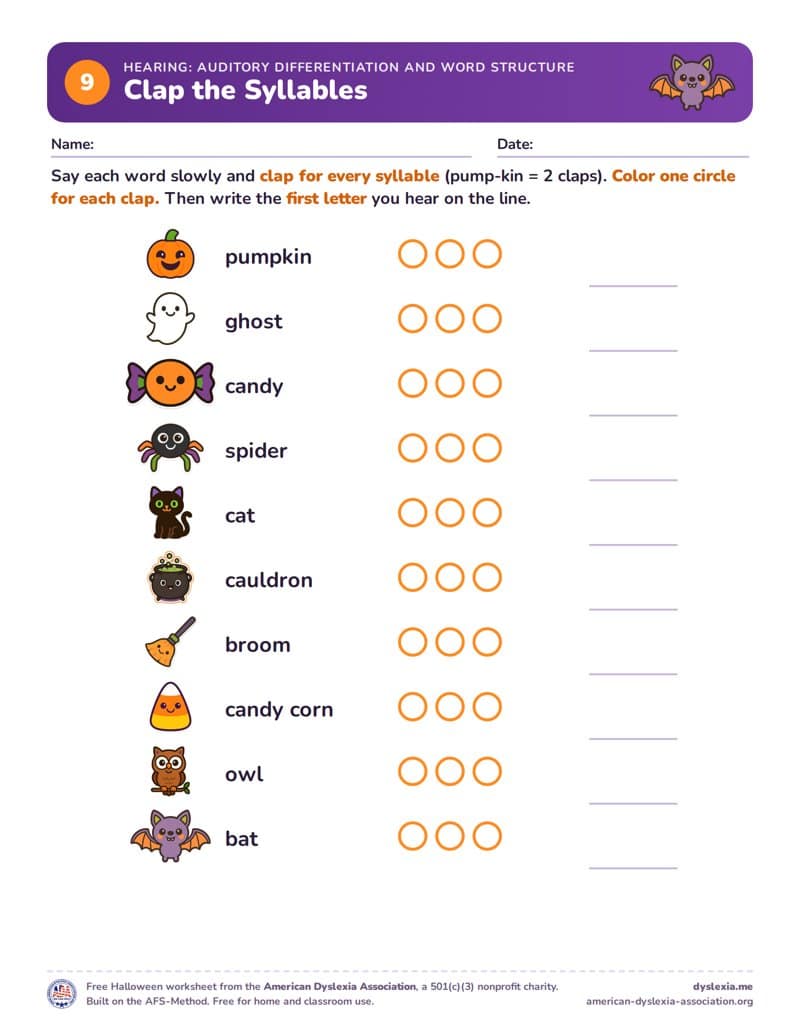
    Free Halloween worksheet 9: Clap the Syllables (Hearing: auditory differentiation)
    9. Clap the Syllables
    Hearing: auditory differentiation. Say the word, clap the syllables, color one circle per clap, and write the first letter.
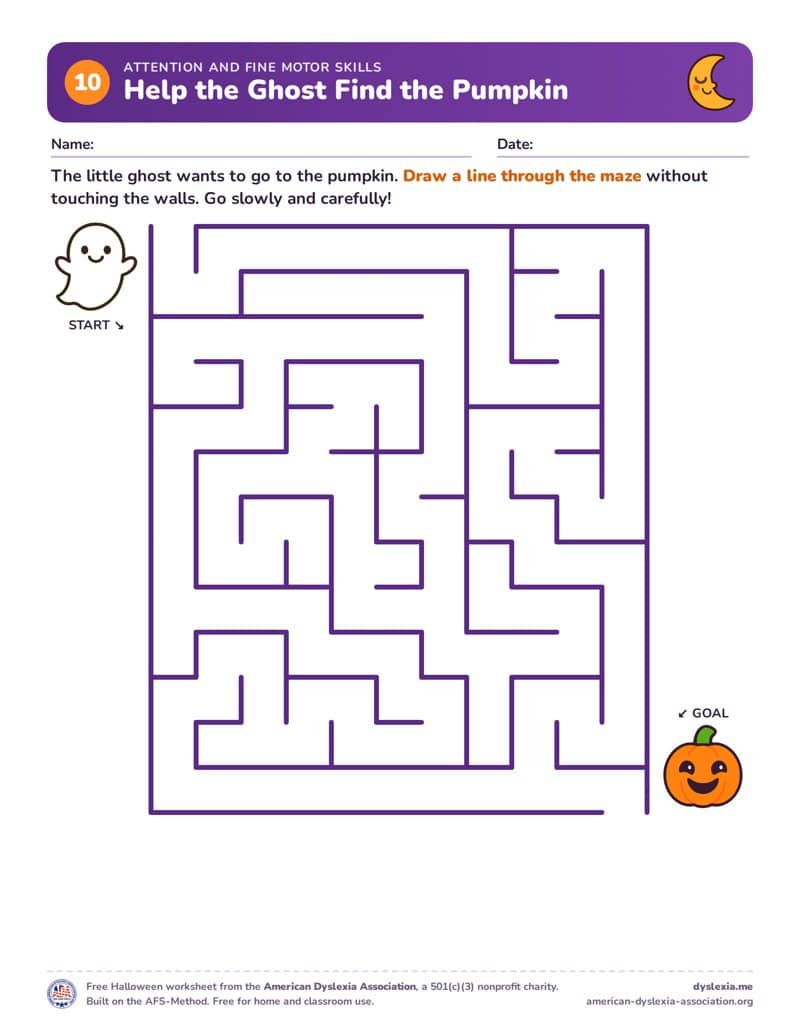
    Free Halloween worksheet 10: Help the Ghost Find the Pumpkin (Attention and fine motor skills)
    10. Help the Ghost Find the Pumpkin
    Attention and fine motor skills. A maze for a slow, careful pencil line.

    How do you use Halloween worksheets with a child who has dyslexia?

    Short and daily works better than long and rare. Ten minutes is enough. Pick a calm time, the same time every day, and stop while it is still fun. Praise the effort, not only the result: a child who tries the maze slowly and carefully has done exactly what the sheet asks.

    A simple plan for the week before Halloween:

    • Start with the sheets for seeing and attention (1, 2, 3, 4, and 10). They warm up the eyes and the focus.
    • Then add space, hearing, and numbers (5, 9, and 6). Read the questions aloud if reading is still hard.
    • Save the letter and word sheets for last (7 and 8). By then the child has practiced looking closely, and b and d are easier to tell apart.
    • Use the answer key together. Errors are information, not failure: they show you which skill needs a little more practice.

    If your child struggles with the same kind of sheet again and again, write it down. That pattern is useful for a closer look with a Certified Dyslexia Trainer.

    Why do the worksheets train seeing, hearing, and space before letters?

    The worksheets follow the AFS-Method, developed by dyslexia researcher Dr. Astrid Kopp-Duller. The method trains three areas together: attention, the sensory perceptions, and the symptoms in reading, spelling, writing, and/or calculating. A child who mixes up b and d often does not need to write b and d fifty more times. The child first needs to see the small difference, remember it, and know where left and right are. That is why most of the Halloween sheets train perception, and only two work with letters and words.

    The sensory perceptions behind reading and math are visual differentiation, visual memory, visual sequencing, spatial orientation, auditory differentiation, and the sense of quantity. Each of them has its own sheet in this pack, so one Halloween week covers the whole set.

    Is there a Halloween game, too?

    Yes. Our free memory game Pairthrum has a Halloween card set with nine funny spooky figures. It runs in any browser, with no ads and no sign-up, and you can choose 6, 8, 12, or 18 cards. Memory games train visual memory, the same skill as worksheet 3.

    For more free practice after Halloween, see our free dyslexia resources for parents and teachers, the 1,500 free worksheets, and the 31-day plan for Dyslexia Awareness Month. More games for every sense are free at easy-training-program.com, a new picture puzzle waits every day at spot-differences.com, and more word searches are at findthewordsabc.com.

    Frequently asked questions

    Are these Halloween worksheets really free?

    Yes. All 10 worksheets and the answer key are free to download, print, and copy for home and classroom use. There is no sign-up and no email address needed. The American Dyslexia Association is a 501(c)(3) nonprofit charity and keeps its materials free for families and teachers.

    What age are the Halloween worksheets for?

    Most sheets work for children from about 5 to 9 years. Younger children can do the picture sheets (find the twin, spot the differences, memory, patterns, maze) with a grown-up reading the instructions. The letter and word sheets fit children who are learning to read and write.

    How long should a child work on one worksheet?

    About ten minutes. Short daily practice works better than one long session. Stop while the child still enjoys it, and praise the effort, not only the result.

    Can these worksheets help a child with dyslexia?

    They can be part of the practice. The sheets train attention and the sensory perceptions that reading, spelling, writing, and/or calculating are built on, in the order of the AFS-Method. They do not replace an assessment or regular training with a Certified Dyslexia Trainer.

    About the American Dyslexia Association

    The American Dyslexia Association (ADA) is a 501(c)(3) nonprofit charity based in Osprey, Florida. It supports children, families, educators, and adults affected by dyslexia and dyscalculia with free information, worksheets, games, and the AFS-Method. More at american-dyslexia-association.org.

    Sources

    1. Kopp-Duller, A.: Dyslexia – Training Using the AFS-Method, 3rd revised edition, 2021.
    2. AFS-Method: overview of attention, function, and symptom training. https://www.afs-method.com/
    3. Pairthrum memory game, Halloween card set. https://appsthrum.com/pairthrum/
  • Free Dyslexia Resources for Parents and Teachers: What We Give Away on International Literacy Day

    Free Dyslexia Resources for Parents and Teachers: What We Give Away on International Literacy Day

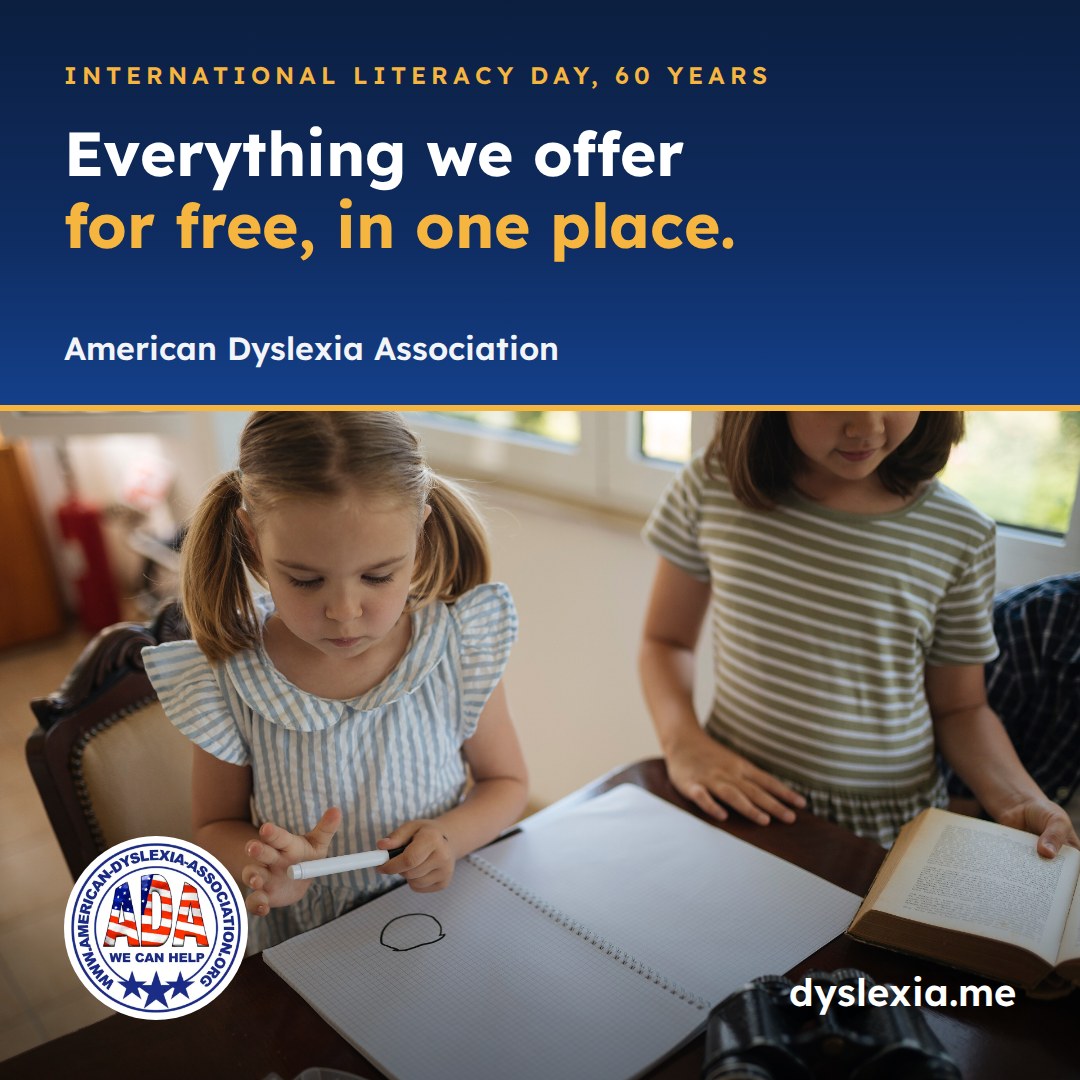
    Free dyslexia resources from the American Dyslexia Association, all in one place: 1,500 printable worksheets, two worksheet generators, a word and a picture every day, ten math games in one app, and a learning platform for families. None of it costs money. Most of it needs no sign-up. We are publishing this list on International Literacy Day, which turns 60 today, because the day is about access, and access starts with price.

    Why free, and why today

    At least 739 million young people and adults still lack basic literacy skills, and 4 in 10 children do not reach the minimum level in reading. Those are UNESCO’s figures for International Literacy Day 2026, the sixtieth since UNESCO proclaimed the day in 1966. Nobody fixes that from Osprey, Florida. What a small association can do is remove the first barrier: no family and no teacher should have to pay to start. A child with dyslexia or dyscalculia does not need a miracle. The child needs practice that fits how he or she perceives letters and numbers, in small daily doses, from adults who stay calm. The free dyslexia resources below are built for that.

    More on this topic: all of this stays free because the American Dyslexia Association is a nonprofit and a 501(c)(3) public charity. Read what ADA’s 501(c)(3) dyslexia charity status means for donors and members.

    1,500 free worksheets, no sign-up

    Our largest collection is the set of 1,500 free printable worksheets on this blog. They follow the three parts of the AFS-Method: attention, sensory perception (the “function” part), and symptom training in reading, writing, and math. Pick what fits your child, print it, use it at home or in class.

    One rule before you print anything: do not start with the mistakes. A child who reverses letters or loses the line does not need the same exercise ten more times. The child needs a few minutes of perception training first, then one short reading or writing task. The worksheet post explains why practicing the errors alone does not work.

    Every freebie on dyslexia.me is licensed under Creative Commons, so teachers may copy and share them. The Freebies section has the running list, and the association keeps its own free worksheet library on the ADA website.

    Two worksheet generators

    Two generators on this blog turn one word or a word list into practice sheets in seconds. The Handwriting Worksheet Wizard lets you choose print or cursive, the font size, and the line pattern. The Math Worksheet Wizard lets you choose the operations and the level, then prints arithmetic sheets for elementary school. Both are free for teachers and for parents who teach at home.

    Something small every day

    Short daily practice beats one long session on the weekend, so two of our sites publish something new every day.

    Word of the Day takes one English word a day through the three steps our trainers use: word image, word sound, word meaning. This is the AFS-Method procedure called word formulation, and it belongs to the symptom part of the method, the part that trains reading, writing, and spelling directly. A word only stays in long-term memory when a child has seen its shape, heard it clearly, and understood what it means, which is why none of the three steps can be skipped. Read it together, say it, write it, and you have done ten minutes of word formulation without opening a workbook.

    Picture of the Day shows a new spot-the-differences picture every day. Your child solves it online, or you print it as a PDF with or without the solution. It looks like a game, and it is one, but it trains visual recognition: the child has to look closely, compare two pictures, and notice where they differ. In the AFS-Method that is the function part of the training, visual differentiation, and it is the same skill a child needs to tell b from d or to see that a word on the page is not the one they just read. If you prefer paper, there is a printable set of 10-differences puzzles on this blog.

    Ten math games in one free app, with no ads

    Free apps for children usually pay for themselves with advertising. A University of Michigan study of 135 apps for young children found ads in 95 percent of them, and in every single free app (Meyer et al., Journal of Developmental and Behavioral Pediatrics, 2019). AFS5 is the exception we built: ten math games in one app, from addition and subtraction to fractions, counting money, and telling time. Ten languages, no account, no ads, no subscription. It runs on iPhone, Mac, and Android.

    A learning platform for families: parents.learnedy.com

    parents.learnedy.com is our online learning platform for parents. The parents package is free: access for up to four children, quizzes without limits, and exercise books you put together for your own child. It has been free of charge and free of advertising since March 2020, and the site promises to ask its users before that ever changes. The platform is endorsed by the American Dyslexia Association and by the International Federation of Dyslexia and Dyscalculia Associations.

    How much practice does a child with dyslexia need?

    Ten to fifteen minutes a day at home, plus one session a week with a trained specialist. That is the pattern the AFS-Method has used since 1997, now in more than 60 countries, and it is the pattern behind the numbers: in a long-term study of children trained this way, 85 percent improved significantly (Kopp-Duller and Pailer-Duller, Dyslexia – Dyscalculia!?, 3rd edition, 2020). Every home session follows the same order: a minute or two of attention, a few minutes of perception exercises, then one reading, writing, or math task. Stop while the child is still willing. Praise every small step, because, in the words of the method’s author, praise is the daily bread of these children. If you want to see how trainers plan this, Lesson 9 of our free 48-part series turns a training plan into home practice.

    Which of the three areas a child needs most is not something you have to guess. The AFS-Test is the educational test built for that question: it looks at the attention span, the sensory perceptions, and the errors the child actually makes, and it has been evaluated on more than 100,000 children between 6 and 14. Dyslexiatest.com explains what the test covers and lists the certified trainers who conduct it.

    Questions parents ask us

    How much should a child with dyslexia practice each day?

    Ten to fifteen minutes a day at home, every day, plus one session a week with a Certified Dyslexia Trainer. Short and daily works better than long and rare. This is the home-training pattern of the AFS-Method (Kopp-Duller 2021). In the long-term study of children trained this way, 85 percent improved significantly (Kopp-Duller and Pailer-Duller 2020).

    Are free worksheets enough to help a child with dyslexia?

    No. Worksheets that only repeat the errors do not help a child with dyslexia and can make things worse. The AFS-Method trains three areas in every session: attention, sensory perception, and only then the symptom, meaning the actual reading, writing, or math task. Use worksheets as the last step of a short session, not as the whole session.

    From what age can a child use these free dyslexia resources?

    The perception exercises, the picture puzzles, and the counting games work from preschool age. The AFS-Test, which tells you which areas to train, has been evaluated on more than 100,000 children aged 6 to 14. If you suspect a problem before school, start with perception games and have the child assessed once reading instruction begins.

    What if the problem is math, not reading?

    The International Dyslexia Association describes dyscalculia as a mathematical disability in which a person has unusual difficulty solving arithmetic problems and grasping math concepts. An estimated 4 to 7 percent of students have it, one or two per classroom, and it often goes together with dyslexia. The same three-part training applies. For arithmetic, always pair the written number with a quantity the child can touch or count. Pictures on a page are not enough: use coins, blocks, or beans, because counting real things is the base of all arithmetic.

    For teachers who want to go further

    If you teach and want to work this way professionally, the Dyslexia Trainer Certification Program is accredited by the American Dyslexia Association. Lesson 1 is free. In September the program site marks International Literacy Month with half-price enrollment for the first 50 sign-ups, through September 30.

    Read to them tonight

    International Literacy Day is a good excuse for the simplest thing that works: read aloud to your child, even if the child can read alone, and especially if reading is hard. If you need a text to start with, bestselling author Don Bentley wrote a message to children with dyslexia for us last month. It is short, and it is worth reading out loud.

    Sources: UNESCO, International Literacy Day. Astrid Kopp-Duller, Dyslexia – Training Using the AFS-Method, 3rd revised edition, 2021. Astrid Kopp-Duller and Livia R. Pailer-Duller, Dyslexia – Dyscalculia!? The importance of pedagogical-didactic assistance in cases of dyslexia, dyscalculia, and other problems in reading, writing, and doing arithmetic, 3rd edition, 2020. Meyer et al., “Advertising in Young Children’s Apps: A Content Analysis,” Journal of Developmental and Behavioral Pediatrics, 2019, PMID 30371646. International Dyslexia Association, Frequently Asked Questions. Learning Disabilities Association of America, What is Dyscalculia?. Understood, What is dyscalculia?.

    Photo: Shixart1985, CC BY 2.0, via Wikimedia Commons.

    More on this topic: put these free resources to work with our 31-day Dyslexia Awareness Month plan, one 10-minute activity for every day of October.

    New for Halloween: 10 free Halloween worksheets for kids, one PDF with spot the differences, memory, patterns, counting, b or d, a word search, syllables, and a maze.