Tag: school

  • Where and How Children Learn: My Experience with Discovering an Optimal Learning Experience

    Where and How Children Learn: My Experience with Discovering an Optimal Learning Experience

    Written by Annie Lacey

    Where: The Inner Universe of a Student With Divergent Learning 

    It was not too long ago, when my bright, creative third grader began to dread going to school, meeting each weekday morning with resistance, which at times was fierce.

    The human need to belong to a group is rooted in survival. School age children feel this instinct acutely – at home, on the playground, and of course, in the classroom. For many students with learning differences, the primary objective in a traditional classroom is not learning, but acting, so as not to appear unlike the others. And still, it is not uncommon for these students to be the bullseye for bullies. More frustratingly, efforts to help these students (special classes, tutors, adjusted seating, etc.) often serve only to further define the separateness and validate to the child that they are different

    I would know, I lived this through my daughter. I am the Director of Admissions for Oakland School, and my daughter, Hadley, is also a student here. I will never forget picking her up after her first day at Oakland School Summer Camp, watching her bounce into the car, gleaming, ‘Mom! These kids are just like me!’ 

    What I failed to fully appreciate until that moment was exactly how difficult her previous school experience had been for her.

    I was witnessing a child who had just set down the cumulative weight of years of punishing self-talk because she was the only one in her class who couldn’t keep up, had a tutor, and in her mind was un-like everyone else. At Oakland, Hadley discovered a place where learning did not equate to the emotional pain of embarrassment and struggle. Hadley was relieved.

    Margaret Shepherd, the founder of Oakland School, understood that learning in a traditional classroom is strained, if not near impossible, for a child who learns differently. She believed when a child feels truly safe in their environment, they can flourish. In the summer of 1950, Shepherd converted her historical family farm into Oakland School, a small co-ed day school and overnight summer camp program for elementary through middle school students. Set upon  a backdrop of rolling hills, forests, horses and other farm animals, Oakland began by first bringing children who didn’t learn like everyone else, together. 

    How: Implementing The Oakland Way 

    Oakland School is founded on a commitment to the individual learner, and a community that backs this mission. Small class sizes and one-to-one instruction are hallmarks of an Oakland School Education. 

    At Oakland School children become confident self-advocates, curious learners, and grow moral character. ‘Where every student thrives’ is not just an idea, it’s a promise we have been keeping for the better part of a century. 

    The Oakland Way is grounded in the belief that once phonics foundations are solid, confidence is established, and the learning process can accelerate. The program uses a synthesis of several pioneering approaches including: 

    Oakland School teachers are well versed in these techniques, and most have advanced degrees and specializations – and some, decades of experience working with children who learn differently.  One example is Oakland School’s horseback riding instructor, Sarah Bailey. For close to 30 years Sarah has been guiding Oakland students to respect, care for and ride a horse – helping these children to build confidence, set goals, focus, and work as a team. Believing children can – and will – attain success is at the core of an Oakland School education.

    As Director of Admissions, the best part of my job is giving prospective students and their families a tour of the grounds. Oakland School, once just an 18th century farmhouse with outbuildings set on 450 acres, is a welcoming environment in every sense. Class sizes are small with an emphasis on multisensory and experiential learning. Foundations are built through individualized learning plans that are calibrated regularly. Children work at their own pace and to their own strengths.

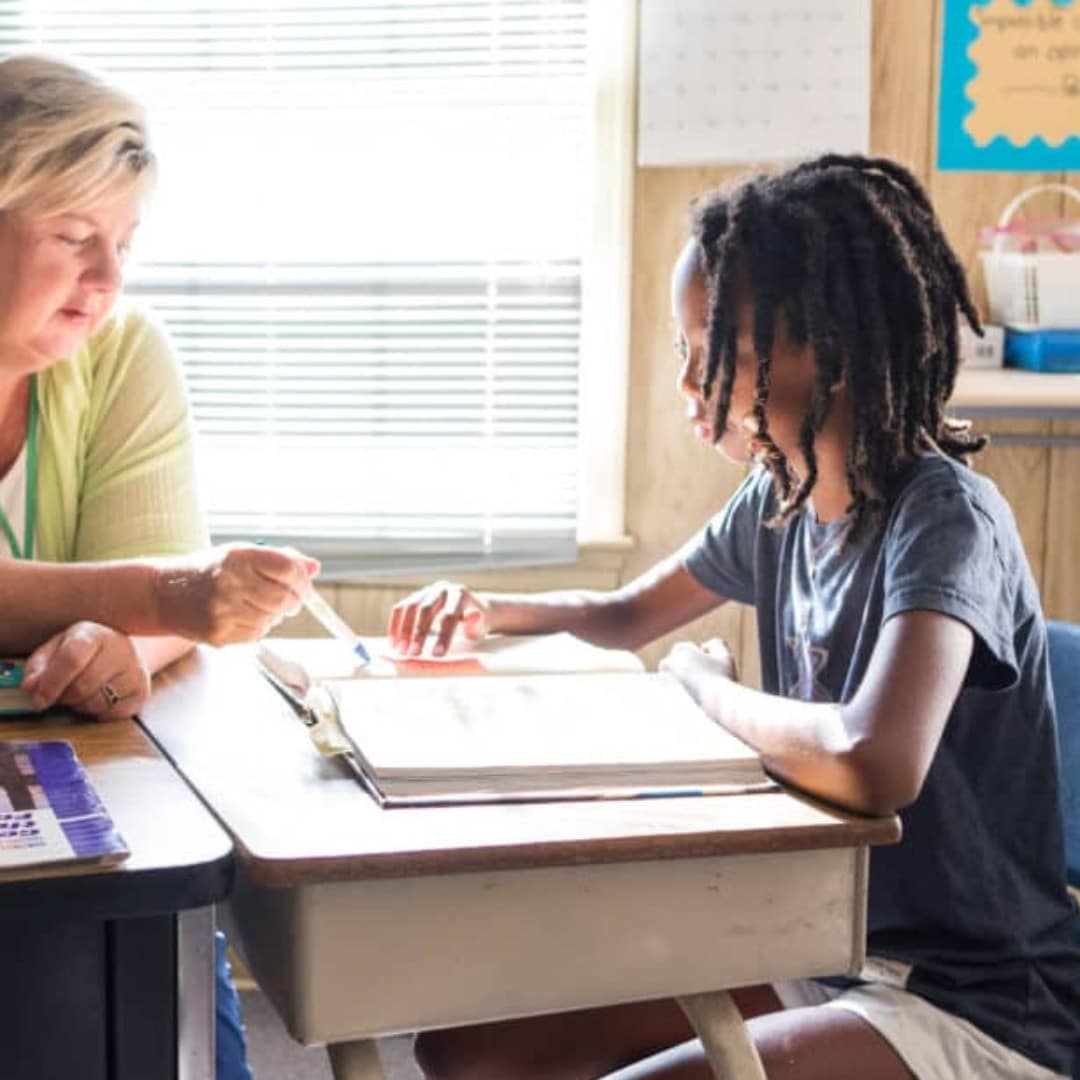
    Almost always on our tours we see a teacher working one-to-one with a student, children working independently or in small groups – with at least one volunteer eager to share what they love most about Oakland School. It is usually at this point of the tour, when, just like my daughter, the prospective student and family realize that learning can – and should – be a wonderful experience.

  • A NYC Class’s “Backwards” Song About Letters

    A NYC Class’s “Backwards” Song About Letters

    Erik Arnesen, a music teacher at a New York City public school (PS 18) in Park Terrace, Manhattan, remembered hearing how some children had difficulty decoding printed letters that looked alike when reversed. At the time, he only had a vague idea that dyslexia meant seeing letters and numbers jumbled, out of order, or turned around. He decided to write a song about the subject, and subsequently created a video with the children singing and acting it out. His YouTube channel is called Mr. Arnesen School Songs and features the children starring in several musically inspired educational videos. Mr. Arnesen’s YouTube channel also has songs about opposites, manners, science, music, and more. It can be found here: https://www.youtube.com/user/fearless5009

  • For Teens Knee-Deep In Negativity, Reframing Thoughts Can Help

    For Teens Knee-Deep In Negativity, Reframing Thoughts Can Help

    (Jenn Liv for NPR)

    “Why didn’t she text me back yet? She doesn’t like me anymore!”

    “There’s no way I’m trying out for the team. I suck at basketball”

    “It’s not fair that I have a curfew!”

    Sound familiar? Parents of tweens and teens often shrug off such anxious and gloomy thinking as normal irritability and moodiness — because it is. Still, the beginning of a new school year, with all of the required adjustments, is a good time to consider just how closely the habit of negative, exaggerated “self-talk” can affect academic and social success, self-esteem and happiness.

    Psychological research shows that what we think can have a powerful influence on how we feel emotionally and physically, and on how we behave. Research also shows that our harmful thinking patterns can be changed.

    You may not be of much help when it comes to sharpening your son’s calculus skills. But during my 35-plus years of clinical practice, it’s become clear to me that parents can play a huge role in helping their children to develop a critical life skill: the ability to take notice of their thoughts, to step back and view the bigger picture, and to decide how to act based on that more realistic perspective.

    Taking heed of an alarmist or pessimistic inner voice is a universal experience. It has survival value; it often protects people from danger. And it’s often true that a worrying thought can act as a motivating force – to study, for example.

    Still, the insecurities that adolescents feel as they undergo the multiple transitions necessary in growing up make them especially vulnerable to believing the worst. This tendency can lead to chronic anxiety, depression, and anger, and can interfere with relationships and success in school.

    Helping children grasp the importance of thinking more realistically may help protect them later when they make the huge transition to college. A 2016 survey by the American College Health Association of undergraduates at over 50 colleges and universities found that about 38 percent had felt so depressed at some time during the previous year that it was tough to function. Some 60 percent had experienced an episode of debilitating anxiety.

    The power of thoughts to affect feelings and behavior is a foundational principle of cognitive behavioral therapy, which is the form of therapy that I practice. CBT teaches people how to recognize faulty negative self-talk, to notice how it makes them feel and act, and to challenge it. Parents can practice this skill themselves and act as models as they guide their kids to question a thought by looking at the evidence for and against it.

    If your child often seems withdrawn, sad, or angry, you may be able to identify a problematic thinking pattern by listening closely. Here are four key styles of negative self-talk to listen for:

    Catastrophizing. One common thought habit is the tendency to jump to the worst-case scenario (“What if I fail the test? I’m never going to get into college!”). Scanning constantly for disaster ahead acts as a huge contributor to anxiety. And catastrophizing often leads teens to avoid people or become reluctant to try new things.

    Zooming in on the negative. Ruminating on a disappointment without taking into account the many positive and neutral aspects of one’s experience is often associated with sadness and depression. A missed soccer goal might overshadow everything else that happens one day – the lunch with friends, the good grade on a test, the hilarious TV show – and consume your high-schooler for days.

    It’s not fair! Interpreting every letdown as a grave injustice – the “it’s not fair!” habit – often underlies teens’ anger and can harm friendships and family relationships.

    I can’t! Reacting habitually to difficult situations or to new opportunities with “I can’t,” rather than “I can try,” leads to helplessness. Changing the thought to “I can try!” encourages problem-solving and a willingness to be proactive, to take positive action — both keys to being successful and resilient.

    Continue reading here:

    https://www.kqed.org/mindshift/49190/for-teens-knee-deep-in-negativity-reframing-thoughts-can-help

  • How Testing Kids For Skills Can Hurt Those Lacking Knowledge

    How Testing Kids For Skills Can Hurt Those Lacking Knowledge

    Excerpted from THE KNOWLEDGE GAP by Natalie Wexler, published by Avery, an imprint of Penguin Publishing Group, a division of Penguin Random House, LLC. Copyright © 2019 by Natalie Wexler.

    By Natalie Wexler

    In 1987, two researchers in Wisconsin, Donna Recht and Lauren Leslie, constructed a miniature baseball field and installed it in an empty classroom in a junior high school. They peopled it with four-inch wooden baseball players arranged to simulate the beginning of a game. Then they brought in sixty-four seventh- and eighth-grade students who had been tested both for their general reading ability and their knowledge of baseball.

    The goal was to determine to what extent a child’s ability to understand a text depended on her prior knowledge of the topic. Recht and Leslie chose baseball because they figured lots of kids in junior high school who weren’t great readers nevertheless knew a fair amount about the subject. Each student was asked to read a text
    describing half an inning of a fictional baseball game and move the wooden figures around the board to reenact the action described.

    Churniak swings and hits a slow bouncing ball toward the shortstop, the passage began. Haley comes in, fields it, and throws to first, but too late. Churniak is on first with a single, Johnson stayed on third. The next batter is Whitcomb, the Cougars’ left-fielder.

    It turned out that prior knowledge of baseball made a huge difference in students’ ability to understand the text—more of a difference than their supposed reading level. The kids who knew little about baseball, including the “good” readers, all did poorly. And among those who knew a lot about baseball, the “good” readers and the “bad” readers all did well. In fact, the bad readers who knew a lot about baseball outperformed the good readers who didn’t.

    In another study, researchers read preschoolers from mixed socioeconomic backgrounds a book about birds, a subject they had determined the higher-income kids already knew more about. When they tested comprehension, the wealthier children did significantly better. But then they read a story about a subject neither group knew anything about: made-up animals called wugs. When prior knowledge was equalized, comprehension was essentially the same. In other words, the gap in comprehension wasn’t a gap in skills. It was a gap in knowledge.

    The implication is clear: abstract “reading ability” is largely a mirage constructed by reading tests. A student’s ability to comprehend a text will vary depending on his familiarity with the subject; no degree of “skill” will help if he lacks the knowledge to understand it. While instruction in the early grades has focused on “learning to read” rather than “reading to learn,” educators have overlooked the fact that part of “learning to read” is acquiring knowledge.

    Continue with article here:

    https://www.kqed.org/mindshift/54054/how-testing-kids-for-skills-hurts-those-lacking-knowledge

  • School-based Identification of Characteristics of Dyslexia: Parent Overview

    School-based Identification of Characteristics of Dyslexia: Parent Overview

    By: Tennessee Center for the Study and Treatment of Dyslexia
    Learn how schools use screening and progress monitoring tools to identify dyslexia characteristics, and then implement reading interventions for students who need dyslexia-specific instruction. You’ll also find out about classroom accommodations and modifications that can help your child learn, as well as information about referrals for special education.

    This article is adapted from a parent resource developed by the Tennessee Center for the Study and Treatment of Dyslexia. Check with your state’s Department of Education to find out more about screening and interventions.

    Dyslexia defined

    Dyslexia is a specific learning disability that is neurobiological in origin and is characterized by difficulties with accurate and/or fluent word recognition and by poor spelling and decoding abilities. These difficulties typically result from a deficit in the phonological component of language that is often unexpected in relation to other cognitive abilities and the provision of effective classroom instruction.

    Secondary consequences may include problems in reading comprehension and reduced reading experience that can impede growth of vocabulary and background knowledge.

    Dyslexia overview

    This overview of dyslexia is presented by Dr. Tim Odegard, Professor of Psychology at the Tennessee Center for the Study and Treatment of Dyslexia at Middle Tennessee State University.

    School-based identification of the characteristics of dyslexia

    Many public schools are required to screen students for characteristics of dyslexia and provide dyslexia-specific interventions to those who are identified. Public schools do not assess and formally diagnose dyslexia; however, the identification of characteristics of dyslexia is sufficient to plan for and implement reading intervention for those students. Schools have procedures in place through the Response to Instruction and Intervention (RTI2) framework (or other similar means) to support this screening and identification.

    Continue reading the article here:

    https://www.readingrockets.org/article/school-based-identification-characteristics-dyslexia-parent-overview

  • We Can’t Teach Love But We Can Teach Reading

    We Can’t Teach Love But We Can Teach Reading

    Teachers can speak a lot of things into existence (a quiet line in the hallway, students sitting “criss, cross, applesauce”) but a love of reading isn’t one of them. Enthusiasm is a part of good teaching, but communicating a love of books isn’t the same thing as teaching reading. I learned that the hard way.

    When reading comes easily, it’s easy to love it

    Reading courses in my teacher preparation program centered around a love of reading. In class, we shared our own memories of learning to read, curated books lists for our classroom libraries, and debated the themes hidden in our favorite children’s books. We were taught to devote time to students reading for pleasure and to be disdainful of basal programs with scripted lessons.

    When I first began teaching, I read aloud to my class every day, gave my students time for independent reading, and facilitated discussions about their books. My approach worked well for students who entered my fourth grade class already reading well. They would sprawl around the classroom and become so absorbed in their books that they’d groan when Read to Self time was over. I had a few students who struggled with reading and they were pulled for intervention by a specialist and I never had the opportunity to see the instruction they received. So while I taught fourth grade in a high-performing school, I believed that if students were given time to read and discuss good books, their abilities would grow and a love of reading would flow naturally.

    But when reading is difficult …

    Five years ago, I moved to a school with low reading achievement. As a literacy coach, I saw teachers try the same strategies I had used, but they experienced very different results. And I quickly learned that in classrooms with children who cannot read well there are a thousand ways a Readers Workshop lesson can backfire.

    In one third grade class, a teacher began to state her teaching point, “Good readers…” only to be cut off by a student who called out, “We don’t got those in here!” The teacher handled the disruption beautifully in the moment, but afterwards she lamented, “The kid had a point.” Just two of her students were reading anywhere near grade level.

    In well-managed classrooms, independent reading periods would devolve into quiet distraction. In less-orderly rooms, students scrawled curse words in books and knocked leveled book bins to the floor. Our school’s kindergarteners had more tolerance for low-level books than the ten year olds who had been struggling for years to make sense of reading. I soon realized that independent reading is a burden, not a pleasure, for students who struggle to lift the words off the page.

    Student: Why do they always put tricky words in there?

    Although we had hundreds of books bins, only the low-level books were being used. Our mini-lessons began to feel too mini and our Guided Reading lessons felt too guided. What had seemed to be enough in my own fourth grade classroom was certainly not enough here. It seemed cruel to talk about a love of reading when students felt taunted by the squiggly lines on the page.

    The joy of cracking the code

    I began to use the time I had devoted to Guided Reading intervention for explicit phonics instruction. The scripted lessons felt dry, but I honored the instructional routines and I faked enthusiasm. My students discovered the joy in the lessons before I did.

    Continue reading here: https://www.readingrockets.org/blogs/right-read/we-can-t-teach-love-we-can-teach-reading

  • Children’s Confidence Boosted Thanks to Dyslexic Artist’s Reading and Learning Resource

    Children’s Confidence Boosted Thanks to Dyslexic Artist’s Reading and Learning Resource

    by Rossie Stone

    MY NAME IS ROSSIE STONE. WHAT HAPPENED TO ME IN HIGH SCHOOL CHANGED ME FOREVER.

    Rossie Strathclyde TEDX photo.jpg

    All my way through school, I struggled with processing information through words, both spoken and written. Listening to the teacher was really hard, as was following and remembering information from books.

     After being at the bottom of the class throughout primary school, I was eventually identified as dyslexic. Though it was a relief to be assured the problem wasn’t stupidity, the diagnosis didn’t make high school any easier. Or exams.

    Kickstarter (Story) Export 09.png

    Eventually, I had a eureka moment. It struck me that if understanding information through text was so hard, I could try turning my revision notes into something I had never found difficult to read: COMICS.

     To my surprise, it was not only highly enjoyable (in a way, I expected that) but highly effective too. Suddenly, the information was getting into my head and staying there, the way I assumed it was for people who take in knowledge more conventionally.

     When it came to my exam, I did my best to remember the notes from my Revision Comic. I was delighted to find how easy that was. I remembered all the pictures and parts of the story in the comic that contained the facts I needed. Even so, I wasn’t expecting to come back with my very first GRADE A in an academic exam!

    It wasn’t the Grade A that filled me with confidence, though, but the realization that I COULD access information – and could have been doing it all along – when it was presented in a way that worked for me.

     Since then, I have made my revision technique into a series of comics more accessible to a younger age, the years when I felt I really missed out.

     These comics turn school subjects like maths, literacy, science, and history into pure entertainment in the form of visual stories.

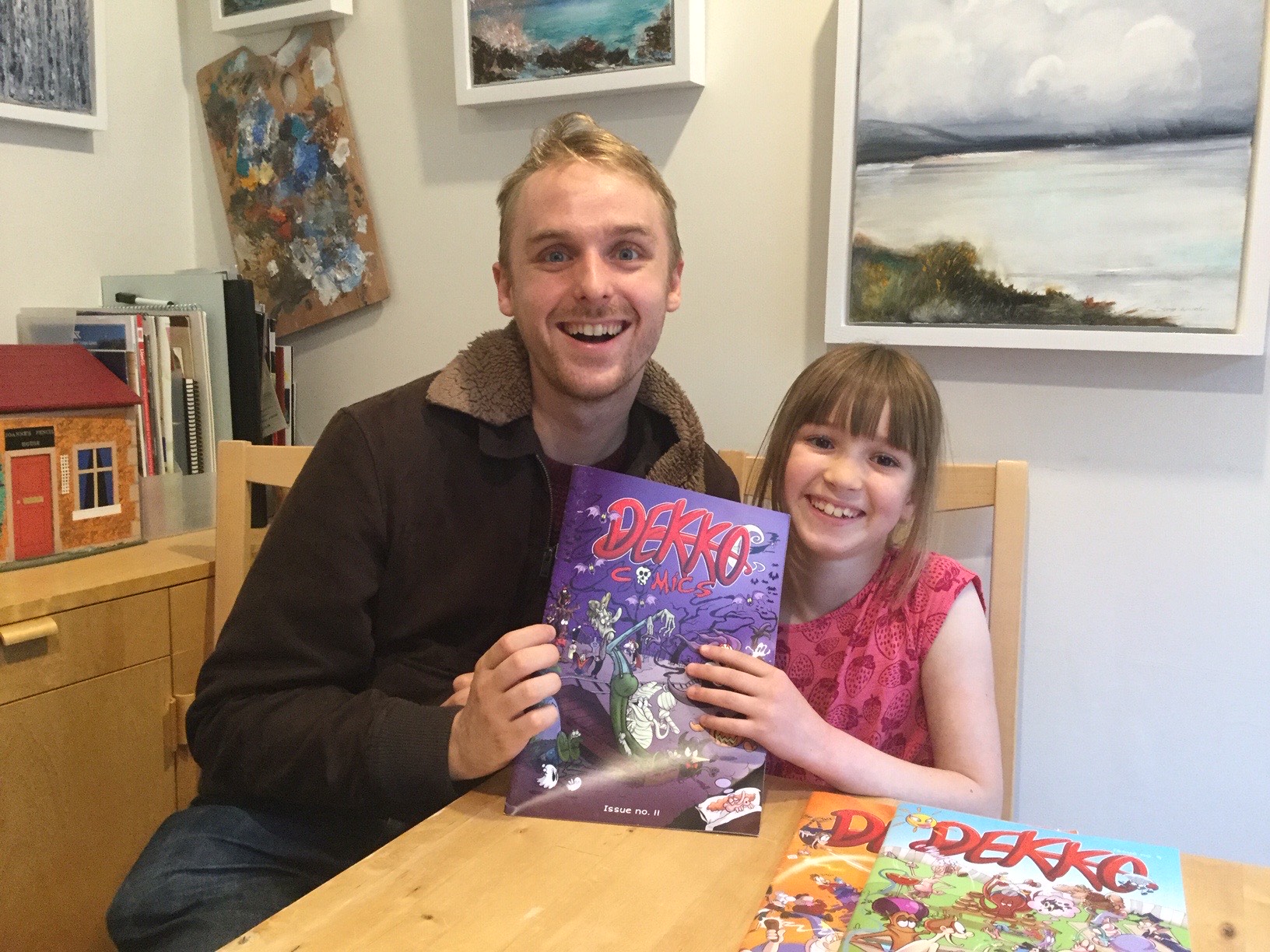
    Continue reading the article, here: https://dekkocomics.com/blog/improving-confidence-through-comics

    The comics can be found on our website, here:
     
  • Dinosaur perception training

    Dinosaur perception training

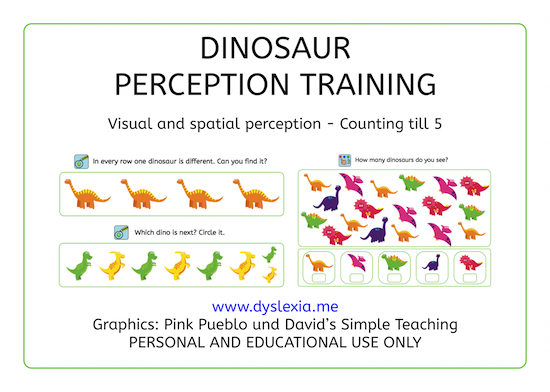
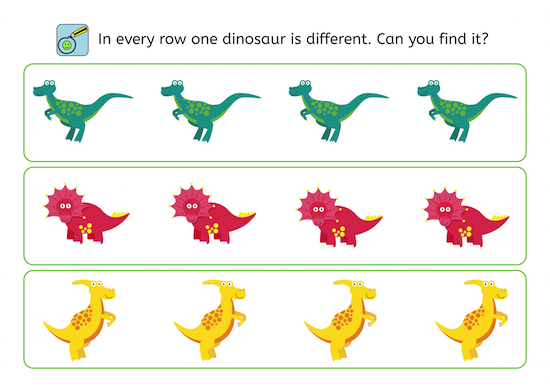
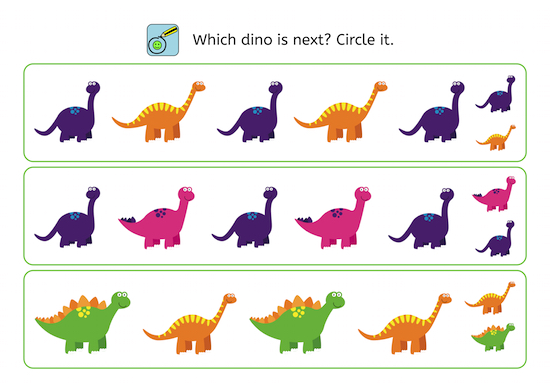
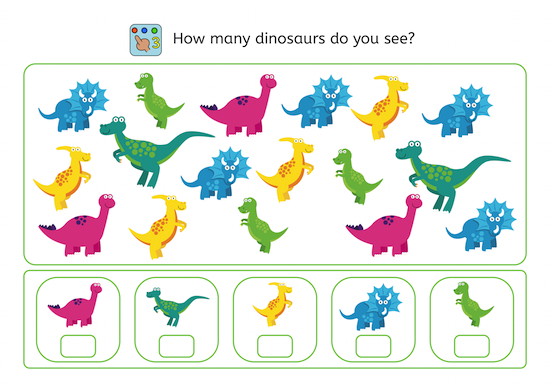
    Kids + dinosaurs = fun! Enjoy our new free no-prep printables with dinosaurs. Kids will have fun and train their visual and spatial perception, patterning, and counting up to 5.

    Dinosaur, perception training, children, freebie, no prep printable, parents, school, teacher, dyslexia, dyscalculia, AFS-method

    Visual and spatial perception:

    Dinosaur, perception training, children, freebie, no prep printable, parents, school, teacher, dyslexia, dyscalculia, AFS-method

    Patterning:

    Dinosaur, perception training, children, freebie, no prep printable, parents, school, teacher, dyslexia, dyscalculia, AFS-method

    Counting till 5:

    Dinosaur, perception training, children, freebie, no prep printable, parents, school, teacher, dyslexia, dyscalculia, AFS-method

    Download: Dinosaur perception training

    You want even more dinosaurs? Check out this free online game: Dinosaur – Find the pairs! You can choose different levels. The game can be played in any browser on any computer, smartphone or tablet.

  • Debunking the Myths about Dyslexia

    Debunking the Myths about Dyslexia

    There are many signs or clues to dyslexia, which are discussed in depth on this website; however, it is also important to be aware of the misconceptions and myths surrounding the disorder. There are several myths regarding dyslexia. We have highlighted some of the more common ones.

    Myth: Smart people cannot be dyslexic or have a learning disability.
    Fact: Dyslexia and intelligence are NOT connected. Many dyslexic individuals are very bright and creative, and they will accomplish amazing things as adults.
    Myth: Dyslexia does not exist.
    Fact: There has been 30 years of documented, scientific evidence and research proving the existence of dyslexia. It is one of the most common learning disabilities to affect children.
    Myth: Dyslexia is rare.
    Fact: In the United States, NIH research has shown that dyslexia affects 20%, or 1 in every 5 people. Some people may have milder forms, while others may experience it more severely. Dyslexia is one of the most common causes of reading difficulties in elementary school children because only 1 in 10 dyslexics will qualify for an IEP and special education that will allow them to get the help in reading that they need.

    CONTINUE READING