Author: Donna Taylor

  • For Teens Knee-Deep In Negativity, Reframing Thoughts Can Help

    For Teens Knee-Deep In Negativity, Reframing Thoughts Can Help

    (Jenn Liv for NPR)

    “Why didn’t she text me back yet? She doesn’t like me anymore!”

    “There’s no way I’m trying out for the team. I suck at basketball”

    “It’s not fair that I have a curfew!”

    Sound familiar? Parents of tweens and teens often shrug off such anxious and gloomy thinking as normal irritability and moodiness — because it is. Still, the beginning of a new school year, with all of the required adjustments, is a good time to consider just how closely the habit of negative, exaggerated “self-talk” can affect academic and social success, self-esteem and happiness.

    Psychological research shows that what we think can have a powerful influence on how we feel emotionally and physically, and on how we behave. Research also shows that our harmful thinking patterns can be changed.

    You may not be of much help when it comes to sharpening your son’s calculus skills. But during my 35-plus years of clinical practice, it’s become clear to me that parents can play a huge role in helping their children to develop a critical life skill: the ability to take notice of their thoughts, to step back and view the bigger picture, and to decide how to act based on that more realistic perspective.

    Taking heed of an alarmist or pessimistic inner voice is a universal experience. It has survival value; it often protects people from danger. And it’s often true that a worrying thought can act as a motivating force – to study, for example.

    Still, the insecurities that adolescents feel as they undergo the multiple transitions necessary in growing up make them especially vulnerable to believing the worst. This tendency can lead to chronic anxiety, depression, and anger, and can interfere with relationships and success in school.

    Helping children grasp the importance of thinking more realistically may help protect them later when they make the huge transition to college. A 2016 survey by the American College Health Association of undergraduates at over 50 colleges and universities found that about 38 percent had felt so depressed at some time during the previous year that it was tough to function. Some 60 percent had experienced an episode of debilitating anxiety.

    The power of thoughts to affect feelings and behavior is a foundational principle of cognitive behavioral therapy, which is the form of therapy that I practice. CBT teaches people how to recognize faulty negative self-talk, to notice how it makes them feel and act, and to challenge it. Parents can practice this skill themselves and act as models as they guide their kids to question a thought by looking at the evidence for and against it.

    If your child often seems withdrawn, sad, or angry, you may be able to identify a problematic thinking pattern by listening closely. Here are four key styles of negative self-talk to listen for:

    Catastrophizing. One common thought habit is the tendency to jump to the worst-case scenario (“What if I fail the test? I’m never going to get into college!”). Scanning constantly for disaster ahead acts as a huge contributor to anxiety. And catastrophizing often leads teens to avoid people or become reluctant to try new things.

    Zooming in on the negative. Ruminating on a disappointment without taking into account the many positive and neutral aspects of one’s experience is often associated with sadness and depression. A missed soccer goal might overshadow everything else that happens one day – the lunch with friends, the good grade on a test, the hilarious TV show – and consume your high-schooler for days.

    It’s not fair! Interpreting every letdown as a grave injustice – the “it’s not fair!” habit – often underlies teens’ anger and can harm friendships and family relationships.

    I can’t! Reacting habitually to difficult situations or to new opportunities with “I can’t,” rather than “I can try,” leads to helplessness. Changing the thought to “I can try!” encourages problem-solving and a willingness to be proactive, to take positive action — both keys to being successful and resilient.

    Continue reading here:

    https://www.kqed.org/mindshift/49190/for-teens-knee-deep-in-negativity-reframing-thoughts-can-help


  • Dyslexia Research Center Online Shop

    Dyslexia Research Center Online Shop

    Check out our online dyslexia and dyscalculia shop for educational tools like Mathe4matics and Letters2Words card games, and the EasyReading Card.

    http://dyslexics.com

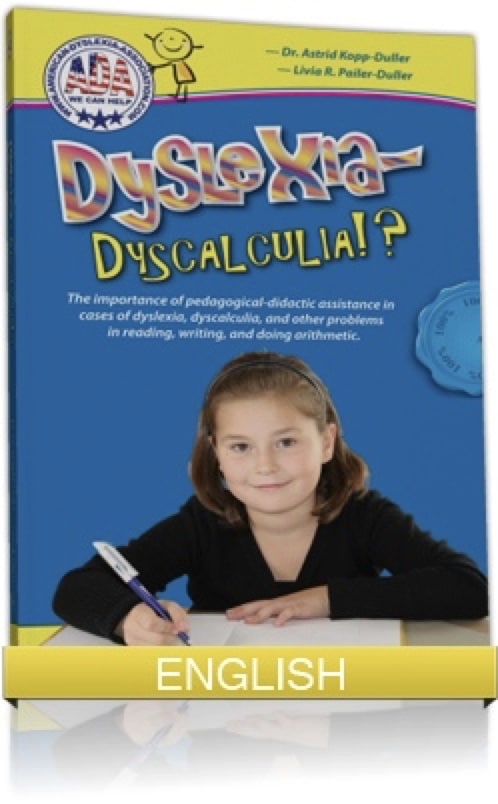
    Also featured in our online shop is Dyslexia-Dyscalculia!?, a publication authored by Dr. Astrid Kopp-Duller and Dr. Livia R. Pailer-Duller, which describes the necessity of intervention on a didactic level.

  • 13 Simple Ways to Practice Addition and Subtraction

    13 Simple Ways to Practice Addition and Subtraction

    In my day, we just memorized math. I don’t know that I ever really truly understood much of what math was nor was I able to compute higher-level skills until I started teaching math and learned how to be flexible with numbers. Flexibility with numbers is a key foundational skill for young learners, and those who don’t have it struggle from early on. When it is hard to figure out what 7 + 4 =, a child will become easily frustrated, leading to the oh so often felt and heard, “I’m just no good at math.” It isn’t about memorization and speed (puuuhhhleeeease – stop with the timed tests!) with basic addition and subtraction – it is about developing strategies that lead to fluency, automaticity, and understanding.

    There are a number of ways to accomplish this, but one thing I am passionate about is making sure instruction is developmentally appropriate. Research tells us that learning through play is most appropriate for early childhood students (and that designation goes through age 8 or 9, depending on where you look), and the kids are way more engaged when they’re playing games. To develop strategic thinking, use lots of concrete representations to start, then move to the more abstract (for example, start with dot dice and move on to numeral dice). So, here are 13 ways to practice simple addition and subtraction that are sure to please.

    Way 1. Dice –

    There are so many different kinds of dice you can get now, and if you can’t find the ones you want, there’s DIY wood block dice!  Place value blocks, ten frames, dots, numerals of any range with any number of sides, big and wooden dice, colorful dice, foam dice… Just search for dice online – but be prepared to get lost in that rabbit hole! Lots of work with making five and ten is required in K/1 and this can easily be done with addition (and frankly, subtraction, too – think fact families) and dice. Tenzi is a great way to have multiple players with a target number in a fast-paced, fun game.

    2. Deck of Cards –

    Pull out the numbered cards and only use those. You can use them in a number of ways – simply flip two cards and add or subtract, play make five or make ten go fish, addition/subtraction war (flip two cards each, whoever has the most/least wins all four cards, repeat) or any of a number of other card games.

    3. Dominoes –

    This low prep way to practice addition and subtraction involves simply giving students a bin of dominoes and having them pull one at a time. Then, they either add or subtract using the two sides of the domino. It is important, as with all of these ideas, to encourage strategy use. They should subitize the numbers, use counting on strategy, think about a rekenrek or a ten frame – playing these while simply counting all the dots won’t improve their skills at all.

    Way 4. Hopscotch  –

    Need to get some wiggles out? Go out to the playground or make an indoor tape hopscotch board and give each square a number 0-10. The directions can vary based on your students’ abilities and be used to find the missing addend or subtrahend (“What goes with 6 to make 10?” and they hop to the 4) or to do more basic addition and subtraction (toss two small pebbles or sticks and add/subtract the two numbers). Ready to up the challenge factor? Have kids make the target number a different way after they give you the first way or make a target number with three addends.

    5. Musical Chairs –

    This is another movement activity for math where you simply put number models on index cards – one per chair. Then play musical chairs like you always would, but kids have to answer their problems correctly to stay in the game as well!

    Continue article here:

    https://educationtothecore.com/2021/01/13-simple-ways-to-practice-addition-and-subtraction/

  • 9 Surprising Clues Of Dyslexia in Children

    9 Surprising Clues Of Dyslexia in Children

    Will Your Child Grow Out of His Reading Difficulty or Is It Dyslexia?

    Are you worried your child’s slow start to reading might indicate dyslexia?

    Is your older child struggling with reading, but you are not sure how serious it is?

    Should you act now or will your child’s reading difficulties most likely resolve naturally?

    We all know the key to helping dyslexia in children is early and intensive intervention.  If you can treat it early — in elementary school — you may short circuit a lot of frustration before bad habits are formed and while there is time to catch up.  Even in later grades, the sooner you know what you are dealing with, the better.

    About 40% of children struggle with reading at some point in their lives. It’s a complex skill that we are not born with.

    According to Yale, about a quarter of children who experience a slow start to reading will go on to be proficient readers as language processing skills mature naturally (boosting phonemic awareness) and vocabulary expands.  And so, yes, there is a risk of over-reacting to early reading problems.

    You don’t want to burden your child with programs or therapies he doesn’t need, possibly creating stress and anxieties in him by pursuing extra treatments that turn out to be unnecessary.

    However, Yale will also tell you that 15-20% of children do not grow out of their reading difficulties — they have a reading disability, loosely described as dyslexia, that will likely not resolve itself without outside help.

    If this is your child, you don’t want to sit idly if it turns out the reading problems are long-term in nature.

    The sooner you recognize the undeniable signs of dyslexia, the sooner you can take action. This may include pressing the school to at least recognize the issue and pursuing your own after-school remedies.

    If there is dyslexia in your family, you likely know there is a strong hereditary component to dyslexia and that you should act at the first sign of difficulty. Similarly, if your child has other diagnosed learning difficulties, you most likely have your answer. Reading is an amazing skill that is not easy to master, even for the most healthy of learners.

    But what if it seems just to be a reading problem?  How can parents distinguish a minor reading difficulty from dyslexia?

    Dyslexia: A Deep-Seated Reading Difficulty (That Probably Won’t Resolve Naturally)

    As an aside, dyslexia is not a condition or a disease.  There is no dyslexia gene or medical diagnosis.  Dyslexia in children is an educational evaluation arrived at through the collection of evidence, symptoms.

    The most important aspects of the dyslexia diagnosis are that the reading difficulty:

    • is not explained by other learning disabilities, and
    • will not likely resolve itself.

    Children with temporary reading difficulties need instruction, guidance and practice.  Children with dyslexia need more intensive treatment.

    Cognitive Delays Associated With Dyslexia

    Many children struggle with reading, so current reading ability is not always a reliable indicator. Your interest is what happens next — will your child go on to be a proficient and enthusiastic reader or will the reading troubles persist?

    Differentiating between a garden-variety reading difficulty and dyslexia comes down to what else is going on with your child. If there are no other apparent difficulties, and no hereditary issues, read on.  There very well could be cognitive difficulties under the surface that are impeding reading progress now and will continue to do so in the future.

    There are three types of cognitive difficulties that impede reading.  These are deep-seated difficulties that will not necessarily fade with maturity and need to be addressed if your child is to become a proficient reader.  They fall into three main categories:

    1. Language processing
    2. Working memory
    3. Attention issues

    Note, this list specifically excludes visual processing and other vision-related issues, which are no longer thought to be significant risk factors in dyslexia.  The predominant causes of dyslexia relate to language, cognitive delays in processing, working memory and/or focus that impede the ability to automatically connect text symbols on a page to language memory.

    Using This List Of Clues of Dyslexia in Children

    This list can help parents identify early signs of dyslexia (away from actual reading ability) by identifying markers or clues of the cognitive delays that are known to impede reading development and are most often associated with dyslexia in children.

    If your child is a struggling reader and one or more of the clues or symptoms below are evident, your child’s reading difficulty may not resolve itself.  The symptom suggests your child has a cognitive skill gap that is already impacting reading and is likely to continue impeding reading progress until it is treated.

    Alternatively, if your child has a reading difficulty and none of the symptoms listed below, there is a good chance he is one of the 25% who starts slowly but eventually masters reading.

    Clue #1. Difficulty Rhyming at 3-4 Years of Age

    This is a well-known dyslexia risk factor.  If you have done any research on dyslexia, this will likely not be surprising as you will be aware of it. We feel it is important to include, however, given its reliability in predicting dyslexia in children.  Rhyming is a good indicator of trouble ahead because it requires the same language processing skills needed in reading.

    Rhyming is the ability to process and manipulate language, language dexterity, which eventually leads to phonemic awareness and fluent decoding.  If your child struggles to match sounds in the middle or at the end of words, i.e. rhyming, it indicates a difficulty with processing and manipulating language. If left unresolved, it is a difficulty that will continue to impede reading progress through life.

    Clue #2. Balance or Coordination Issues

    • Late in learning to ride a bike
    • Struggles to catch a ball
    • Lacks spatial awareness on a sports field

    These are three different symptoms of the same underlying issue — sensory integration disorder that often manifests itself in learning as ADHD-PH (Predominantly Hyperactive).

    Learning to ride a bike requires balance.  If your child struggled to ride a bike “on time” (on average around 4-7 years of age), it may indicate a sensory integration issue.  Balance is a response to sensory inputs.  If those signals are out of sync, your child’s adjustments will be out of sync, making balance a challenge.

    Catching a ball requires good hand-eye coordination which, of course, requires sensory integration.  Similarly, spatial awareness — such as being able to manage your positioning on a sports field where people and the ball are constantly moving — also requires good sensory integration skills.

    Neuroscientists tell us “neurons that fire together wire together.” If sensory inputs are out of sync, even the tiniest little bit, there is noise in the brain that is disorienting, distracting, exhausting and an impediment to learning, which includes learning to read.

    Reading is a difficult skill to learn even with perfect attention skills.

    The lack of synchronicity of auditory and visual inputs creates timing issues that impede focus and make it difficult to engage.  Not only can this slow down the learning to read process, the extra effort required to read can make reading hard to do for any length of time, depriving your child of much needed reading practice.

    Therefore, if your child is a struggling reader and exhibits signs of sensory integration issues, reading could be a long term challenge.  In this case, an intervention that works on sensory integration, such as Interactive Metronome, might be appropriate.  In any case, it’s a clue that your child’s current reading  challenges may not resolve naturally.

    Continue reading:

    https://www.gemmlearning.com/blog/dyslexia/9-surprising-clues-of-dyslexia-in-children/

  • Ellen Woodward and the Women Who Brought Literacy to Southern Families

    Ellen Woodward and the Women Who Brought Literacy to Southern Families

    By: Laken Brooks

    In 1933, Ellen Woodward (1887-1971) came to Washington, D.C. She had recently begun working with the Federal Emergency Relief Administration, but she held onto her primary passion: women’s poverty and unemployment. So when First Lady Eleanor Roosevelt hosted a White House Conference on the Emergency Needs of Women later that same year, Woodward did not hesitate to attend.

    At the conference, Woodward encouraged administrators and legislators to fund more jobs for women, especially women in the South (including in her native Mississippi). These projects would impact thousands of citizens and make American history.

    Among Woodward’s favorite programs was the Mississippi Library Project, where counties received funding to create libraries. Over time, the WPA-era libraries in Mississippi were demolished or renovated. But preservationists continue to point to the Library Project as the start of something special, a legacy that would survive outside of the confines of any historic building.

    While the federally funded libraries could employ women as librarians and improve literacy in Mississippi, these brick-and-mortar structures could not serve the families living in the most remote areas of her state. Woodward grew up in the American South and had traveled throughout its rural communities.

    Mrs. Ellen S. Woodward, former Assistant WPA Administrator, being sworn in as a member of the Social Security Board on December 30, 1938.

    photo by:Library of Congress/Harris & Ewing, Photographer

    Mrs. Ellen S. Woodward, former Assistant WPA Administrator, being sworn in as a member of the Social Security Board on December 30, 1938.

    While she grew up with the financial privilege to attend seminary school and to read voraciously, Woodward saw firsthand that many Southern families did not have this same access to educational opportunities. So she hired women to deliver books on houseboats and by foot across Mississippi. Little did Woodward know, at the time, that word of these traveling librarians would circulate past even those rural spots in her home state.

    The traveling women working with the Library Project inspired one of the most famous and influential WPA projects in rural America: the packhorse librarians.

    Continue reading here:
  • Scientists May Have Found the Real Cause of Dyslexia—And a Way to Treat It

    Scientists May Have Found the Real Cause of Dyslexia—And a Way to Treat It

    Dyslexia is often described as trying to read letters as they jump around the page. Because of its connections to reading difficulties and trouble in school, the condition is often blamed on the brain. But according to a new study published in Proceedings of the Royal Society B, the so-called learning disability may actually start in the eyes.

    As The Guardian reports, a team of French scientists say they’ve discovered a key physiological difference between the eyes of those with dyslexia and those without it. Our eyes have tiny light-receptor cells called rods and cones. The center of a region called the fovea is dominated by cones, which are also responsible for color perception.

    Just as most of us have a dominant hand, most have a dominant eye too, which has more neural connections to the brain. The study of 60 people, divided evenly between those with dyslexia and those without, found that in the eyes of non-dyslexic people, the arrangement of the cones is asymmetrical: The dominant eye has a round, cone-free hole, while the other eye has an unevenly shaped hole. However, in people with dyslexia, both eyes have the same round hole. So when they’re looking at something in front of them, such as a page in a book, their eyes perceive exact mirror images, which end up fighting for visual domination in the brain. This could explain why it’s sometimes impossible for a dyslexic person to distinguish a “b” from a “d” or an “E” from a “3”.

    These results challenge previous research that connects dyslexia to cognitive abilities. In a study published earlier this year, people with the condition were found to have a harder time remembering musical notes, faces, and spoken words. In light of the new findings, it’s unclear whether this is at the root of dyslexia or if growing up with vision-related reading difficulties affects brain plasticity.

    Continue reading article: https://www.dyslexia.me/?p=2283&preview=true

  • Dyslexia and Working Memory Go Hand in Hand—How to Help Students Remember More

    Dyslexia and Working Memory Go Hand in Hand—How to Help Students Remember More

    Brought to you by Learning Ally

    As teachers, we know that when students have certain abilities,
    they’re better prepared for school and life. Working memory is one of
    those things. We know it when we see it: Students are organized, know exactly what to do after you’ve given directions, and are able to follow in-depth discussions.

    On the flip side, there are students who need extra help to develop their working memory. As it turns out, working memory and dyslexia go hand in hand, and there’s a lot we can do to help students with dyslexia remember more.

    What is working memory?

    In short, our working memory helps us hold and use information. It’s the cognitive process we use to hold some information in our minds while we retrieve other information. It’s also involved with recalling information, from a set of directions to a story. We’re using our working memory across the day—completing step-by-step math problems, following a recipe after reading it, or doing tasks like identifying rhyming words or sounding out multisyllabic words.

    Our working memory is small; only a few bits of information will fit at any time. That’s why, when you’re working through a math problem, you may have to refer back to it a few times to retrieve the information you lost. That’s also why it’s so frustrating for kids who struggle with poor working memory—everything seems to be passing them by.

    Children with dyslexia have a higher rate of working memory concerns. The rate of poor working memory in students with dyslexia and other learning disabilities ranges from 20 to 50 percent , compared to 10 percent of students overall. So, it’s something that you’re likely to see in classrooms. Here’s how to help:

    1. Give students personal reference charts.

    Reduce the amount that students have to keep in their working memory with personal reference charts. This gives them the chance to actually think through higher-order tasks because they don’t have to take energy to recall basic information (math facts, vocabulary words, editing notations). It also helps them complete tasks faster because they aren’t relying solely on their memory to get information.

    Teacher tip: Work with students to identify what information they have trouble recalling and show them how to create a personal reference chart. This teaches them to use this strategy throughout their lives.

    2. Place anchor charts strategically.

    Anchor charts are, really, a whole-class visual reference sheet, but they can also clutter your walls and make it difficult for students to identify which information they need to use now. Consider having rotating anchor charts at a specific space in your room where you can post the anchor chart that students should be using for the task at hand.

    3. Embrace audiobooks.

    For students with dyslexia, audiobooks remove the difficulty of sounding out words. This takes the pressure off their working memory so they can understand the story or content. Using a solution like Learning Ally, which provides kids with audiobooks that have options like highlighted text, lets kids enjoy books without taxing their working memory.
  • How Testing Kids For Skills Can Hurt Those Lacking Knowledge

    How Testing Kids For Skills Can Hurt Those Lacking Knowledge

    Excerpted from THE KNOWLEDGE GAP by Natalie Wexler, published by Avery, an imprint of Penguin Publishing Group, a division of Penguin Random House, LLC. Copyright © 2019 by Natalie Wexler.

    By Natalie Wexler

    In 1987, two researchers in Wisconsin, Donna Recht and Lauren Leslie, constructed a miniature baseball field and installed it in an empty classroom in a junior high school. They peopled it with four-inch wooden baseball players arranged to simulate the beginning of a game. Then they brought in sixty-four seventh- and eighth-grade students who had been tested both for their general reading ability and their knowledge of baseball.

    The goal was to determine to what extent a child’s ability to understand a text depended on her prior knowledge of the topic. Recht and Leslie chose baseball because they figured lots of kids in junior high school who weren’t great readers nevertheless knew a fair amount about the subject. Each student was asked to read a text
    describing half an inning of a fictional baseball game and move the wooden figures around the board to reenact the action described.

    Churniak swings and hits a slow bouncing ball toward the shortstop, the passage began. Haley comes in, fields it, and throws to first, but too late. Churniak is on first with a single, Johnson stayed on third. The next batter is Whitcomb, the Cougars’ left-fielder.

    It turned out that prior knowledge of baseball made a huge difference in students’ ability to understand the text—more of a difference than their supposed reading level. The kids who knew little about baseball, including the “good” readers, all did poorly. And among those who knew a lot about baseball, the “good” readers and the “bad” readers all did well. In fact, the bad readers who knew a lot about baseball outperformed the good readers who didn’t.

    In another study, researchers read preschoolers from mixed socioeconomic backgrounds a book about birds, a subject they had determined the higher-income kids already knew more about. When they tested comprehension, the wealthier children did significantly better. But then they read a story about a subject neither group knew anything about: made-up animals called wugs. When prior knowledge was equalized, comprehension was essentially the same. In other words, the gap in comprehension wasn’t a gap in skills. It was a gap in knowledge.

    The implication is clear: abstract “reading ability” is largely a mirage constructed by reading tests. A student’s ability to comprehend a text will vary depending on his familiarity with the subject; no degree of “skill” will help if he lacks the knowledge to understand it. While instruction in the early grades has focused on “learning to read” rather than “reading to learn,” educators have overlooked the fact that part of “learning to read” is acquiring knowledge.

    Continue with article here:

    https://www.kqed.org/mindshift/54054/how-testing-kids-for-skills-hurts-those-lacking-knowledge

  • Digital Text is Changing How Kids Read—Just Not in the Way That You Think

    Digital Text is Changing How Kids Read—Just Not in the Way That You Think

    After his bath each night, Julie Atkinson’s eight-year-old son grabs the iPad and settles into bed for some reading time through kids’ book app Epic! Though Atkinson and her husband were accustomed to reading to him, now their son explores different subjects on his own inside the app’s 25,000 titles, reading biographies, history and fiction all pre-selected for his reading level. Atkinson is impressed with Epic’s quality titles, and likes the recommendation feature that makes the monthly subscription service feel like Netflix.

    But Atkinson, who guesses that her family of four in Orinda, California, spends half their reading time with physical books, said that she has noticed a difference between how her son reads paper books and how he reads digitally. He has a tendency to skim more in Epic! “He might be more inclined to flip in Epic!, just flip through and see if he likes a book, skipping around. When it’s a physical book, he’s going to sit and read until he’s tired of reading. But in Epic!, he knows there are so many [books], he will read a little faster.”

    According to San Jose State University researcher Ziming Lu, this is typical “screen-based reading behavior,” with more time spent browsing, scanning, and skimming than in-depth reading. As reading experiences move online, experts have been exploring how reading from a screen may be changing our brains. Reading expert Maryanne Wolf, author of Proust and the Squid, has voiced concerns that digital reading will negatively affect the brain’s ability to read deeply for sophisticated understanding, something that Nicholas Carr also explored in his book, The Shallows. Teachers are trying to steer students toward digital reading strategies that practice deep reading, and nine out of ten parents say that having their children read paper books is important to them.

    But since digital reading is still in its infancy, for many adults it’s hard to know exactly what the issues are—what’s happening to a young brain when reading online? Should kids be reading more paper books, and why? Do other digital activities, like video games and social media apps, affect kids’ ability to reach deep understanding when reading longer content, like books? And how do today’s kids learn to toggle between paper and the screen?

    The digital revolution and all of our personal devices have produced a sort of reading paradox: because of the time spent with digital tech, kids are reading more now, in literal words, than ever. Yet the relationship between reading and digital tech is complicated.

    Cognitive scientist Daniel T. Willingham said that digital devices aren’t changing the way kids read in terms of actual cognitive processes—putting together letters to make words, and words to make sentences. In fact, Willingham is quick to point out that in terms of “raw words,” kids are reading more now than they were a decade ago (thanks mostly to text messaging). But he does believe, as he writes in his book, The Reading Mind: A Cognitive Approach to Understanding How the Mind Reads, that kids’ reading habits are changing. And it’s reasonable to guess that digital technology, in all its three-second-video and Snapchat glory, is changing those habits.

    In the chapter “Reading After the Digital Revolution,” Willingham, who has four children of his own, takes a measured approach toward screen reading.

    “Digital reading is good in some ways, and bad in others,” he said: in other words, it’s complicated. Much of the online interaction that kids take part in involves reading, including texting, social media, and even gaming. And all that online reading increases ‘word knowledge,’ or repeated exposure to words, even if there isn’t a big range of vocabulary words to draw from in text messages back and forth to friends. But will all of this reading of texts and Instagram posts make kids better readers?

    “Probably not,” he said. “Based on theory, it’s not going to influence reading comprehension at all. After all, they’re not reading a New York Times article on Instagram. They’re mostly taking selfies and posting comments.”

    Continue article here:

    https://www.kqed.org/mindshift/49092/digital-text-is-changing-how-kids-read-just-not-in-the-way-that-you-think