Author: Donna Taylor

  • In What Grade Should My Child Be Reading?

    In What Grade Should My Child Be Reading?

    Child development isn’t an exact science, which is why it doesn’t usually make sense to compare your child to his/her peers. Some kids take to reading, writing, and math early on, and others need more time to master these skills. There isn’t necessarily anything wrong just because your child isn’t reading yet.

    Let’s look at some common language milestones. If you notice issues or your child is experiencing challenges in and out of the classroom, it might be time to consider getting some additional help.

    Common Reading Milestones

    Kids learn to read and write one sound at a time. Here are some typical language accomplishments during early childhood:

    Kindergarten (ages 4-5): Links letters to sounds and pronounces simple words. Students may be able to write some letters.

    First Grade (ages 6-7): Learns about 100 common words. By mid-first grade, many students can read simple books on their own. They also learn to write the alphabet and sound out words when they’re unable to read them on sight.

    Second-Fourth Grades (ages 8-10): By this age, students understand the sounds of all letters and recognize lower versus upper case letters. They begin reading short chapter books and can discuss characters, settings, and storylines. By fourth grade, students can also do basic research projects.

    Continue reading here: https://blog.brainbalancecenters.com/in-what-grade-should-my-child-be-reading

  • Visualizing to Make Meaning

    Visualizing to Make Meaning

    By: Judy Zorfass, Tracy Gray, and PowerUp WHAT WORKS

    I grabbed my purse, stepped outside into the cold night air, and watched as a flake drifted to the ground. I started walking to my car, but I had to grab hold of a mailbox to keep from slipping.

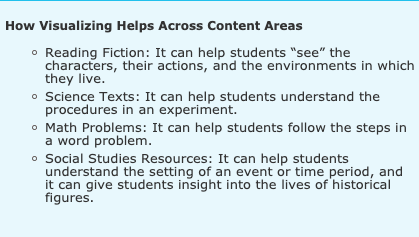
    Did you picture a woman standing outside on a winter’s night watching the snow fall? Or maybe you pictured her taking a step and then slipping on the icy sidewalk as she headed to her car? If so, you were visualizing — a critical reading skill that is necessary to comprehend both informational texts and literature. Within the College and Career Readiness Standards for Reading, visualizing has a role to play in helping students identify key ideas and details and understand craft and structure.

    Proficient readers scan and interpret text, forming a mental image of what is happening. Visualizing while reading adds texture to a scene by adding imagined details that the text may not spell out, and it is an indication of successful text comprehension.

    By incorporating differentiated models, practicing visualization, and supporting your students as they visualize (drawing on principles for Universal Design for Learning), you can help them learn to use all of their senses to engage with and imagine the world of a text, and to bring that world to life as they read. See UDL Editions Visualize Strategy for a student-friendly explanation and rubric for visualizing.

    Technology Tools for Visualizing

    A range of tools (both low-tech and high-tech) can support your students’ ability to visualize. For example, you could encourage students to draw, use dramatizations, and/or create music. Students could use cameras to take photos, or they could search for photos, images, and other graphics. They could create their own videos or watch those produced by others; they could listen to music or use programs to create their own. A variety of software tools and apps are available that stimulate students’ visualizations and support their efforts to draw, diagram, and create images.

    If students are reading digital text, they can access a variety of embedded supports to enhance visualization (e.g., audio explanations, photos, and images), including embedded prompts that encourage students to stop and visualize. All of these tools can help you to differentiate instruction. The video below provides ideas for using supports that are built into text to differentiate instruction.

    Continue reading here: http://www.ldonline.org/article/Visualizing_to_Make_Meaning

  • Crickets, Books, and Bach: Develop a Summer Listening Program

    Crickets, Books, and Bach: Develop a Summer Listening Program

    Summer reading is as much a seasonal pastime as baseball and fireworks. Many parents put together a selection of books that are meaningful, educational, and engaging—books to nourish and stimulate young minds during these few freewheeling months.

    Parents should consider assembling a summer listening list, too. When we think of literacy, we tend to think first of reading and writing. That’s because for centuries, printed text has been the dominant means of recording and sharing information. Yet for most children, listening is really the first entry point into language—the cornerstone of learning and of cognitive development. In an age when kids are regular users of personal multimedia technologies, the importance of learning to listen and listening to learn is as great as ever.

    The importance of learning to listen

    Listening is an engaging way to learn, a primary approach to developing or strengthening reading strategies, and, in some cases, a necessary means to access information and knowledge. Listening media, such as audiobooks and text-to-speech, can be especially helpful to children with learning disabilities, such as those with dyslexia and attention deficit/hyperactivity disorder (ADHD), who struggle with print-based learning, and central auditory processing disorder (CAPD), who may struggle to listen.

    For such students, well-chosen listening experiences can open up new vistas of learning, providing access to information and ideas previously ‘hidden’ in books and supporting the reading process itself. Such opportunities provide a powerful supplement or alternative to a reading program focused around printed text.

    Research has shown that combining reading and listening through the use of audiobooks or text-to-speech programs improves the literacy skills of struggling readers, including those with learning disabilities. Reading comprehension, listening comprehension, phonological awareness and blending, and naming skills have shown to be improved with a combined reading-listening program. Listening while reading helps children learn the patterns of language, the obvious ‘code’ of letters and words on the page, as well as less obvious codes, such as tone, nuance, and implied meaning. Brain imaging technologies show that when we listen, different parts of the brain are engaged than when we read—or even when we merely hear something. Listening can provide whole levels of information that are essential to determining the value and validity of a source. Teaching children to listen to tone of voice not only helps them develop reading skills but can help in the development of their social and conversational skills, too. (For more information, see Plato Revisited: Learning Through Listening in the Digital World by David Rose& Bridget Dalton, published by RFB&D.)

    Continue reading here: http://www.ldonline.org/article/15904/
  • 10 Ways to Help Kids Overcome Math Anxiety

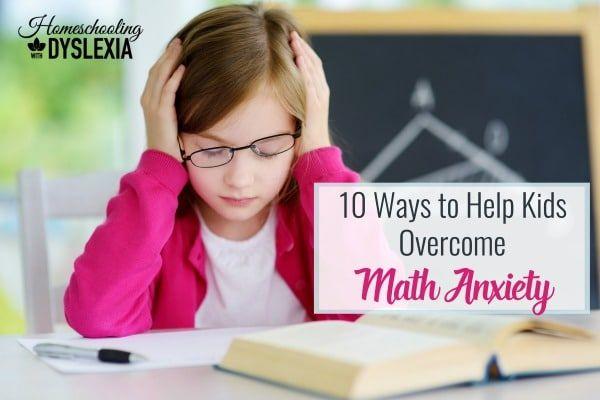
    10 Ways to Help Kids Overcome Math Anxiety

    For kids who struggle with math – the ones who have trouble with math no matter what they try – it is not uncommon to feel anxiety when even simply thinking about math. As the mom of a handful of kids who struggle with math, sometimes called dyscalculia, I have had a ton of practice helping them not only to figure out how to solve math problems but to overcome their unnecessary worrying about math. Whether your child is six or 16, these 10 tips will help them to build their confidence and ability in math class.

    10 Ways to Help Kids With Math Anxiety

    Overcome Math Anxiety

    Normalize their challenges.  I often laughingly refer to myself as my kids’ life coach.  How encouraging is it to a struggling learner to hear that many students have a hard time with math. Research shows that up to 50% of students nationwide are experiencing some degree of math difficulty.  Remind kids that “All kids can learn math, we just need to figure out how you learn best.”

    Continue reading here: https://homeschoolingwithdyslexia.com/help-kids-math-anxiety/

  • Why Dyslexia Is More Than a Reading Disorder

    Why Dyslexia Is More Than a Reading Disorder

    People with dyslexia have difficulty reading letters and words; it’s a learning disability that has nothing to do with their intelligence. Until recently, researchers assumed the challenge could be traced to language difficulties, including problems processing printed words, and they focused their attention on the language parts of the brain.

    But in the latest research published in the journal Neuron, scientists led by John Gabrieli, a professor of brain and cognitive sciences at Massachusetts Institute of Technology, found that dyslexia may be due to a much broader difference in brain function. After analyzing functional MRI brain scans of people with and without dyslexia, they found that those with dyslexia were less adept at something called adaptive learning. When the brain sees something new, whether it’s a word, object, voice or experience, it expends a lot of neural energy to gather as much information about the novel stimulus as possible. But if it does this every time it hears the same voice, or encounters the same dog barking, for example, that wouldn’t be efficient. It’s therefore able to adapt and quickly triage new encounters from familiar ones.

    Gabrieli found that in the brains of dyslexics, this process wasn’t occurring when they heard the same person speak different words. Nor did it occur in other tests of the brain’s plasticity, or ability to adapt. That suggests that the trouble with reading has less to do with language specific problems but rather broader issues with adaptivity. In other words, the issues with adapting to new things may compromise skills like reading.

    Continue reading here: https://time.com/4608060/dyslexia-reading-disorder/

  • Dyscalculia and Brain Activity-The Connection,  by Shradha Kalyani Kabra

    Dyscalculia and Brain Activity-The Connection, by Shradha Kalyani Kabra

    The fear of Mathematics and numbers is called Dyscalculia, which is a learning disability, also termed as number blindness. Extensive studies have recorded that nearly 7% of the population with average intelligence have the problem. The innate number sense of the human brain is not in sync in dyscalculics, as numerical ability relies on special brain networks.

    The theory that separates Dyscalculia from other deficiencies of memory and language is that the approximate number sense gets severely affected. A common symptom that defines the problem is the inability to recognize the place value system. The mathematical ability of people who are unable to grasp the recognition pattern of small numbers is impaired significantly.

    Brain Function In Dyscalculia Sufferers

    The inability to properly estimate and grasp quantifiable figures is the hallmark of Dyscalculia. The disability signifies the inability or impaired ability to recognize small numbers. The brain scans of persons suffering from this issue show that the intraparietal sulci show less activity and are less connected with the greater brain when dealing with numbers.

    Other learning disabilities like dyslexia and aligned problems like ADHD and autism spectrum disorder are also common in dyscalculics.  The treatment becomes a little complex as it is difficult to separate the issues. These comorbidities often make the diagnosis difficult.  The neuronal basis of Dyscalculia is not widely studied due to this phenomenon. Several neuroimaging studies have detailed the representation and processing of numerical information, but no comprehensive and conclusive findings are available. There are many forms of Dyscalculia, and some of them are associated with demonstrated alterations in metabolism, brain structure, and function.

    Image Source: dyscalculiamathdisability.weebly.com

    Developmental Dyscalculia

    Developmental Dyscalculia tends to present as abnormalities in the parietal cortex and involves the cortical and subcortical regions. Recent studies have given clarity on brain activity during number processing as well as calculation. The IPS or intraparietal sulcus is known to be the centre for numerical processing. Research has illustrated that the IPS is activated when mathematical tasks and even simple counting exercises are carried out.

    Memory, perceptual, spatial and motor functions are also involved in the process. Attention is also a key factor. The cognitive processes that are involved in calculation tasks add to the complexity. Developmental Dyscalculia (DD) demonstrates deficits in core brain regions associated with number processing. The brain activation pattern is also not adequate in children afflicted with DD. The gap is bridged with the child resorting to finger counting and memory to compensate.

    The need for remediation measures and education for children with special needs is the need of the hour. There are some steps taken in this direction by experts, but the gap is much more significant than the remedy. Urgent intervention is needed to collate research findings and create practical special education resources to help children suffering from DD.

    Practical Application of Research in Educational Processes for Special Needs

    The first step is to recognize that the child has a problem. Unfortunately, the children suffering from Developmental Dyscalculia are not even diagnosed in time to help them. They are often labelled as slow or below average and are left to fend on their own. The need of the hour is to educate parents and educationists alike about the existence of DD and how it affects the child.

    Academic and emotional negligence often tortures the otherwise intelligent child. They are special and hence need proper guidance and help, more than the other children. They may be subjected to bullying and rampant ignoring in the classroom. Teachers need to be sensitized about the occurrence and issues related to Dyscalculia as they are prone to dismiss the condition as a lack of general intelligence. There are few practical steps that can be taken to ensure that the child finds a way to cope with the problem and even overcome it to a certain extent.

    Continue reading here: https://numberdyslexia.com/dyscalculia-and-brain-activity-the-connection/