
Category: Books

  • Can Print-on-Demand (POD) Publishing Mean More Books for Readers with Dyslexia?

    Can Print-on-Demand (POD) Publishing Mean More Books for Readers with Dyslexia?

    By Theodore J. Cohen, PhD (aka ‘Alyssa Devine’)
    Award-Winning Author of The Hypnotist

    Anyone who’s self-published a book in the last ten years (or more), or who has ordered a book from Amazon, Barnes & Noble, Apple, or Kobo, among other online retailers, is probably familiar with the term print-on-demand, or POD, publishing. Simply put, the book you order isn’t printed until you order it . . . it is ‘printed on (your) demand’.

    That’s a tectonic shift from the way the retail book business used to be run. In the past, when a book was published, whether by a legacy publisher or so-called ‘vanity press’, a fixed number of books was printed and literally put on the shelf (or packed in boxes and stored in warehouses or garages) in hopes they eventually would find buyers. Today, thanks to advancements in printing technology, that’s no longer the case for those of us who publish our own books. (Legacy publishers still print thousands of books for distribution through their retail outlets, and eBooks are a completely different story altogether.) Our books—that is, those usually published by so-called ‘indie’ authors—are available ‘on demand’, thanks to a multitude of POD publishing houses around the US. If you want to see one of these presses in operation—and they truly are a marvel to behold—take a look at this Website:

    So, whether you want to purchase one or a hundred copies of a book available on demand, your order is not printed until it’s received and payment is tendered.

    How can this benefit readers with dyslexia? Well, I’m sure you’ve noticed that there are not many books with interiors specifically designed for readers with dyslexia. In fact, I recently did a search on Goodreads’ Website, and was able to find only a few books, including The New Testament, King James Version, printed in OpenDyslexic.

    https://www.amazon.com/dp/1481290886?tag=legasthenie0c-20

    For more books, check out these two Goodreads groups:

    https://www.goodreads.com/group/show/158134-dyslexia-friendly-publishing

    https://www.goodreads.com/group/show/75371-dyslexics-untie

    The fact is, despite one in five people being dyslexic, most books are not printed for dyslexics, something of which many of you are painfully aware. To some extent, those who labor under this condition compensate for it by adjusting the typeface of the eBook they are reading (perhaps trying such typefaces as Arial, Comic Sans, Verdana, and others), increasing the spacing of the letters and/or the lines, using left-justification only (if that is even an option), changing the color of the letters (e.g., using blue-colored text on a white background or even trying black on a light blue/pink/yellow background), and other ‘tricks’. And when it comes to paperbacks, options are slim to none. Unless someone has gone to great lengths, it’s highly unlikely you’ll encounter special colors for type and paper. Finally, in the case of Kindle readers, there is very little flexibility when it comes to the typefaces that can be displayed, unless you apply a ‘fix’ to your Kindle. (There is a ‘fix’, by the way, that does not require hacking, but few will go to the trouble.)

    So, how do we address the problem?

    Well, a step in the right direction would be to make more POD books available in formats that are ‘dyslexic friendly’, something I recently attempted using the interior of my Young Adult (YA) novel, The Hypnotist. I published this book earlier this year in Kindle and paperback formats under the pen name ‘Alyssa Devine’.

    Know, first, I am not dyslexic. But I came to appreciate the problems readers with dyslexia face not long ago when I read about the work of UK graphic designer Daniel Britton. Britton created a typeface that is intended to recreate for non-dyslexic readers the frustration and embarrassment people with dyslexia experience when they attempt to read newspapers, books, and other literature that most people are able to read every day of their lives. An example of simple text rendered in this typeface is shown below:
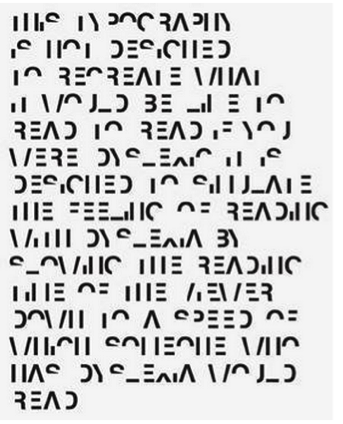
    Typeface Britton
    Typeface Britton

    It’s not easy to read, is it?! You can read more about Britton and his work at the following site:

    http://danielbritton.info/195836/2165784/design/dyslexia

    His work also was discussed recently in this article on CNN:

    http://www.cnn.com/2015/06/17/living/dyslexia-graphic-design-typeface-daniel-britton/index.html

    It was Britton’s work that inspired me to move forward with the creation of a special edition of The Hypnotist for readers with dyslexia.

    The first thing I had to do was select the font I was going to use. Without boring you with the details, I’ll refer the interested reader, as my professors used to say, to the following blog I wrote, which should answer most of your questions (and then some):

    https://www.goodreads.com/author/show/3251724.Theodore_Jerome_Cohen/blog

    Suffice it to say, I selected OpenDyslexicAlta as my typeface of choice (the same one used in the version of The New Testament cited above). Frankly, the idea of using a typeface specifically designed for people with dyslexia appealed to me, and if it were to be free (‘open source’), so much the better. The Open Dyslexic typefaces fit the bill, here. Bottom heavy, with unique character shapes, help make it more difficult for the reader to confuse letters. You can read more here:

    http://opendyslexic.org/

    Once the font was selected, I quickly eliminated the text’s right justification, which I learned could confuse dyslexics, substituted OpenDyslexicAlta for the regular text’s Georgia typeface, adjusted the font size, and voila, that was it. Total elapsed time: about two hours.
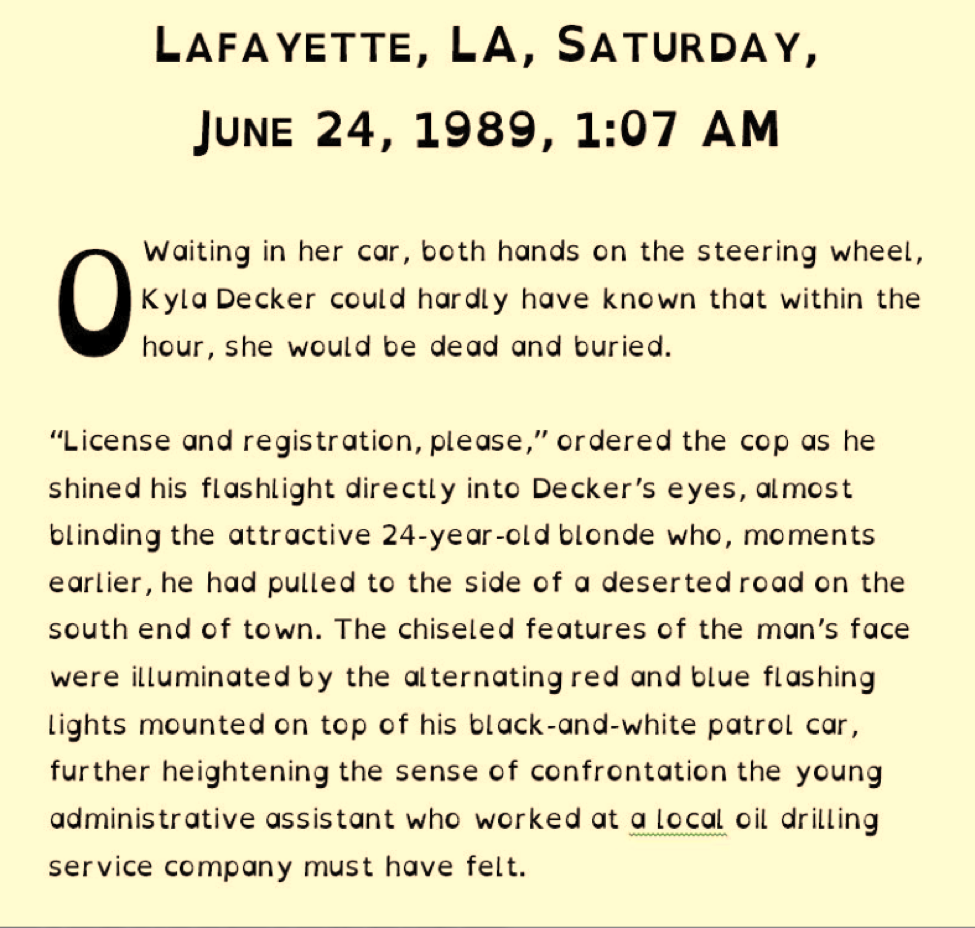
    OpenDyslexicAlta
    OpenDyslexicAlta

    Now it was just a matter of obtaining a new piece of royalty-free artwork and configuring a special front cover (another two hours), and it was completed…the new edition was ready for uploading to Amazon’s CreateSpace for approval.

    By the way, I felt it only right to include the following statement on the book’s Amazon.com Web page:

    “This special edition of The Hypnotist is printed using OpenDyslexicAlta developed by Abelardo (Abbie) Gonzale: “Your brain can sometimes do funny things to letters. OpenDyslexicAlta tries to help prevent some of these things from happening. Letters have heavy weighted bottoms to add a kind of ‘gravity’ to each letter, helping to keep your brain from rotating them around in ways that can make them look like other letters. Consistently weighted bottoms can also help reinforce the line of text. The unique shapes of each letter can help prevent flipping and swapping.” You can get a good idea what the print looks like by using the LookInside feature on this Web page. Will the use of OpenDyslexicAlta help everyone with dyslexia? No. Because the expression of dyslexia in an individual is as unique as the individual him- or herself, no guarantee can be made that the use of OpenDyslexicAlta will help any given person with readability. This special edition of The Hypnotist, however, is intended, at the least, to provide an option to those readers with dyslexia who might be helped when reading books printed using the OpenDyslexicAlta typeface.”

    You’ll find the special edition of The Hypnotist for dyslexics here:

    https://www.amazon.com/dp/1514789337?tag=legasthenie0c-20

    [NB: the LookInside feature may or may not be active when you read this; it often takes several days before the feature comes ‘live’.]

    Importantly, CreateSpace’s editors approved the book within 12 hours of submittal (actually, overnight), so theoretically, what was conceived as a project over dinner with my wife and editor, Susan, could have resulted in the book being available for sale on Amazon.com the next morning. That I waited until I was able to review a proof copy of the paperback edition three days later is simply good practice. (CreateSpace also gave me the option of reviewing the interior and cover online, but you never know what the final product will look like until you hold it in your hand.)

    So, to my question: Can print-on-demand publishing mean more books for readers with dyslexia? It can…if…IF…POD publishers, especially indie authors/publishers, take the time to create special editions for the 20% of the population that would benefit from access to books tailored to their needs.

    Theodore J. Cohen, PhD
    Theodore J. Cohen, PhD

    Editor’s note: The author welcomes your comments and feedback; you may reach him by e-mail through either of his Websites:


    http://www.theodore-cohen-novels.com/bio-contact.html

    http://alyssadevinenovels.com/contact.html

  • Definition and Deflection and Dyslexia by Chris Stanton

    Definition and Deflection and Dyslexia by Chris Stanton

    What does being a dyslexic mean to someone learning he is one at age 42? Very little, and I am speaking with the exclusive authority of being me. What does it mean to a lad having so much trouble learning to read that a private school kicked him out, but then a public school teacher provided him with patient attention? Life-changing good! In this case, I am speaking of my younger brother, a wide-ranging, avid reader, with an unconventional problem-solving mind.

    I became a dyslexic at the age of 42, the result of running into my senior year high school English teacher. She was an exceptional teacher. In the course of our conversation, she told me that I was the most dyslexic student she ever had. I asked why hadn’t she told me? Obviously, she understood I was asking why hadn’t she helped me? She said she’d told my parents at a teacher conference, “and that didn’t go well.” She figured smart, affable me would acquire a secretary and I would be fine.

    I had been married three years when my wife announced, as revelation, “You know all those (Odd? Crazy? Funny? Sad?) stories you’ve told – they are true!” I’m still married, so I cannot divulge how downhill that conversation went. My teacher encounter ten years later was no revelation to my wife; she had been telling me I was dyslexic forever.

    Shortly after I had the teacher encounter, my wife and I picked up my older brother at the airport. We stopped for lunch. In the course of our what’s-going-on-in-our-lives conversation, I told the story of learning I am dyslexic. That factoid revision was angrily scoffed at by older brother. No good comes (later in life) from opening the dyslexic closet.

    I think my brother assumed dyslexia was synonymous with illiteracy. I think he also took it as criticism, since I had asked him and others for help when I was a kid, and was blown off. They had their lives; I wasn’t their job. I am a middle child; what can I tell ya.

    So how does a kid go from being the dumbest kid in class in grades 2 through 7, and graduate from a good university? Seventh grade in public school was brutal, too, but there I had friends. I knew in 7th grade that the school was seriously considering holding me back, but I tested way above their expectations on a battery of tests.

    The best class I ever had was University Freshman English. The teacher, a middle-aged woman, announced, “All writing assignments will be about a subject of your choosing. If you lack a fascination, you will neither be a good writer nor a good thinker.” She was an enthusiastic delight, visiting each student asking the same question, “What are you trying to say?”

    I have written an Apple iBook, “Renvyle Revisited, an Irish Odyssey,” that neatly provides text and audio together. It also can be had at Amazon on Kindle and Audible.

    A central theme of the book is story telling. The stories are not respectful of authority and ideologies – or what might be described as conventions. The book is a celebration of a youth finding his way from where he came.

    If you know a dyslexic, have them read the blog stories and then hopefully the book.

    Renvyle Revisited an Irish Odyssey

    By Chris Stanton

    Please subscribe to my blog – it’s free: https://irishodyssey.wordpress.com
    Scroll down to the earliest blog entries; they concern dyslexia.

    Chris Stanton
  • If the Walls Could Speak By Deirdre M. Silvestri

    If the Walls Could Speak By Deirdre M. Silvestri

    It’s a beautiful, clear spring day, and soon the cherry blossoms will fall from the trees and blanket the ground like snow. This season promises to be extraordinary, but it won’t be the same without Da, who passed away at Christmastime. Finn O’Brine stares out the window, taking it all in. He can’t believe his father will never spend time with him again. And he can’t believe there’s a bat at his window—talking to him.

    Before his death, Mr. O’Brine told Finn many stories about colossal dragons, sorcery, and the magic of Wickum Mannor in Ireland—but they couldn’t possibly be real, right? Wrong! Magic runs in the O’Brine family; it’s part of their heritage.

    Now thirteen, Finn will begin to show signs of his magical inheritance any day now. It’s time for Finn, his twin sister, Neave, his younger brother, Jack, and his mother, Ailish, to leave the comfort of their home in America and journey to Wickum Manor themselves. They expect a summer-long adventure, but the O’Brine children may not be as ready as they think. With all the fantastic things to experience and discover on the four-hundred-acre estate, will Finn want to enroll at the magical Wickum Academy, or will he choose to return to his friends and classes in America at summer’s end?

    Deirdre M. Silvestri, author of children’s and YA books, was born in Sarsfield Barracks, Limerick City, Ireland. Because of dyslexia, her lifelong dream of becoming an author seemed dim. However, as her children grew, Silvestri often told them they could do anything. If the Walls Could Speak is Silvestri’s first book, the first installment of the realization of her dream.

    Get your copy on Amazon: If the Walls Could Speak By Deirdre M. Silvestri

  • Inspirational Book ‘Dyslexia: TIME FOR TALENT’ Wins Honorable Mention Award

    Inspirational Book ‘Dyslexia: TIME FOR TALENT’ Wins Honorable Mention Award

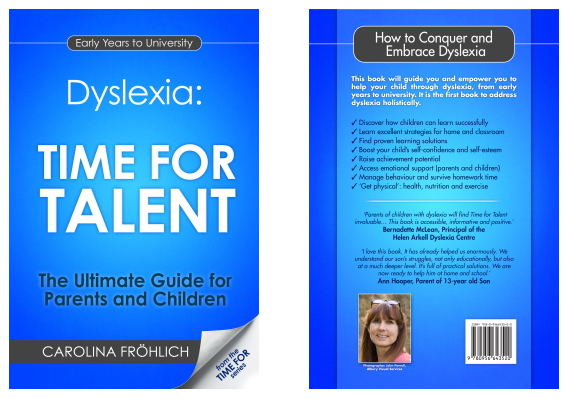
    An inspirational book about empowering children and adults to deal with dyslexia has been hailed with numerous accolades since its launch earlier this year – and it’s now been awarded an Honorable Mention in the Readers’ Favorite International Book Awards 2014. Dyslexia: Time For Talent (The Ultimate Guide for Parents and Children) received glowing reviews and excellent endorsements from education and publishing experts when it was released, and has now cemented its status as one of the premier books on youth dyslexia currently on the market with the highly coveted award.

    Debut author Carolina Fröhlich, who wrote the book after many years working as an educational consultant, is thrilled that her helpful and moving guide has been received so well by readers and critics alike. After suffering from dyslexia herself throughout her life, Fröhlich has dedicated much of her career to helping parents and children deal with the difficult ‘condition’, and is now reaping the rewards of her commitment.

    Fröhlich says, “I’m over the moon to have received an Honorable Mention at the Reader’s Favorite Book Awards – hearing that critics and readers have been moved and affected by my book is the biggest prize of all. The book was originally intended to empower children and parents suffering as a result of dyslexia in the family, and to hear that it’s now winning awards after the fantastic reviews it initially received is wonderful.”

    She adds, “My own experiences with dyslexia moved me to write the book, and it’s a real thrill to hear that my work in the field is being recognized by experts as well as by those who are confronting the challenging ‘condition’ head-on.”

    The book set itself immediately apart from the crowd by helping readers to emphasize the talent of a child, rather than focusing on any shortcomings or perceived failures that occur as a result of their dyslexia. Rather than viewing dyslexia as something which needs to be cured, Dyslexia: Time For Talent encourages everyone to see it as a different way of learning. The book promotes positive attitudes in children, parents and teachers, and is equal parts informative and encouraging in the fight to overcome the challenges that having dyslexia presents for millions across the world.

    The book also goes above and beyond the level set by many similar books, by emphasizing that dyslexia doesn’t stop at pre-school or infant level. With advice on how to handle the condition in later years, even stretching as far as career advice and learning to drive, the book has been rightly hailed as one of the most comprehensive and essential books on the condition.

    Time for Talent by Crolina Fröhlich

    For more information about Carolina Fröhlich and to buy her celebrated dyslexia book, visit the book’s Amazon listing.

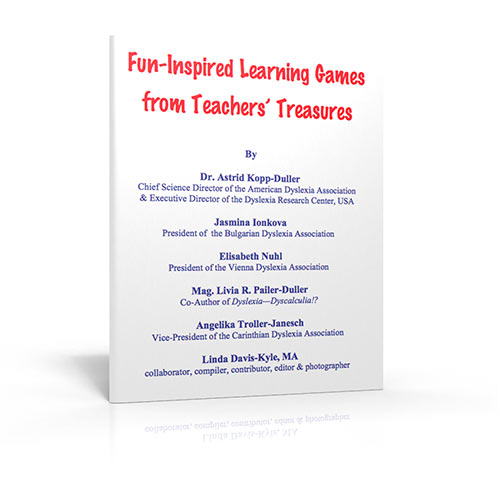
  • Fun-Inspired Learning Games from Teachers’ Treasures

    Fun-Inspired Learning Games from Teachers’ Treasures

    Tyron Edwards said, “To waken interest and kindle enthusiasm is the sure way to teach easily and successfully.”
    Educators around the world have found that incorporating fun learning games into their lesson plans not only wakes interest when a class of new students meets for the first time, but also for a group already familiar with each other. Both time-tested games, such as dominoes, new ones that are created somewhere each day, and spur-of-the-moment games that pop into the minds of seasoned teachers—just when they need them—have a way of grabbing and holding attention, strengthening concentration, and stirring emotion among the players. Plato said, “All learning has an emotional base.” If the games are intriguing enough to invite and rivet attention, boost concentration, and create a healthy passion for participation, the likelihood of retaining the information presented is high.

    It is no secret that young learners who can relax can pay attention and maintain concentration on any task at hand with greater ease than those who may feel nervous or anxious. In addition, whatever is learned in a more relaxed state enhances retention of the information. In turn, remembering what has been learned fosters self-esteem, which furthers motivation. So, at the heart and soul of many learning philosophies, instructing strategies, and teaching systems, relaxation is held in high regard.

    Combining a Passion for Participation with Relaxation
    It seems that one wonderful combination to help children learn is by teaming a passion for participation with relaxation. The handful of multi-sensory games shared here are favorites from Austria, Bulgaria, and the United States that invite participation and foster relaxation. Even further, the activities are organized incrementally to support confident learning.


  • Apple iBook: Dyslexia – Dyscalculia !?

    Apple iBook: Dyslexia – Dyscalculia !?

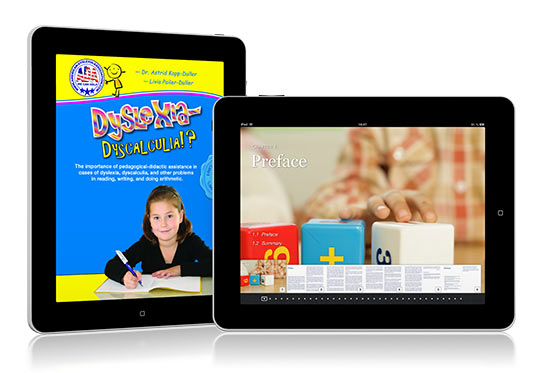
    An interactive iBook for the iPad shows solutions for persons with dyslexia and dyscalculia. It is on sale for only $1.99 .

    In this inspiring publication Dr. Astrid Kopp-Duller and Livia R. Pailer-Duller show again that they are experts on the subject of dyslexia and dyscalculia. With incredible insight they show the necessity of helping people with dyslexia and dyscalculia on an educational-didactic level. This is of preeminent importance for success when helping people who have difficulties with reading, writing, or calculating.

    dyslexia dyscalculia

    More information: http://www.dyslexia-dyscalculia.com

    The iBook is available in the iTunes Store USA.


  • There is hope for dyslexic and dyscalculic people!

    There is hope for dyslexic and dyscalculic people!

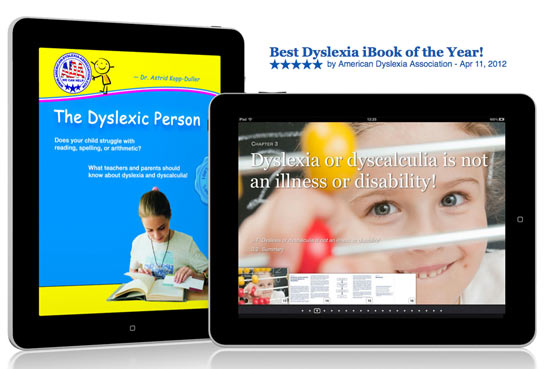
    An interactive Apple iBook for the iPad shows solutions for dyslexic persons. It is on sale for only $1.99.

    In this inspiring publication, Dr. Astrid Kopp-Duller and Livia R. Pailer-Duller perpetuate their title as the authority on the subject as they delineate the necessity of intervention with incredible insight at the educational-didactic level. Which is of preeminent importance for success in the training of those who have difficulties with reading, writing, or calculating.

    Interactive Apple Ibook - The Dyslexic Person

    http://www.the-dyslexic.com

    iTunes Store USA


  • “Ready, Set, Action!”

    “Ready, Set, Action!”


    An Entertainment Fun Book for Parents of Dyslexic Pre-teens
    David Carlson
    Linda Davis-Kyle, Editor

    Foreword by Dr. Astrid Kopp-Duller, President of the Austrian Dyslexia Association

    “Ready, Set, Action! is destined to become not only a loyal friend to the parents of preteens challenged with dyslexia, but also, that it will be a boon to their young learners. This fun book is brimming with an abundance of writing and performing exercises that reveal the world as an exciting learning laboratory.

    (more…)