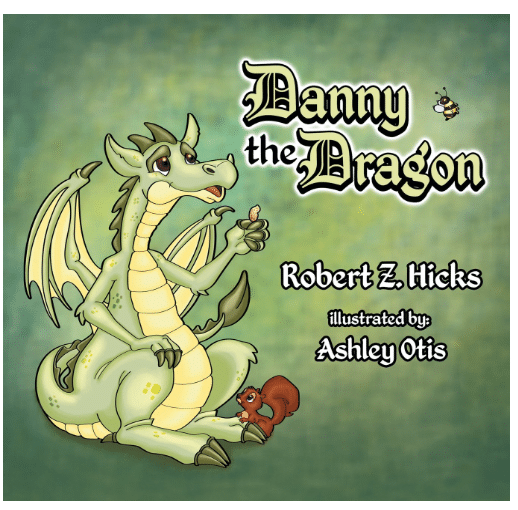
My children’s rhyming story picture book, Danny the Dragon, was at the Page Design department of my publisher when I picked up the Winter Bulletin of the Society of Children’s Book Writers and Illustrators. (SCBWI) An article by Dr. Theodore Cohen, PhD, “Are Authors Giving Up On 20% of Their Readers?” caught my attention.
Dr. Cohen discussed things that helped children with language-based learning disabilities, especially those with dyslexia.
Some of the things that Dr. Cohen mentioned, like a font that keeps space between letters (sans serif) spacing out lines of text, and enlarging the text, I had already implemented in my previous books. These readability elements help any child, not just those struggling to read. Prompted by his article, I informed our publisher we wanted Arial font, which is sans serif, and no right justification which can create irregular spacing between words.
An email to the American Dyslexia Association asking for suggestions for making my book “dyslexic friendly” resulted in a response confirming our choice of font, and giving a suggestion to avoid “noise” behind letters, such as text over artwork. I was pleased that the American Dyslexia Association offered to look at my books.
I was delighted to receive a message from American Dyslexia Association with the information that they had “tested” my books on school children, especially one girl said “she was delighted.” In fact, the girl asked for two of the books to be read again! My books, especially Danny the Dragon, are now approved by the American Dyslexia Association.
A serendipity occurred when I went online to see what Open Dyslexic font looked like. I found an article by dyslexia expert Dr. Guinevere Eden, a professor at Georgetown University and director of its Center for the Study of Learning. In the context of discussing the lack of research validating “dyslexic friendly” fonts, Dr. Eden stated: “The fundamental problem of dyslexia is in mapping the shapes of letters to the right sound units or phonemes.”
The ”right sound units or phonemes” jumped out at me, because I had already learned that rhyming helps children make the connection for phonemic awareness! And, my books are stories in rhyme!
Another search of rhyming and dyslexia uncovered research by Usha Goswami, Professor of Cognitive Developmental Neuroscience at Cambridge. Dr. Goswami asserts: “Children who are dyslexic struggle with speech rhythm.” She suggests that children can overcome dyslexia by learning nursery rhymes, dancing, and singing, because the condition is caused by a lack of rhythm patterns in the brain.
Rhyming with rhythm is what I do!
Danny the Dragon is a rhyming story picture book with a rhythmic beat!
Robert Z Hicks, known as “Mr. Bob” is an award-winning author and publisher of children’s rhyming picture books.
Coming from a career of teaching college, how did you get started writing children’s books? Had you always dreamed of someday writing children’s books?
No, it never occurred to me to write children’s books. I thought I was retired after teaching speech communication for 24 years at the University of Hawaii. But, after watching my wife Betty chase a green tree toad around the living room trying to capture it under a paper cup, I started reminiscing about critters I enjoyed as a child growing up on my grandfather’s farm in Michigan in the 40’s. I felt inspired to write a rhyming poem based on my memories.
A friend encouraged me to write more stories, and there followed a flood of inspiration of rhyming stories triggered by memories of my childhood experiences.
How many stories did you write?
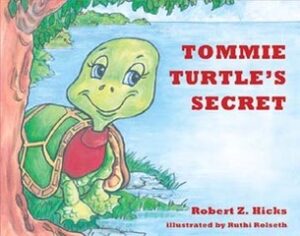
About 40. We took manuscripts of Tommie Turtle’s Secret, Mouse in the Manger, and several other stories to the Florida Christian Writers’ Conference in 2005 to find out what writing and publishing books entailed. Surprised and encouraged that the stories won Best Submission for Children’s Writing, we decided to publish my first book, “Tommie Turtle’s Secret”.
What makes your books different from other children’s books out there?
The stories are written in rhyme, and each stanza is accompanied by an illustration that helps the child visualize the story and what the words are saying.
As a teacher, I add value to my books by including a study guide with questions to test comprehension, and comments to highlight things to be learned.
I discovered research that early learning of rhymes increases phonemic awareness and improves the ability to read. Reading nursery rhymes and rhyming stories to babies and young children helps establish the ear-brain connection for discriminating sound units.
I asked Crystal Bowman, my mentor, friend, mother, and successful children’s author, what she thought of rhyme, which she uses in her books.
Crystal Bowman’s perspective on rhythm, rhyme, and reading:
“I know that babies are born with a strong sense of rhythm. They respond to rocking, repetition, and music. They naturally clap their hands and move to music and rhythm.
Text written with repetition and rhyme is a help to a struggling reader because the repetition helps them learn new words, and the rhyme helps them with pronunciation. (they know what the word needs to sound like).”
I was excited to learn that rhyming helps children read more effectively. It gave purpose and direction for the inspiration of the stories God gave me, and for my gift for rhyme. I wasn’t looking for another career, but I am delighted to have a new purpose and cause to pursue in my life.
What is Tommie Turtle’s secret?
Tommie’s secret is the story of the day he raced Speedy Hoppy Bunny to teach the bunny valuable lessons about friendship. A surprise twist at the end highlights moral values of forgiveness, and that being nice, not bragging and teasing, is the way to make friends.
Questions and commentary at the end of the book test comprehension, stimulate critical thinking, and provide a basis for discussion of the effect of bragging and teasing on relationships. Parents can also point out that by focusing on the abilities Tommie had, not on what he couldn’t do, Tommie could still enter the race.
“Tommie Turtle’s Secret,” won Best Children’s, and Book of the Year in the 2008 Florida Writer’s Royal Palm Awards competition.
How many books have you published?
I’ve published three picture books, “Tommie Turtle’s Secret,” “Mouse In the Manger,” and “Danny the Dragon,” and an ebook, “Once I Was A Kid, With the Wild Things On The Farm”.
Are you going to publish more children’s books?
Absolutely! My heart’s desire is to use my gift of rhyme to help children learn to read and to develop a love for reading!
Michele Clark McConnochie is not dyslexic, nor does she have a loved one who is dyslexic. What she is is a teacher and children’s author who passionately believes that all young people are entitled to books with stories that they love and characters that they can identify with.
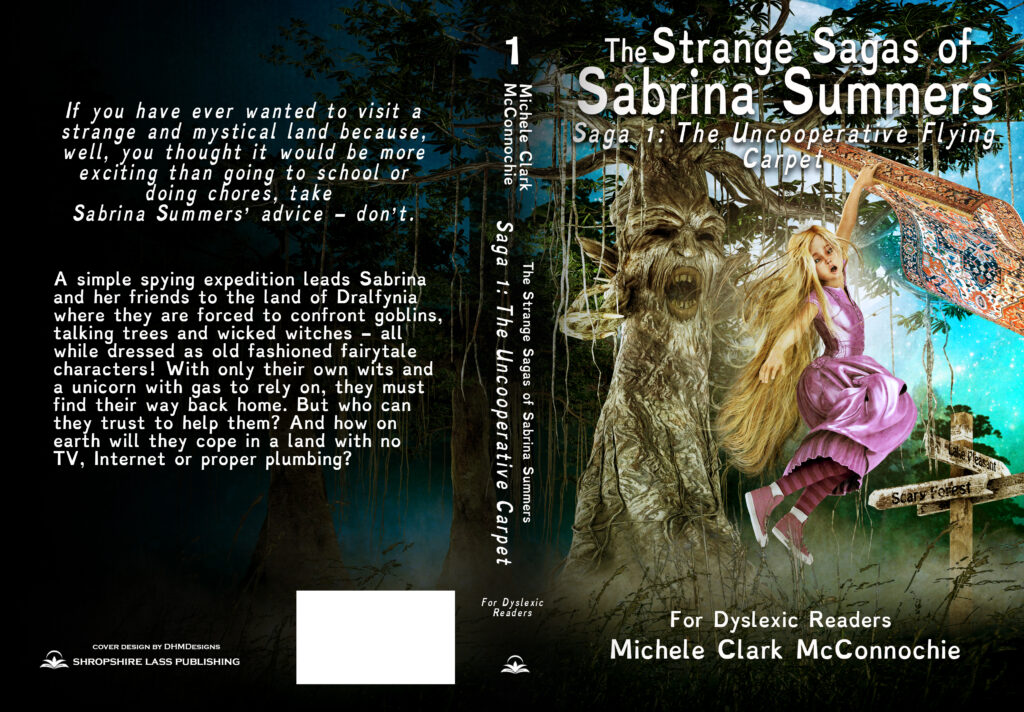
Growing up in Europe, she was a bookworm who dreamed of becoming a writer. After a career in education, she finally achieved that dream, and her first middle-grade children’s novel—The Uncooperative Flying Carpet—is scheduled for publication in August 2018 by Morgan James Publishing. However, Michele wanted to make her book available to all readers, including those who are dyslexic. She realized that there would need to be a version especially for dyslexic children. With the permission of Morgan James, Michele has arranged for The Uncooperative Flying Carpet to be available on Amazon.com in a special dyslexia-friendly version.
These versions are printed in dyslexie font, a special font created in the Netherlands, which is designed to make reading easier for the dyslexic brain. They also have cream, rather than glaring white paper, and a ragged right-hand margin. The feedback from readers has been really positive, with dyslexic children saying they found these versions much easier to read.
From the get-go, The Uncooperative Flying Carpet was written for avid and reluctant readers alike. Each chapter is short, suitable for those who find reading taxing, but most end with a cliff-hanger to encourage the child to read ‘one more chapter.’ There is plenty of humor and a fast pace to keep readers engaged; the feisty central character is Sabrina Summers, a leader who is a great role model for girls, and her brother Rory is a dyslexic boy who goes on to prove that the creative way of thinking that he credits to his dyslexic brain can save the day.
One dollar of every copy of The Uncooperative Flying Carpet for Dyslexic Readers sold will be donated by Michele to the American Dyslexia Association, Inc.
I DON’T KNOW of any industry that purposely would give up 20% of its potential markets without a fight. Yet, mistakes we make in the selection of typefaces, formats, and backgrounds can indeed have that effect.
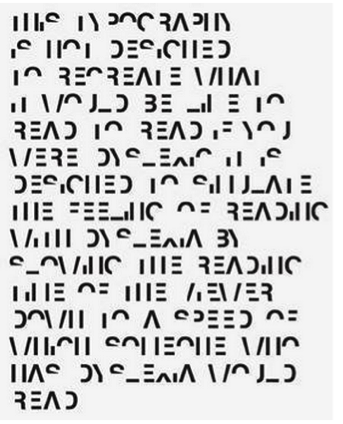
What I am speaking of is the fact that one in five students, or 15-20% of the population, has a language-based learning disability, with dyslexia being the most common of the language-based learning disabilities. Importantly, approximately the same percentage of males and females have dyslexia. For clarity, kids with dyslexia have trouble reading accurately and fluently. They may also have trouble with reading comprehension, spelling, and writing (see goo.gl/dAFaeP). Not being dyslexic myself, I sought insight into the problem from someone who was: UK graphic designer Daniel Britton. What he revealed was startling. What Britton did was to design a typeface intended to recreate for non-dyslexic readers the frustration and embarrassment people with dyslexia experience when they attempt to read newspapers, books, and other literature most people are able to read every day of their lives (http://danielbritton.info/dyslexia). An example of simple text rendered in this typeface is shown below:
Typeface Britton
Not a pretty picture, is it?! Were you able to decipher it?
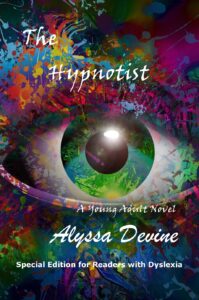
Take heart. The situation is not hopeless. It was Britton’s work that inspired me to move forward with the creation of a special edition of my YA novel, The Hypnotist, for readers with dyslexia. Here, I completely reformatted the text using the free, OpenDyslexicAlta typeface (http://opendyslexic.org/). Bottom heavy, with unique character shapes, the OpenDyslexicAlta typeface helped make it more difficult for the reader to confuse letters. I also eliminated the text’s right justification, which confuses dyslexics. The final text was sufficiently “dyslexic friendly” as to win the endorsement of the American Dyslexic Association and the Wisconsin Institute of Learning Disabilities/Dyslexia (WILDD).
Admittedly, changing the typeface for your paperback book to meet a subset of your potential readership is a time-consuming effort, and there is no guarantee the return on investment will prove worthwhile. (NB An Open Dyslexic typeface is available on all Kindle readers; check availability on other eReaders you are considering.) But there are other things you can be doing as you prepare your books, including your eBooks, for publication that will help those suffering from language-based learning disabilities.
I’ve already mentioned dropping right-justification in your text. This will help the reader maintain line-to-line continuity.
Use a sans serif typeface (e.g., Arial, Comic Sans, Verdana, and others). For my series of illustrated children’s storybooks in verse, I use Segoe Print.
Increase the spacing of the letters and/or the lines over that normally used.
If you are embedding text within your images/graphics, as many do in children’s storybooks today, especially for eReader presentation, be careful to ensure the text is not masked or “entangled” in the artwork.
Be careful about changing letter colors or font sizes within the same sentence . . . it can be confusing.
Finally, as for students with dyslexia who use eReaders, have them experiment with typefaces as well as with letter and background colors (e.g., try using blue-colored text on a white background or even black text on a light blue/pink/yellow background). You and they may be pleasantly surprised with the results.
The items cited above are things we, as authors, can do to help students suffering from language-based learning disabilities. Best of all, many are easy to implement.
Theodore Jerome Cohen, PhD, authored and illustrated the children’s series Stories for the Early Years. He also writes YA novels under the pen name Alyssa Devine. You can visit him at www.theodore-cohen-novels.com or www.alyssadevinenovels.com. Member, SCBWI.
This article originally appeared in the Winter, 2018, edition of BULLETIN, the journal of the Society of Children’s Book Writers & Illustrators (SCBWI). Reprinted by permission of the author.
On behalf of 3 Paws Up, It is my honor to share our story with the readers of the American Dyslexia Association:
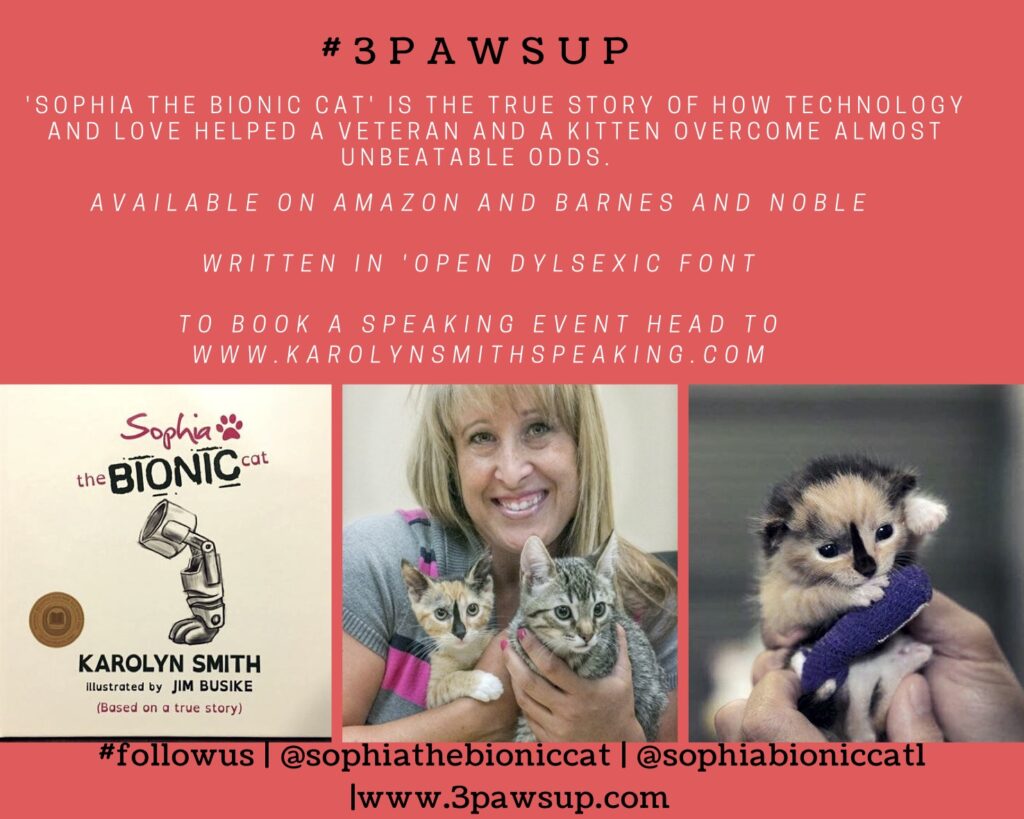
My name is Karolyn Smith, I am the 2014 Veterans of the Year for the 71st District of California, Author of ‘Sophia the Bionic Cat’, Public Speaker and 3D inventor.
I was born and raised in San Diego and am the daughter of a Vietnam Veteran and the granddaughter of two WWII Veterans. For the longest time as a youth, I found my calling as a velodrome cyclist and went to my first Olympic Trials at 19, but failed to make the team. A year later, I would be invited to move down to Australia, where I would be the only woman racing on behalf of the USA. That year abroad at such a young age gave me a lifetime of experience that would help me out later in life.
Shortly after the horrific events unfolded on September 11, 2001, I would hang up my bicycle and, at the tender age of 29, enlist in the United States Army as a Military Police Officer. As I found myself the oldest enlistee in basic training, I also found myself the most advanced, which allowed me to experience leadership responsibilities and advanced training that my peers didn’t experience. I would graduate top of my class and 18 weeks later be stationed in Hauau, Germany with the most historic Military Police unit in the Army, the 18th MP Brigade. Six months later, I would deploy.
In April of 2004, with the 127th Military Police Company (709th MP Bat, 18th MP Brigade), I deployed in Support of Operation Iraqi Freedom, and would break the first of many glass ceilings in my life; I was a crew serve machine gunner. After 13 roadside bombs, mortar attacks, and sniper attacks that took the life of my Team Leader….we suffered, I suffered. When we came home a year later…We had lost two.
I came home with injuries, PTS(d), spinal injuries, and a mild traumatic brain injury that were left untreated by the VA system because they were not used to a woman who had been in combat. After 11 years of suffering, my life was saved by a private non-profit called Operation MEND UCLA, which provided advanced medical care, including a bio-tech spinal fusion, which is creating my own genetic bone back into my spine. Once that searing pain was gone, a little kitten by the name of Sophia waddled, skipped, and hopped into my life…with her best friend in tow.
Sophia was an 8-day-old premature kitten found abandoned in a field here in San Diego. She was found with her umbilical cord wrapped around her paw and with no mother, food, or shelter found around her. Sophia was taken to the San Diego Humane Society, where an amputation was performed of her right rear paw, but because she was born premature and it was evident she never received the vital mother’s milk, the amputation was proving too much, and she was not recovering from the surgery. On that same day, a young male kitten was brought into the shelter as part of a litter. This young male was pulled out of his litter and placed with Sophia because the Nursery Advisory saw something in him that was unique and thought he might be able to help encourage little Sophia; he was then placed in her enclosure, and something magical happened.
Leonidas snuggled up to Sophia and never left her side for nearly a week. He could often be found cleaning her ear of her amputated side, but not her ear of her un-amputated side. Within a week, Sophia began to lift her head…and then she began to eat…then she began to crawl….Soon, they would both be put up for adoption as a bonded pair.
As I was recovering from my surgery, I saw a Facebook post from the San Diego Humane Society, and there were these two faces- two little fluffy, furry faces cuddling each other, and then I read the story and cried. I cried because Sophia’s story was my story; just replace the name, and I was drawn to her. I called the Humane Society and asked about adopting her, and they said I would need to adopt both, and I was hooked- who would break up a sweetheart couple anyway! When I walked into the Humane Society, they knew who I was by that time, as I had already been selected as the 2014 Veteran of the Year for the 71st District of California. They created the byline “Disabled Veteran adopts disabled Kitten,” and in partnership with the Humane Society and Fresh Step cat litter, we would create our first PSA commercial: https://www.youtube.com/watch?v=eY2F1vUju3c
As my twelve-year career in high-threat risk mitigation (in and out of the military) would teach me, I knew that Sophia’s good leg would, at some point, have to fail. While my degrees were not in engineering, they were in Homeland Security and Risk Mitigation. What I did know is that if you use what you do know, and not focus on what you don’t know, you can apply skills and help solve any issues that come your way. I started researching companies that created prosthetics for animals and was amazed that no one had created a prosthetic for cats. So in partnership with Fablab San Diego, I created the first ever 3D printed Prototype prosthetic for cats, and started with little Sophia! The first one in history!
Every time I went to the lab, there would be kids asking about the story, which gave me the idea of writing a children’s book, as I don’t have kids of my own; my injuries prevented that gift for me. So I created “Sophia the Bionic Cat” https://www.amazon.com/dp/1684193451?tag=legasthenie0c-20 which is now also available on Barnes and Noble (online and in stores!). This book is based on the true story of how this journey of mine, Sophia, and Leonidas unfolded in a way that we hope inspires children, but we took one more step. We found a person who created the “open-dyslexic” font, and our book, to this point, is the only true story children’s book that is written in this font. I chose this method of font because when I get tired, I noticed that when I am reading, my brain injury can often act like it’s dyslexic, which can be a result of a traumatic brain injury, and that is what I deal with. I wanted my book to show a range of topics, but in a way that lends power to the topic instead of powerless feelings about the topic. So, while reading the book, if the reader has dyslexia, they will read the book the way I wrote it; if they don’t, they won’t notice anything other than a true story about how technology and love help overcome.
From our book, we created 3 Paws Up, an approved 501(c)3 here in San Diego that will have ‘Ambassadors’ hand deliver our book (and other inspirational true stories that we help other Veterans create) to children in critical care hospitals, nationwide.
I’m writing the second book in Sophia’s series as we have just partnered with the Colorado School of Mines, the number 2 school of engineering in the US as we continue to enhance Sophia’s prototype so other animals around the nation can also have a better life through what we discover. I spend my time now as a public speaker telling my story, and I am honored to be able to stand on stages around the nation and share my life, it’s a way for me to heal and a way to open the minds of those who would never consider using the ‘open-dyslexic’ font in their projects, but now we get to talk not just about me, but about all of you, and I’m honored to be able to help do that. I can’t begin to express my truest thanks to the American Dyslexia Association for accepting our project, ‘Sophia the Bionic Cat’ as worthy of the ADA’s seal of approval. It’s through innovative projects and collaborative partnerships that we can create dialogue that can bring the best solutions.
Tobias Stone was diagnosed with Dyslexia when he was 18, having failed to get into university. Thanks to his diagnosis, he was able to complete a Bachelor’s Degree and a Master’s Degree at two of the world’s top universities. He is currently completing his PhD, after a total of 13 years at university on and off, and is now a professional writer. His teachers were wrong when they said he couldn’t go to university. His message to other dyslexics: Dyslexia does NOT mean you are stupid, just that you find some things harder than other people. But you can also do different things better than other people. Never give up!
Here is an excerpt of his motivational article on Medium.
I once saw a t-shirt that said ‘Daily sex, can you help?’ Then ‘daily sex’ was crossed out in pen and corrected as ‘dyslexia.’ I liked that. I was 19 at the time.
At 18, after failing to get into university, and having dragged myself, with great pain and anguish, through my exams at school, I found myself in an enforced year off. Ostensibly, I was re-sitting some of the exams I had failed so I could reapply to university, but that was about as pleasant as regurgitating the same meal, and re-eating it, day after day. In the middle of all this, I went to see an educational psychologist. The worry was that I was bright yet underachieving, and there were massive inconsistencies in my abilities. Even in the IQ test they gave me, there were inconsistencies. The IQ test is a series of little tests added together to reach your average score. In one test, I got the highest score the examiner had ever seen, and yet I was unable to answer two of the questions at all. Clearly, something was wrong when I was getting between 0% and 100% on different questions, rather than an average of similar scores.
So they gave me a dyslexia test, and it turned out I was ‘considerably’ dyslexic (around 7 on a scale of 1–10), and unfortunately for me, I was a bit more clever than I was dyslexic, so I had been able to compensate for the dyslexia fast enough that it had not become obvious to my teachers…
How to Motivate Students to Write for a Cause: Getting Non-dyslexic & Dyslexic Teens to Write about Health & More
Loving to write as she does and knowing that helping students polish their writing skills boosts their confidence, Davis-Kyle, author of the Kindle book, How to Motivate Students to Write for a Cause: Getting Non-dyslexic & Dyslexic Students to Write about Health & More, is dedicated to instructing beginning writers of all ages. Her 2015 Kindle book, The Busy English Teacher’s Fun Activities & Exercises for Pre-Teens: Nutrition Tips & More, blends an abundance of writing practices with physical exercises and brings them to teachers’ fingertips to select the activities that work best for their pre-teens.
This 2016 Kindle book, How to Motivate Students to Write for a Cause, honored with a Foreword by the eminent Astrid Kopp-Duller, PhD, creator of the Attention Function Symptom [AFS] system, is more than a gold mine of writing prompts for teens to save time for teachers. It shares topics that can help teens focus on healthy futures. The book also urges teens to research the topics of the day, interrogate the evidence presented in various media, then think, analyze data, and write to share their own thought-provoking solutions with the world.
With guidance from caring teachers, teens can build their reading and listening abilities and polish their writing and speaking talents. To remove all doubt that teens can write, if they embrace writing, Davis-Kyle highlights currently successful non-dyslexic teen writers from Canada, Scotland, and the United States. She also reminds teens of outstanding dyslexic writers such as Agatha Christie, F. Scott Fitzgerald, Octavia Estelle Butler, and Daniel Eckstein of yesteryear, and Sherrilyn Kenyon, of today, all of whom also began their writing careers early in life. Thus, the teens are championed to step over, navigate around, or bulldoze through any obstacles that intrude, if they truly want to write. With a plan, a caring coach, and practice, they, too, can make their writing dreams come true.
This unique book takes a passionate stand to help prevent the bullying that dyslexic students sometimes face. Davis-Kyle introduces programmer Victor Widell’s resourceful innovation that helps non-dyslexic teens see—for a moment—what many dyslexics must endure every moment as they try to read. Some non-dyslexics boast that they have no problem reading Widell’s depiction. So be it for some. Nevertheless, Davis-Kyle gently reminds those who can read with such ease to be grateful for their good fortune. With the guidance of thoughtful instructors, dyslexic teens can and do often write with great success. With How to Motivate Students to Write for a Cause, it is hoped that they will find topics to pursue and will write with great vigor to share ideas from their often unique and profound perspective to help our society today.
Linda Davis-Kyle has been published in more than a dozen countries on five continents in magazines such as World Travel Magazine in Australia and Healthy Options in New Zealand, and professional journals such as Modern Drama in Canada and Studies in English Literature in Japan. Nothing brings her greater joy than to help others who are also beset with an insatiable desire to write just as she is. Many in our society today seem to be lost in a vast wasteland that limits thinking and clouds understanding. Reading widely, interrogating the evidence, analyzing fully, and drawing worthwhile conclusions can clarify a great deal, and sharing their ideas with the world can benefit not only the writers themselves but also their readers. Go for it!
“As a dyslexic, the typeface used in the special paperback edition of this book [OpenDyslexicAlta] assisted me with the tracking issues I have and made this a much more positive reading experience. The Hypnotist is a ‘must read,’ dyslexic or not.” Ervin Carpenter, Executive Director of WILDD
When Tom Lassiter hypnotized his friend Amanda Wilcox, the last thing he thought she would reveal was an abduction and murder that took place 25 years earlier. But who were the murderers, and why did Amanda and Tom have them to fear now?
“A great story from a new author . . . entertaining and fresh, even fascinating at times.”Lee Ashford for Readers’ Favorite
When, on an afternoon outing in Bayou Vermillion, Lafayette, LA, Amanda Wilcox has her fortune read by Madam Zu-Zu, she and her friend, Tom Lassiter, never thought it would lead to her having a nightmare in which she dreamed she was being choked to death. Under hypnosis, Amanda reveals to Tom that she once was a woman named Kyla Decker, who disappeared 25 years earlier after being stopped by a policeman while driving home early one morning after partying with her girlfriends. An Internet search reveals the name of another woman, Cindi Lathrop, who disappeared some years after Decker under similar circumstances. As Amanda’s and Tom’s relationship blossoms, the teenagers uncover evidence linking a former Lafayette, LA, policeman and a funeral home employee to the abductions, men who they suspect murdered the two women. But then, in what appears to be a real-life enactment of what the fortune teller told Amanda, Amanda and Tom find their lives threatened by one of the two men they think was responsible for the murders committed 25 years earlier. Can the teenagers survive, knowing the last of the five tarot cards read to Amanda by Madam Zu-Zu was Death? The only way to learn the answer to that question is to read The Hypnotist.
Available in Kindle and two paperback editions (Georgia and OpenDyslexicAlta fonts).
I was diagnosed with dyslexia at age 7. It was my mother who noticed it to start off with, as I had been able to get past my lack of reading by memorizing books from people reading them to me. The big issue at this time was reading, which I found incredibly hard, and that meant my writing was reams behind my classmates.
This all came to a head with my mum sending me to go and see a specialist teacher on the weekends, who helped me start to untangle the strange symbols into letters, and then into words, but by this time, I was far behind my friends in my writing. The good news was that as soon as I understood the letters I could read the words, in some fashion, and from there I started to fully grasp the English language and catapulted forwards with my reading, going from the worst in my class to one of the best readers – all in the space of a year or two and kindling a new found love of books that remains to this day. Sad to say, though, I wasn’t out of the woods; in fact, this is where the real issue with my dyslexia started.
Now I could read, articulate myself as well as the best of them, and had no real downside to my reading, so no obvious outward expression of my dyslexia until I started to write, and it was there I really showed how severe I had it. The fact was that most teachers, classmates, and the like couldn’t understand anything I wrote, so I stopped writing and did the bare minimum of notes in class, which was fine due to my ability to memorize things fairly well. I could still cope in class, but writing each year became more and more of an issue as the assessments got longer and longer, and my ability to string a coherent sentence together got weaker and weaker, resulting in the need for a scribe for my GCSE and A-levels. An issue that was slightly embarrassing at the time. But because I was good verbally and my recall was fine, I was able to sit for my exams, which I passed, and then I went to university. During my exam years I had stopped having specialist support lessons and help from teachers to try and improve my writing because of the severity of my writing meant that I had reached a point where the staff of the school I was at, as well as the staff at my university, didn’t know what to do me, being in the top 1% of dyslexic in the world. But although my writing structure could not improve, having a scribe in the exams allowed me to speak the answers, and as I could read and memorize things, this was fine. However, my lack of writing made it harder to really relate to people work-wise, as people couldn’t understand my emails, and most people find my text messages difficult to decipher!!
My biggest issue at university, which was almost a forewarning for my later life, was that the majority of people don’t understand dyslexia and definitely don’t understand that it comes at different levels. My dissertation brought down my overall final grade at university because my dissertation tutor had no idea how bad I was and assumed I was like the majority of dyslexics he had seen with a “mild case,” as he put it, but saying that I finished uni, got my degree in History, and set off to join the army. A job I had been working towards for five years, mainly because I had realized at 14, during my first job, that the inability to write coherent sentences without someone checking them puts a big black mark against getting a lot of jobs. So I got myself fit and had always been good at sports, and assumed my life would center on practical things outdoors – a career without writing. An idea I assume a lot of dyslexics have – to get me as far away from writing as possible. Anyway, as fate would have it, it was because of my dyslexia that the army failed me during my officer assessment. I actually have a letter from them acknowledging that my dyslexia is the problem, and as they don’t have to comply with discrimination laws, that was the end of the road for me.
A sting that took a long time to get over – I found it hard to accept that something I was born with would stop me from doing a career that I thought I was meant to do.
From this point on though, a very strange thing happened, I started writing, creative writing, maybe to help better myself or to prove to myself that I could, I don’t know but I started writing reams and reams of stuff and then landed on my series, Riders of the North, and I wrote all three books back to back; the two short stories and the main full novel story. It was at this time that some of my family and friends heard about what I was doing and wanted to read them, to which I hesitantly obliged. Strangely enough, they seemed to like them with comments like “that’s good,” “very visual,” “great battle scenes, very bloody” started coming back to me, followed by “You should try to get that published.”
Which leads me to here, probably the most severely dyslexic person you will meet who is an author with two books and a very small but still respectable audience, now trying to hit the big time and show the world that even if you are born with something that stops you from doing something, you still can. I shouldn’t be a writer. It’s crazy, if we bumped into each other in the street and you asked me to write down something for you, I probably couldn’t – or if I did, you wouldn’t understand it, but here I am with two books because of hard work and a good team around me. And it’s put me almost into a position that I believe I was born to occupy; writing my stories is something I really enjoy doing. It takes a lot of editing to get it to publication, but I want to show that with perseverance, it can be done. I have no contacts to make my route easy, no parent in publishing, no rich family to underwrite me, just a computer and a ton of hard work sprinkled with a bit of luck, and a heap load of dyslexia, which has made me so creative, something I now realize, and a good editor. So if you are dyslexic or know how hard dyslexia is to deal with, then please help me get my books out there to an even wider audience, and share them with your friends. If I can do it, anyone can, and I hope sharing my story will inspire others.