
Category: Dyscalculia

  • Dyslexia Research Center Online Shop

    Check out our online dyslexia and dyscalculia shop for educational tools like Mathe4matics and Letters2Words card games, and the EasyReading Card.

    http://dyslexics.com


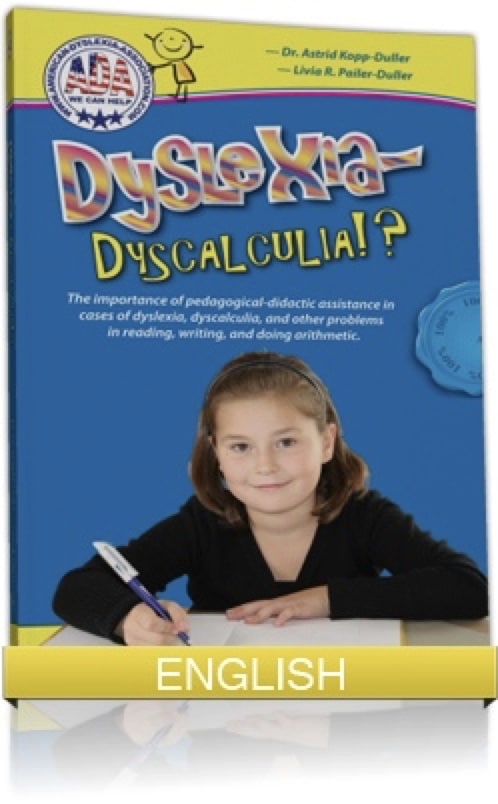
    Also featured in our online shop is Dyslexia-Dyscalculia!?, a publication authored by Dr. Astrid Kopp-Duller and Dr. Livia R. Pailer-Duller, which describes the necessity of intervention on a didactic level.


  • 13 Simple Ways to Practice Addition and Subtraction

    In my day, we just memorized math. I don’t know that I ever really truly understood much of what math was nor was I able to compute higher-level skills until I started teaching math and learned how to be flexible with numbers. Flexibility with numbers is a key foundational skill for young learners and those who don’t have it, struggle from early on. When it is hard to figure out what 7 + 4 =, a child will become easily frustrated, leading to the oh so often felt and heard, “I’m just no good at math.” It isn’t about memorization and speed (puuuhhhleeeease – stop with the timed tests!) with basic addition and subtraction – it is about developing strategies that lead to fluency, automaticity, and understanding.

    There are a number of ways to accomplish this, but one thing I am passionate about is making sure instruction is developmentally appropriate. Research tells us that learning through play is most appropriate for early childhood students (and that designation goes through age 8 or 9 depending on where you look) and the kids are way more engaged when they’re playing games. To develop strategic thinking, use lots of concrete representations to start, then move to the more abstract (for example, start with dot dice and move on to numeral dice). So, here are 13 ways to practice simple addition and subtraction that are sure to please.

    Way 1. Dice –

    There are so many different kinds of dice you can get now and if you can’t find the ones you want, there’s DIY wood block dice!  Place value blocks, ten frames, dots, numerals of any range with any number of sides, big and wooden dice, colorful dice, foam dice… Just search for dice online – but be prepared to get lost in that rabbit hole! Lots of work with making five and ten is required in K/1 and this can easily be done with addition (and frankly, subtraction, too – think fact families) and dice. Tenzi is a great way to have multiple players with a target number in a fast-paced, fun game.

    2. Deck of Cards –

    Pull out the numbered cards and only use those. You can use them in a number of ways – simply flip two cards and add or subtract, play make five or make ten go fish, addition/subtraction war (flip two cards each, whoever has the most/least wins all four cards, repeat) or any of a number of other card games.

    3. Dominoes –

    This low prep way to practice addition and subtraction involves simply giving students a bin of dominoes and having them pull one at a time. Then, they either add or subtract using the two sides of the domino. It is important, as with all of these ideas, to encourage strategy use. They should subitize the numbers, use counting on strategy, think about a rekenrek or a ten frame – playing these while simply counting all the dots won’t improve their skills at all.

    Way 4. Hopscotch  –

    Need to get some wiggles out? Go out to the playground or make an indoor tape hopscotch board and give each square a number 0-10. The directions can vary based on your students’ abilities and be used to find the missing addend or subtrahend (“What goes with 6 to make 10?” and they hop to the 4) or to do more basic addition and subtraction (toss two small pebbles or sticks and add/subtract the two numbers). Ready to up the challenge factor? Have kids make the target number a different way after they give you the first way or make a target number with three addends.

    5. Musical Chairs –

    This is another movement activity for math where you simply put number models on index cards – one per chair. Then play musical chairs like you always would, but kids have to answer their problems correctly to stay in the game as well!

    Continue article here:

    https://educationtothecore.com/2021/01/13-simple-ways-to-practice-addition-and-subtraction/

  • Close the Learning Gap: Learnedy now for free!

    Close the Learning Gap: Learnedy now for free!

    CLOSE THE LEARNING GAP: Just because one should / must stay at home at the moment does not mean that learning and practicing should also stop!

    The Dyslexia Research Center has 25 years of experience with distance learning and, in cooperation with the American Dyslexia Association, wants to help parents to design meaningful lessons for their children at home!

    We offer the new online learning platform Learnedy free of charge for parents. Learnedy is an educationally useful online diagnosis and learning platform for English Language Arts and mathematics in the early and elementary school yearsSuccess in three steps: educational diagnosis, individual program with exercises for practicing and regular re-testing.

    Parents can now gain free access to Learnedy until the start of the next school year, so that lessons can be meaningfully continued at home over the summer. Most of the time, parents don’t know where to start. With Learnedy, the child can continue learning exactly where he/she stands.

    Parents can register here free of charge: https://parents.learnedy.com/register/

  • Dyslexia – Dyscalculia!?

    Stacks Image 0
    The authors, Dr. Astrid Kopp-Duller and Dr. Livia R. Pailer-Duller, describe in this publication the necessity of intervention at the educational-didactic level, which is of preeminent importance for success in the training of people who have problems with reading, writing, or calculating.
    Information on ordering is found here: https://www.dyslexia-dyscalculia.com/
    Available in English, German, and Spanish.
    It is a fact that many people who simply have problems with learning how to read, write, or do arithmetic continue to undergo only psychological or medical therapy, and don’t receive the educational-didactic assistance which they actually need. In cases of problems with reading, writing, or calculating, only the specially trained educator will be able to help these people using educational methods which have been developed through educational-didactic research.
  • Close the Learning Gap: Learnedy now for free!

    CLOSE THE LEARNING GAP: Just because one should / must stay at home at the moment does not mean that learning and practicing should also stop!

    The Dyslexia Research Center has 25 years of experience with distance learning and, in cooperation with the American Dyslexia Association, wants to help parents to design meaningful lessons for their children at home!

    We offer the new online learning platform Learnedy free of charge for parents. Learnedy is an educationally useful online diagnosis and learning platform for English Language Arts and mathematics in the early and elementary school years.

    Success in three steps: educational diagnosis, individual program with exercises for practicing and regular re-testing.

    Parents can now gain free access to Learnedy until the start of the next school year, so that lessons can be meaningfully continued at home over the summer. Most of the time, parents don’t know where to start. With Learnedy, the child can continue learning exactly where he/she stands.

    Parents can register here free of charge: https://parents.learnedy.com/register/

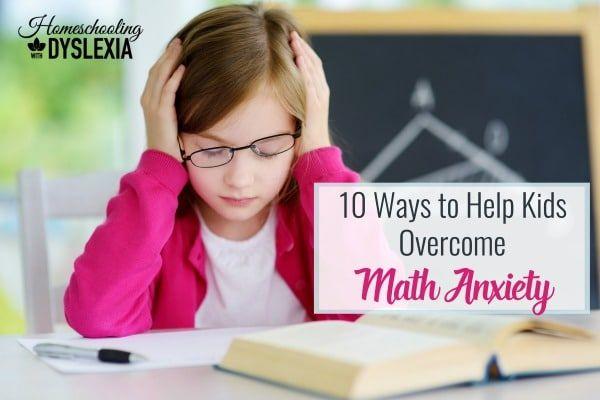
  • 10 Ways to Help Kids Overcome Math Anxiety

    For kids who struggle with math – the ones who have trouble with math no matter what they try – it is not uncommon to feel anxiety when even simply thinking about math. As the mom of a handful of kids who struggle with math, sometimes called dyscalculia, I have had a ton of practice helping them not only to figure out how to solve math problems but to overcome their unnecessary worrying about math. Whether your child is six or 16, these 10 tips will help them to build their confidence and ability in math class.

    Overcome Math Anxiety

    10 Ways to Help Kids With Math Anxiety

    Normalize their challenges.  I often laughingly refer to myself as my kids’ life coach.  How encouraging is it to a struggling learner to hear that many students have a hard time with math. Research shows that up to 50% of students nationwide are experiencing some degree of math difficulty.  Remind kids that “All kids can learn math, we just need to figure out how you learn best.”

    Continue reading here: https://homeschoolingwithdyslexia.com/help-kids-math-anxiety/

  • The Difference Between Dyslexia and Dyscalculia

    Peg Rosen

    Both dyslexia and dyscalculia can make it hard to learn math. It’s possible to have both, but they’re very different.

    Dyslexia is better known than dyscalculia. That may be why some people call dyscalculia “math dyslexia.” This nickname isn’t accurate, though. Dyscalculia is not dyslexia in math.
  • Dyscalculia and Brain Activity-The Connection, by Shradha Kalyani Kabra

    The fear of Mathematics and numbers is called Dyscalculia which is a learning disability also termed as number blindness. Extensive studies have recorded that nearly 7% of the population with average intelligence have the problem. The innate number sense of the human brain is not in sync in dyscalculics as numerical ability relies on special brain networks.

    The theory that separates Dyscalculia from other deficiencies of memory, language and memory is that the approximate number sense gets severely affected. Common symptom that defines the problem is the inability to recognize the place value system. The mathematical ability of people who are unable to grasp the recognition pattern of small numbers is impaired significantly.

    Brain Function In Dyscalculia Sufferers

    The inability to properly estimate and grasp quantifiable figures is the hallmark of Dyscalculia.The disability signifies the inability or impaired ability to recognize small numbers. The brain scans of persons suffering from this issue show that the intraparietal sulci show less activity and are less connected with the greater brain when dealing with numbers.

    Other learning disabilities like dyslexia and aligned problems like ADHD and autism spectrum disorder is also common in dyscalculics.  The treatment becomes a little complex as it is difficult to separate the issues. These comorbidities often make the diagnosis difficult.  The neuronal basis of Dyscalculia is not widely studied due to this phenomenon. Several neuroimaging studies have detailed the representation and processing of numerical information, but no comprehensive and conclusive findings are available. There are many forms of Dyscalculia, and some of them are associated with demonstrated alteratiometabolism, brain structure and function.

    dyscalculia brain scan

    Image Source: dyscalculiamathdisability.weebly.com


    Developmental Dyscalculia

    Developmental Dyscalculia tends to present as abnormalities in the parietal cortex and involves the cortical and subcortical regions. Recent studies have given clarity on brain activity during number processing as well as calculation. The IPS or intraparietal sulcus is known to be the centre for numerical processing. Research has illustrated that the IPS is activated when mathematical tasks and even simple counting exercises are carried out.

    Memory, perceptual, spatial and motor functions are also involved in the process. Attention is also a key factor. The cognitive processes that are involved in calculation tasks add to the complexity. Developmental Dyscalculia (DD) demonstrates deficits in core brain regions associated with number processing. The brain activation pattern is also not adequate in children afflicted with DD. The gap is bridged with the child resorting to finger counting and memory to compensate.

    The need for remediation measures and education for children with special needs is the need of the hour. There are some steps taken in this direction by experts, but the gap is much more significant than the remedy. Urgent intervention is needed to collate research findings and create practical special education resources to help children suffering from DD.

    Practical Application of Research in Educational Processes for Special Needs

    The first step is to recognize that the child has a problem. Unfortunately, the children suffering from Developmental Dyscalculia are not even diagnosed in time to help them. They are often labelled as slow or below average and are left to fend on their own. The need of the hour is to educate parents and educationists alike about the existence of DD and how it affects the child.

    Academic and emotional negligence often tortures the otherwise intelligent child. They are special and hence need proper guidance and help, more than the other children. They may be subjected to bullying and rampant ignoring in the classroom. Teachers need to be sensitized about the occurrence and issues related to Dyscalculia as they are prone to dismiss the condition as a lack of general intelligence. There are few practical steps that can be taken to ensure that the child finds a way to cope with the problem and even overcome it to a certain extent.

    Continue reading here: https://numberdyslexia.com/dyscalculia-and-brain-activity-the-connection/


  • Dyslexic/Dyscalculic children learn times table, thanks to new ‘Math Stories’

    Brain Magic is a stories-based times tables course that gets children with dyslexia &/or dyscalculia to memorize the entire times (multiplication) table in just a matter of hours.

    The parent of a child living with dyslexia & dyscalculia who used these math stories to memorize the times table in a single weekend, had this to say:

    “My 10 year old daughter is a very visual learner and she picked this method up extremely easily. She enjoyed herself as well, and really enjoyed being successful! As she has dyslexia and dyscalculia this was a real confidence booster for her. Just yesterday she had trouble telling the time on an analog clock and I told her to multiply 7 by 5 minutes (she was trying to count it up) and with only a split second later she told me it was 35… When she realized how quickly she can get the correct answer the smile on her face was absolutely priceless!” Melanie Ledger, Mila’s mom, Vancouver, Canada

    Elementary school teacher (and Canada’s current #2 ranked memory competitor) Darren Michalczuk, used his mnemonic experience to develop these math stories as a way to teach children in his own class who were having difficulty with math. And he’s been refining them for the past 20 years.

    “Going through 20 years, you come across every single kid, and it just feels like I’ve kind of done the rotation and seen every disability, or learning disability, or problem that a kid’s come across, and these [stories] have just blanketed every problem that I’ve come across, and have brought the kids out of that area where they were frustrated and crying, and it’s just brought them up to a different level.” Says Darren.

    These are the basics of how it works:

    Bran Magic has given each question in the times table it’s own 30-second story (9×3 has its own story, 6×7 has its own story, etc..).  And in each story are objects that represent both the question and the answer.

    To recall the answer to any math fact, a child listens to it’s funny story, is explained the very logical association, and voila!  To recall a math fact all the child has to do is recall it’s funny story!

    There are several aspect to the course that make it so appropriate for children with dyslexia &/or dyscalculia. For example, the larger number is always represented by the physically larger object.  For example, in one story, a windshield of a car is broken. The car (4 tires) is obviously bigger than the windshield (2 windshield wipers), so the answer is 42. In another example, extra camping string is kept inside the backpack, next to the tent.  The tent (3 poles) is obviously larger than the backpack (2 straps), so the answer is 32.

    There are many many consistencies across all the stories that make the answers easier to recall.  For example, all the object representations are color coded – purple objects =4 (like the purple car), all blue objects = 2 (like the blue backpack), and black objects = 8 (like the black spider).

    Last year, Darren thought that many more children could benefit from this story based approach, so he created a condensed course and partnered up with friend and entrepreneur Drewe MacIver to put on weekend-long Math Camps.  In the fall of 2017, in Vancouver and Toronto, Canada, over 80% of the children who attended a Math Camp learned the times table in one weekend.

    Seeing it in action for the first time, Drewe was stunned, “When parents approached us with damp eyes, saying they really didn’t think their child could learn the times table, and now they had, I knew we had something special.”

    Bran Magic’s course will soon be available for others on Kickstarter, as the company is fundraising to turn Darren’s math stories into an interactive digital course and testing app that children all around the world can use from their home computer, smartphone, or tablet.

    Focused on making this learning approach available to children around the world, Drewe says “It’s not a guarantee that we will hit our funding goal, but I really hope we do because I’ve seen the impact this program has on children first-hand and it’s heartwarming.  The thought of doing that for thousands of children, year after year… We need as many people as possible to believe in us right now.”

    Please fund this project on Kickstarter:

    https://www.kickstarter.com/projects/256662355/brain-magic-times-table-math-stories-for-ages-7-an?ref=33vgoq