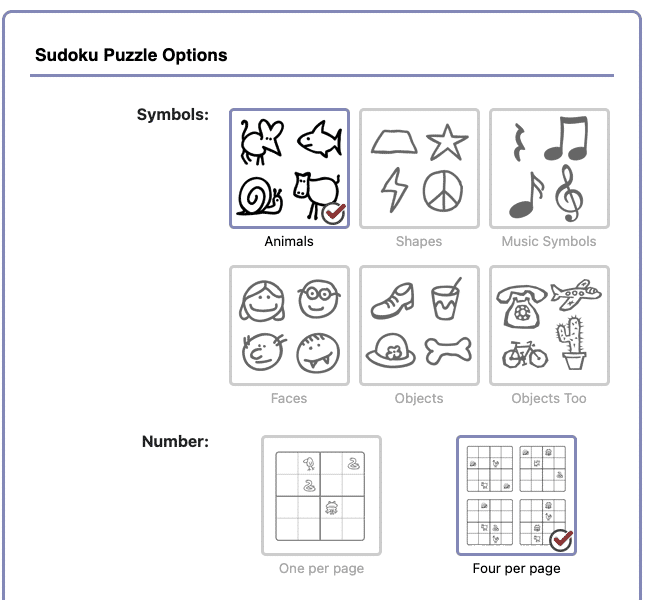
Sudokus are everywhere: in almost every shop to buy, and on the internet as free printables or to play online. So why another post about Sudokus? Because it is not easy to find good Sudoku puzzles for children, and it is even less easy to find Sudokus with symbols. Worksheetworks.com, however, offers a free symbol Sudoku generator. Simply choose the symbols, how many Sudoku puzzles you want (one or four per page), choose the difficulty level, and click “create worksheet”. You get a PDF which you can save or print. Both a solution and an explanation of the solution are included.
We like symbol sudokus very much. Young children can solve them as well and are very proud of being able to do the same kind of puzzles as adults. Older children like the extra challenge of drawing the symbols – this trains creativity and visual perception. What more can you wish? Access the Symbol Sudokus here
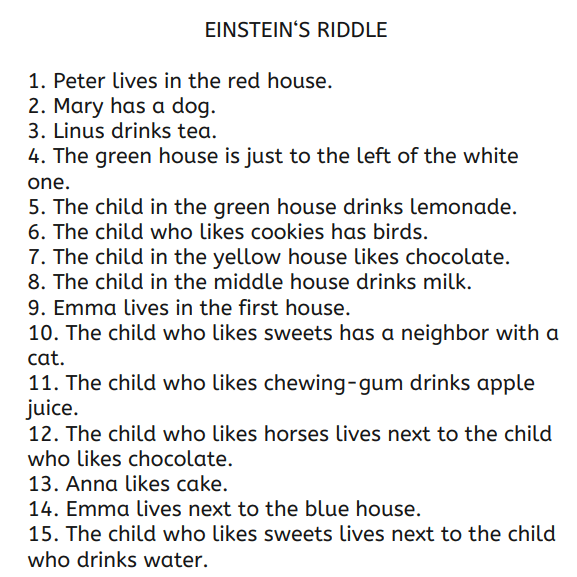
Einstein is said to have claimed that only 2 percent of the world can solve this puzzle. There is no evidence he wrote it, and no evidence for the 2 percent either. We will make the opposite claim: anyone who reads carefully and combines patiently can solve it. Children can too, with a little help depending on age and reading experience.
We rewrote the classic riddle in a version for children. No smoking and no alcohol, sweets and soft drinks instead. The question stays the same: who owns the fish?
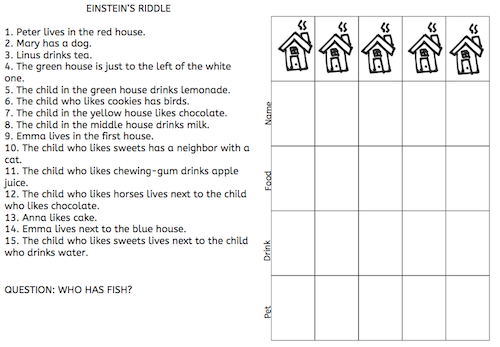
It is a logic grid puzzle, sometimes called a zebra puzzle. You are given five houses in a row, each with a different color, a different owner, a different drink, a different sweet, and a different pet. A list of clues tells you how these things relate to one another. Nothing is guessed. Every single answer can be derived from the clues, and there is exactly one solution.
How to solve it
The trick is not cleverness. It is a system. Anyone who works through it in order will get there.
Draw the grid. Five columns for the five houses, one row for each category. Everything you learn goes into the grid, never into your head.
Start with the clues that fix a position. Any clue that names a specific house, or the middle, or the first one on the left, is a free answer. Fill those in first.
Then use the clues that link two things. If the person who drinks milk sits next to the green house, you may not know where yet, but you know they are neighbors.
Cross out what is impossible. This is the part most people skip and it is where the puzzle is actually won. Every time you place something, five other options die.
Go around again. Each new entry unlocks a clue that was useless a moment ago. Read the whole list again after every entry.
Why we put a logic puzzle on a dyslexia blog
Because of what it asks for. Reading a clue exactly as it is written, holding several conditions in mind at once, working in an ordered sequence, and staying with a task long enough to finish it are the same skills that carry reading and arithmetic. A puzzle trains them without any of it looking like schoolwork, and a child who has spent the school day being corrected gets to be the one who is right.
Read the clues aloud together if the reading itself is the hard part. The point of the exercise is the combining, not the decoding, and there is no reason a child should fail at the first step for the wrong reason.