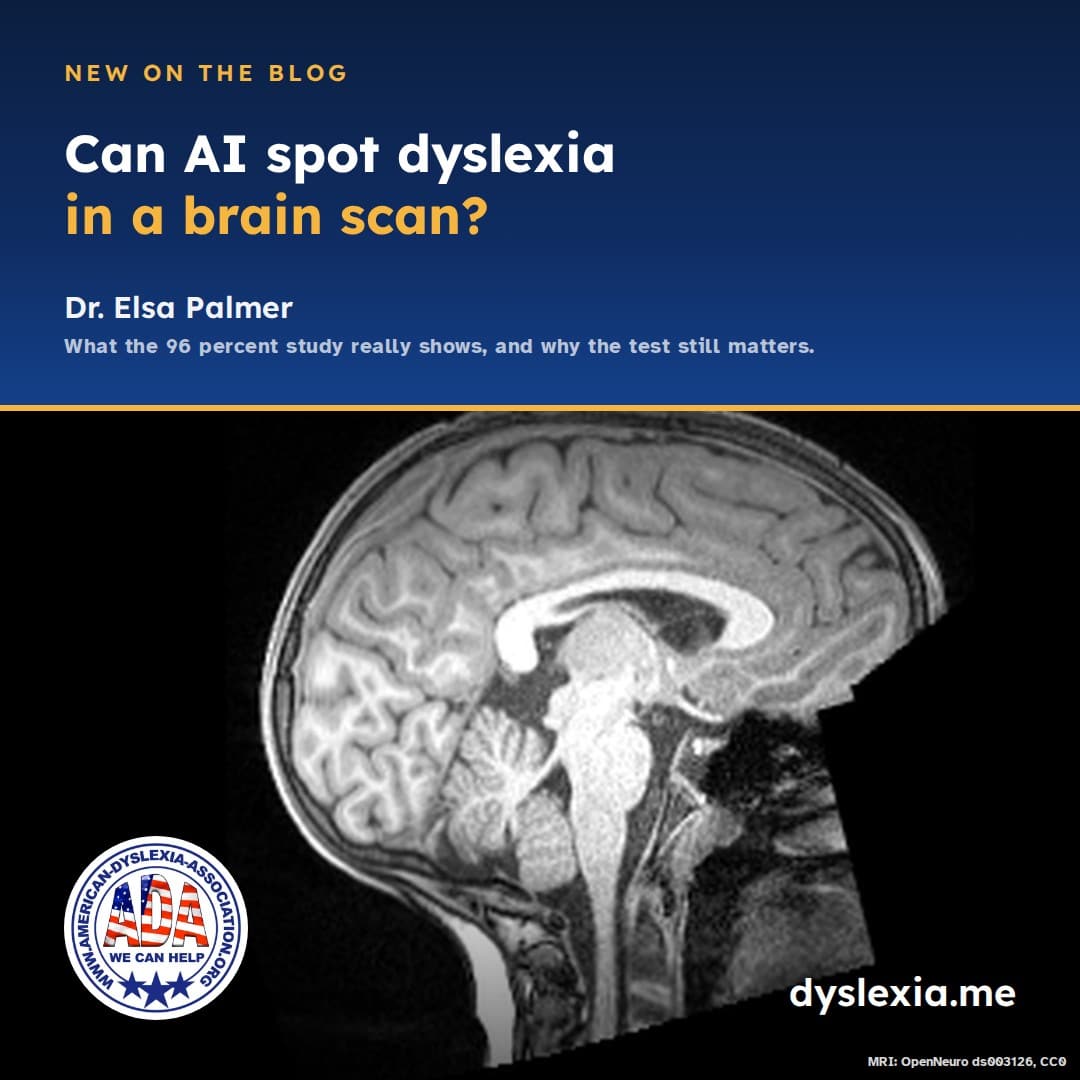
An AI model sorted children by their brain scans with 96 percent accuracy. That is the headline of a study published on October 9, 2026, in the journal Neural Computing and Applications [Source: Santhiya and Kanimozhiselvi, 2026]. What the news coverage leaves out: the 58 brain scans were not taken in India, where the study was done. They come from children in Austria, recorded for a study at the University of Graz. This article explains what the 96 percent really mean, what brain research tells us about dyslexia, and why parents still do not need a brain scan to find out whether their child has dyslexia.
In short
- Researchers in India trained an AI on 58 MRI scans of children. It told apart typical readers, children with isolated spelling problems, and children with dyslexia with 96 percent accuracy.
- The scans come from a free public dataset of the University of Graz, Austria. The children were 8 to 10 years old [Source: OpenNeuro ds003126].
- Fifty-eight children is a very small number for an AI. The team added computer-generated brain images, and the method has not yet been tested on new children.
- The AI learned to match groups that reading and spelling tests had already defined. The educational test is still the yardstick. Such tests only show that a child struggles, not why: only an assessment of attention and the sensory perceptions separates dyslexia from an acquired reading and spelling difficulty.
- Dyslexia is identified through an educational assessment such as the AFS-Test, which looks at attention, sensory perceptions, and the errors a child makes.
What the study did: an AI reads MRI scans
S. Santhiya and C. S. Kanimozhiselvi of Kongu Engineering College in Tamil Nadu, India, used structural MRI scans, so-called T1-weighted images that show the anatomy of the brain [Source: Neural Computing and Applications 38, article 781]. Their AI had to place each child in one of three groups: typical readers and spellers, children with isolated spelling difficulties, and children with dyslexia.
Because only 58 real scans were available, the researchers used two image generators to create synthetic brain images. These extra images balanced the groups and gave the AI more material to learn from. The team then compared several approaches, from simple machine learning models to three modern neural networks. Their combined model, MedFusionNet, merges those three networks. It reached 96 percent accuracy, while a single 3D network trained with the synthetic images reached 92 percent.
The science news site Scienmag presented the study on October 10, 2026, as a step toward early detection [Source: Scienmag, October 10, 2026]. The same report notes that the method will need validation on independent groups of children before it could ever be used outside the lab.
Where the 58 brain scans come from: children in Graz, Austria
The 58 scans come from Austria. The study names its data source as the public dataset ds003126 on the OpenNeuro platform. The dataset lists Chiara Banfi, Karl Koschutnig, Kristina Moll, Gerd Schulte-Körne, Andreas Fink, and Karin Landerl as its authors [Source: OpenNeuro ds003126, version 1.3.1]. The team worked at the University of Graz in Austria and at Ludwig Maximilian University in Munich, Germany, with funding from the Austrian Science Fund FWF [Source: FWF project I 1658].
The Graz researchers originally asked a different question: how does the brain work during reading when a child struggles only with spelling, and how does it work when a child has dyslexia? The children read real words and made-up words aloud while lying in the scanner [Source: Banfi and colleagues, Language, Cognition and Neuroscience, 2021]. According to the dataset, 22 children were typical readers, 16 had isolated spelling difficulties, and 20 had dyslexia, all between 8 and 10 years old. The researchers shared the data under the free CC0 license, which is why a team in India could use it years later.
This detail matters. Which child belonged to which group was decided before any AI saw a single image. The Graz team had sorted the children with standardized reading and spelling tests, the kind US schools call achievement tests: the Salzburg Reading Screening (SLS 2–9), the Salzburg Reading and Spelling Test (SLRT-II, reading words and pseudowords), and the Diagnostic Spelling Test (DRT 3). A child counted as dyslexic with a reading score at or below the 16th percentile, and as having an isolated spelling deficit with a spelling score at or below the 16th percentile and typical reading. The starting point was a screening of 2,562 children at the end of third grade [Source: Banfi and colleagues, Human Brain Mapping, 2019]. The AI learned to find the result of those tests in the brain images. The test remains the yardstick.
A reading and spelling test, however, only shows that a child struggles with reading and spelling. It does not show why. Dyslexia can only be confirmed when attention and the sensory perceptions are assessed as well. This matters because dyslexia and an acquired reading and spelling difficulty look alike on paper but have different causes: dyslexia is genetic and shows in different sensory perceptions, while an acquired difficulty results from outside circumstances such as long absences from school, a change of school, or a stressful event in the family. Because the cause is different, the training has to be different, too. The AFS-Test separates the two, because it assesses attention and the sensory perceptions alongside the errors. Our guide to dyslexia and sensory processing explains the difference in more detail.
What 96 percent means with 58 children
Ninety-six percent sounds almost perfect. With 58 children, the remaining 4 percent equals two or three children. The researchers checked their model with five-fold cross-validation: the data is split into five parts, the AI learns from four and is tested on the fifth, five times in turn. Each test round therefore includes only about a dozen children.
Then there are the synthetic brain images. They help the AI learn, but they are derived from the real scans. The study summary does not say whether the synthetic images were created only from the training data in each round. That detail decides how much the 96 percent can be trusted. The Scienmag report also calls 58 real scans a modest foundation and stresses that the method has to work on new children from other studies.
A comparison shows how much such numbers vary. In 2020, a research group in Spain let a similar 3D network analyze brain activity of 55 children during reading. It classified 72.73 percent of the children correctly [Source: Zahia and colleagues, Computer Methods and Programs in Biomedicine, 2020]. Small groups, different data, and different test procedures lead to very different results.
The dyslexic brain: different, and able to change
Researchers have known for a long time that, on average, the brains of children with dyslexia work differently during reading. Dr. Astrid Kopp-Duller, who developed the AFS Method, describes dyslexia as genetic and as a matter of different sensory perceptions: people with dyslexia take in letters, sounds, and symbols differently, which affects reading, spelling, writing, and/or calculating. It is a learning difference, not an illness.
Brain research also shows that these patterns can change through teaching. At the University of Washington, researchers scanned 10 children with dyslexia and 11 typical readers. After 28 hours of comprehensive reading instruction, the brain activity of the children with dyslexia during reading tasks closely resembled that of the typical readers [Source: Aylward and colleagues, Neurology, 2003; University of Washington News]. For parents, this is the most useful message from the brain scanner: the right training makes a visible difference.
How dyslexia is identified without a brain scan
Parents and teachers do not need an MRI to find out whether a child has dyslexia. A brain scan is expensive, requires a child to lie still for a long time, and tells you nothing about which training will help. An educational assessment does exactly that. The AFS-Test looks at three areas together: attention while writing, the sensory perceptions, and the errors themselves. The result leads straight to a training plan. Our series Inside the AFS-Test explains each area week by week.
The assessment always comes first. Only if it shows signs that a child may not see or hear well do we recommend a visit to a doctor. Certified Dyslexia Trainers carry out the AFS-Test and the training that follows. If you want to support children with dyslexia yourself, the Dyslexia Trainer Certification Program at dyslexiacertificate.com is a good place to start.
What AI research means for parents today
- No child needs a brain scan to find out about dyslexia. Educational assessments are proven, quick to arrange, and lead directly to training.
- Look early. If a child keeps misspelling the same words in different ways despite practice, an assessment makes sense.
- Words stick through word formulation, which works with word image, word sound, and word meaning, not through copying a word ten times.
- Technology can support learning, but it does not replace a teacher. We wrote about that in Technology Is a Tool, Not a Teacher.
- When you read headlines about AI and the brain, ask three questions: How many children? Was it tested on new children? What was the yardstick?
- Inside the AFS-Test, Week 1 of 25: What Is the AFS-Test?
- Lesson 11 of 48: Sensory Perception Training
- Dyslexia Spelling: How Word Formulation Teaches a Word
- Technology Is a Tool, Not a Teacher
Frequently asked questions
Not in everyday practice. In studies, groups of children with and without dyslexia differ in brain images, but a single scan does not replace an educational assessment. Dyslexia is identified with tests such as the AFS-Test.
The model MedFusionNet classified 96 percent of the children correctly. It was based on only 58 real scans plus computer-generated images, and it has not yet been tested on new children [Source: Santhiya and Kanimozhiselvi, 2026].
From a free public dataset of the University of Graz, Austria, with 58 children aged 8 to 10, published on OpenNeuro.
On average, yes: brain activity during reading differs. Research from the University of Washington shows that these patterns can change after 28 hours of reading instruction [Source: Aylward and colleagues, 2003].
With an educational assessment. The AFS-Test looks at attention, sensory perceptions, and errors and leads to a training plan. A reading and spelling test alone shows that a child struggles, not why; assessing attention and the sensory perceptions is what separates dyslexia from an acquired reading and spelling difficulty. Training to become a Certified Dyslexia Trainer is available at dyslexiacertificate.com.
Sources
- Santhiya, S., and Kanimozhiselvi, C. S. (2026). MedFusionNet integrating diffusion augmentation and multi backbone models for pediatric MRI classification. Neural Computing and Applications 38, article 781. doi.org/10.1007/s00521-026-12492-3
- Scienmag (October 10, 2026). AI Model Reads Brain Scans to Spot Dyslexia in Children with 96% Accuracy. scienmag.com
- Banfi, C., Koschutnig, K., Moll, K., Schulte-Körne, G., Fink, A., and Landerl, K. Dataset “Reading-related functional activity in children with isolated spelling deficits and dyslexia,” OpenNeuro ds003126, version 1.3.1, CC0. openneuro.org
- Banfi, C., and colleagues (2021). Reading-related functional activity in children with isolated spelling deficits and dyslexia. Language, Cognition and Neuroscience 36(5), 543 to 561. doi.org/10.1080/23273798.2020.1859569
- Banfi, C., Koschutnig, K., Moll, K., Schulte-Körne, G., Fink, A., and Landerl, K. (2019). White matter alterations and tract lateralization in children with dyslexia and isolated spelling deficits. Human Brain Mapping 40(3), from page 765; sample, tests (SLS 2–9, SLRT-II, DRT 3), and group criteria. pmc.ncbi.nlm.nih.gov
- Austrian Science Fund FWF. Project I 1658. fwf.ac.at
- Zahia, S., and colleagues (2020). Dyslexia detection using 3D convolutional neural networks and functional magnetic resonance imaging. Computer Methods and Programs in Biomedicine. doi.org/10.1016/j.cmpb.2020.105726
- Aylward, E. H., and colleagues (2003). Instructional treatment associated with changes in brain activation in children with dyslexia. Neurology 61(2), 212 to 219. PubMed 12874401