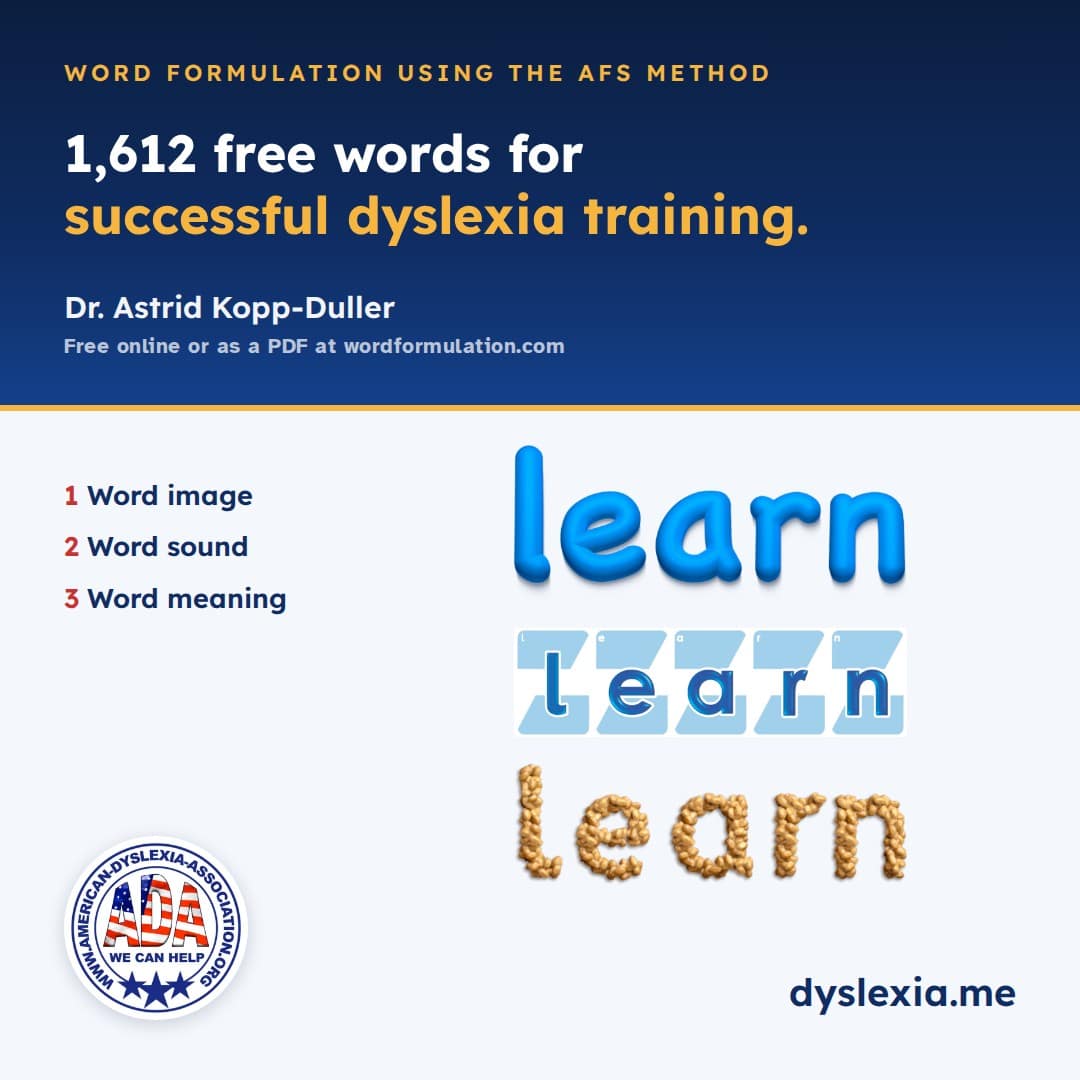
A child with dyslexia can copy a word ten times and still misspell it the next morning. Dyslexia spelling problems rarely go away with more copying. Word formulation, a technique Dr. Astrid Kopp-Duller developed for the AFS Method in 1997, takes a different route: every word is learned through its image, its sound, and its meaning. The Dyslexia Research Center USA now offers 1,612 English words prepared this way, free of charge at wordformulation.com. Here is how word formulation works, what brain research from the University of Washington later found, and how parents and teachers can use it.
In short
- Word formulation helps with dyslexia spelling by teaching a word in three steps: the word image, the word sound, and the word meaning. None of the steps can be skipped.
- 1,612 English words are free on wordformulation.com, covering nine parts of speech, from basic vocabulary to common error words, online or as a printable PDF.
- Dr. Astrid Kopp-Duller developed the concept in 1997 as part of the symptom training of the AFS Method.
- Brain research from the University of Washington points the same way. In 2003, Elizabeth Aylward, Virginia Berninger, and colleagues showed that after 28 hours of instruction, brain activation in children with dyslexia closely resembled that of typical readers.
- Word formulation works best as part of individual training with a Certified Dyslexia Trainer, plus a few minutes of practice at home every day.
Dyslexia spelling: why copying a word ten times often does not work
Children with dyslexia have different sensory perceptions and tend to lose attention when they work with letters. That is why the AFS Method by Dr. Astrid Kopp-Duller works in three areas: attention training, function training, and symptom training. Practicing mistakes alone does more harm than good, because it does not reach the reasons behind the mistakes. You can read more about this in From Errors to Insights and Sensory Perception Training.
Word formulation belongs to the symptom area, the part of the method that trains reading, spelling, writing, and/or calculating directly (Symptom Training in Language Arts). A word only stays in long-term memory when the child has seen its shape, heard it clearly, and understood what it means. If one of the three is missing, the word slips away again, no matter how often it was copied.
Step 1: The word image, in three dimensions
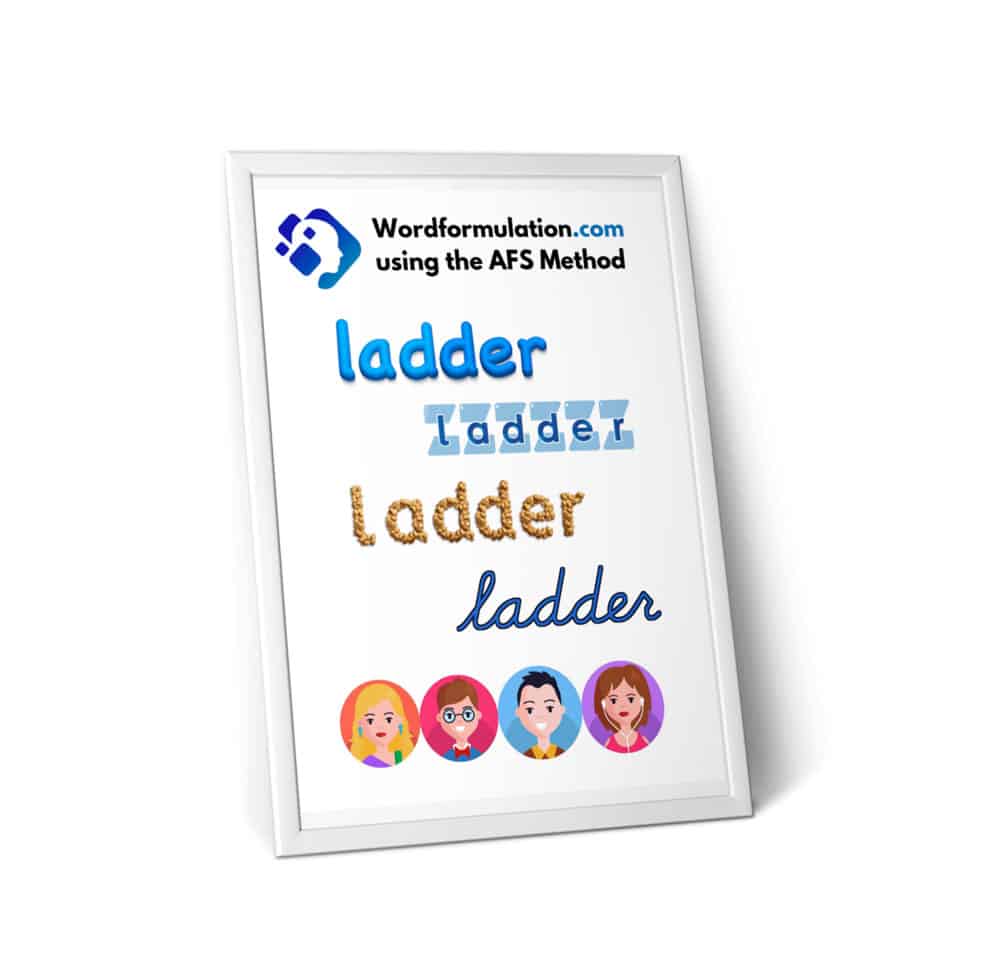
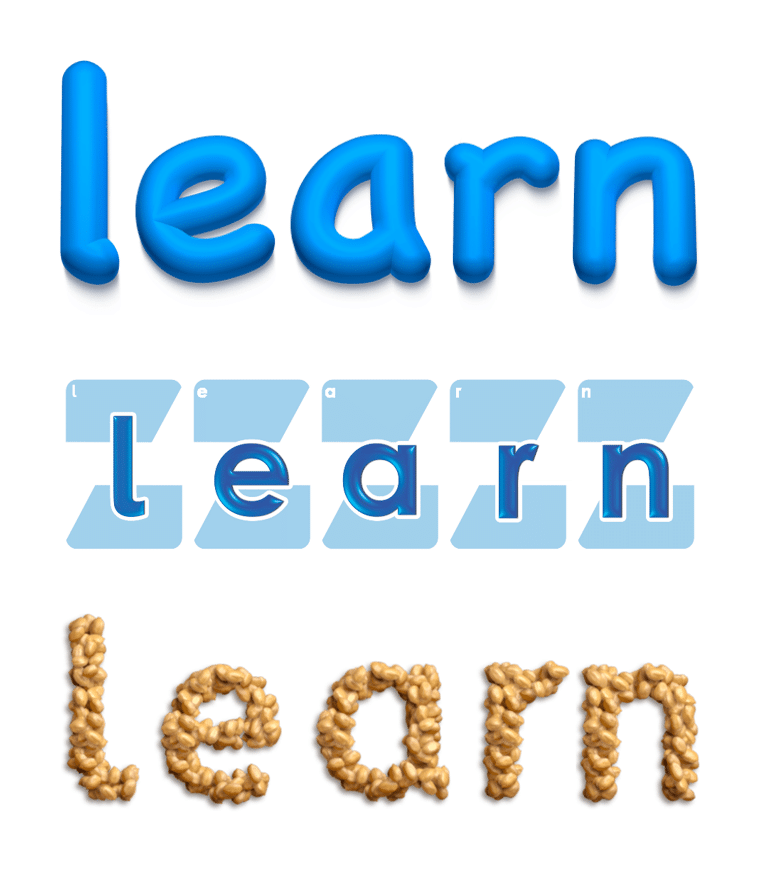
Representing the word image three-dimensionally is a principle of the AFS Method. Children shape a word from modeling clay, lay it out with wooden letters or tiles, or write it in spray cream. Each of the 1,612 words on wordformulation.com shows the word in several of these forms, for example in clay, on tiles, laid out with peanuts, and in cursive. In addition, every word can be assembled in a word puzzle in different sizes and found again in the word search game Find the Words.

Step 2: The word sound, spelled out and sounded out
The second step is hearing the word clearly. With Word Sound, children listen to how a word sounds and how it is spelled out letter by letter or sounded out. They can listen as often as they like and speak along. Saying the word while hearing it links the sound to the letters the child has just seen.

Step 3: The word meaning, from part of speech to your own sentences
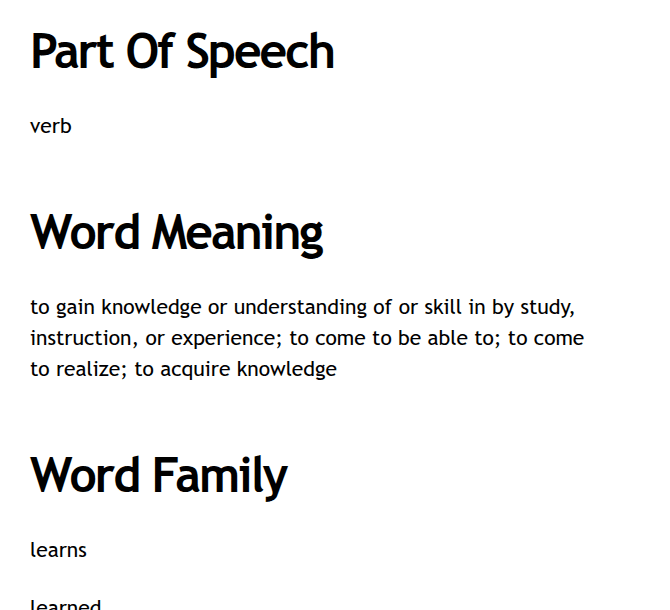
The third step makes sure the child knows what the word means and how to use it. First, the word is assigned to a part of speech. Then its meaning is explained, followed by grammatical details such as the plural or verb forms. Finally, the child works through the word family and forms sentences with the word and its relatives. The word family matters because it shows that “learns,” “learner,” and “unlearn” share the same spelling core. On the page for learn, for example, the word family lists ten related words and ten example sentences.
Confirmed by brain research at the University of Washington
Dr. Astrid Kopp-Duller described word formulation with its three parts in 1997, as part of the symptom training in the AFS Method. What she built from practice was later confirmed by brain research at the University of Washington in Seattle, where Virginia Berninger, Elizabeth Aylward, and their colleagues studied how children with dyslexia learn words.
In 2003, Elizabeth Aylward, Todd Richards, Virginia Berninger, and colleagues scanned the brains of 10 children with dyslexia and 11 typical readers while they mapped sounds to letters and connected suffixed words to their roots. The children with dyslexia then received 28 hours of comprehensive reading instruction. Afterward, their reading scores had improved, and the amount and pattern of their brain activation closely resembled that of the typical readers (Aylward et al., 2003). As Aylward put it, the instruction did not rewire the brain but strengthened circuits that were already there (University of Washington, 2003).
In 2006, the same team published what they call triple word form theory. They found distinct brain signatures for three forms of a word: the phonological form (how it sounds), the orthographic form (how it is spelled), and the morphological form (its meaningful parts, such as the root and endings). Instruction that addressed one form also changed how the brain processed the others (Richards et al., 2006). These three forms correspond closely to the word sound, the word image, and the word meaning with its word family in Dr. Kopp-Duller’s word formulation. Researchers also use the term orthographic mapping for the process of connecting sounds and letters so that a word is stored for good.
How to use wordformulation.com at home and in class
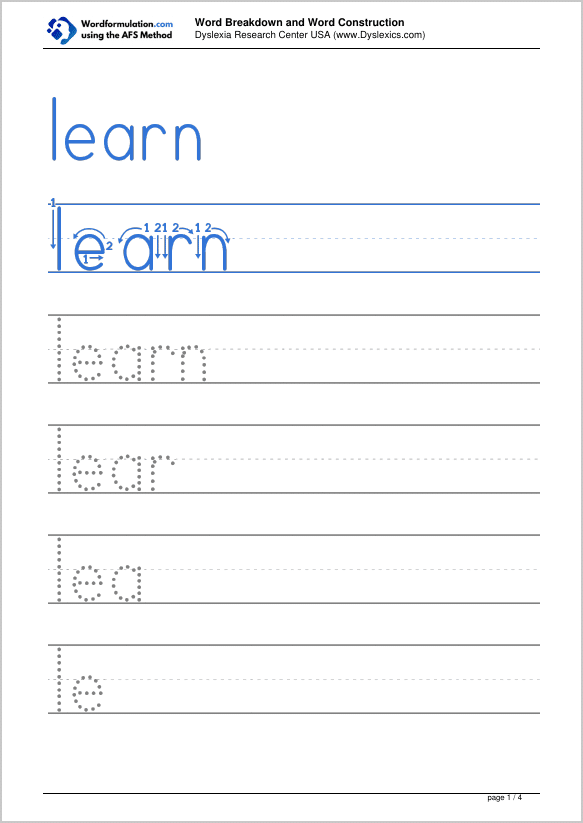
The collection was compiled over many years. It started with common error words, then added core and basic vocabulary, and it keeps growing. The 1,612 words cover nouns, verbs, adjectives, adverbs, prepositions, conjunctions, numerals, pronouns, and interjections. Every word can be practiced online or printed as a PDF with tracing lines and letter construction, so children can collect their words in a folder.
A simple routine for one word a day:
- Look: open the word page, look at the word image, and build the word from clay or letter tiles.
- Listen: play the word sound, spelled out and sounded out, and say it together.
- Understand: read the meaning, find the part of speech, and go through the word family.
- Use: say or write one sentence with the word, then do the puzzle or the word search.
Ten minutes are enough. Short daily practice works better than one long session on the weekend, as our 31-day plan and our overview of free dyslexia resources explain. Praise every small step, and compare a child only with their own progress. A Certified Dyslexia Trainer can choose the right words for each child after an AFS test and combine word formulation with attention and sensory perception training.
Frequently asked questions
Word formulation is a technique from the AFS Method by Dr. Astrid Kopp-Duller. A child learns each word through three steps: the word image, the word sound, and the word meaning, including part of speech, word family, and sentences. 1,612 English words prepared this way are free at wordformulation.com.
Copying a word trains only part of what is needed. A word stays in long-term memory when a child has seen its shape, heard it clearly, and understood its meaning. Children with dyslexia also tend to lose attention with letters, so training needs to include attention and sensory perception as well, as described in Lesson 11.
Brain research at the University of Washington confirmed the approach. Aylward, Berninger, and colleagues showed in 2003 that after 28 hours of instruction, brain activation in children with dyslexia closely resembled that of typical readers. In 2006 the team described distinct brain signatures for how a word sounds, how it is spelled, and its meaningful parts. See Aylward et al., 2003 and Richards et al., 2006.
Yes. The Dyslexia Research Center USA offers all 1,612 words on wordformulation.com free of charge, online or as printable PDFs, together with Word Sound, Word Puzzle, Find the Words, and a Word of the Day.
About ten minutes a day is enough for one word. Short daily sessions work better than long ones. A Certified Dyslexia Trainer can plan which words to practice based on the child’s mistakes.
- Mastering Word Formulation: How the AFS Method Is Transforming Language Learning for Dyslexic Individuals
- Ways Parents Can Help With Spelling
- Lesson 13 of 48: Symptom Training in Language Arts
- Free Dyslexia Resources for Parents and Teachers
- Technology Is a Tool, Not a Teacher: What Children With Dyslexia Still Need
Sources
- Aylward, E. H., Richards, T. L., Berninger, V. W., Nagy, W. E., Field, K. M., Grimme, A. C., Richards, A. L., Thomson, J. B., & Cramer, S. C. (2003). Instructional treatment associated with changes in brain activation in children with dyslexia. Neurology, 61(2), 212–219. https://doi.org/10.1212/01.wnl.0000068363.05974.64
- Richards, T. L., Aylward, E. H., Field, K. M., Grimme, A. C., Raskind, W., Richards, A. L., Nagy, W., Eckert, M., Leonard, C., Abbott, R. D., & Berninger, V. W. (2006). Converging evidence for triple word form theory in children with dyslexia. Developmental Neuropsychology, 30(1), 547–589. https://doi.org/10.1207/s15326942dn3001_3
- University of Washington News (2003, August 7). Overcoming dyslexia: Brain scans show intervention makes a difference.
- Kopp-Duller, A. (2021). Dyslexia – Training Using the AFS-Method (3rd revised ed.).
- Dyslexia Research Center USA. Word Formulation using the AFS Method. wordformulation.com
- Kopp-Duller, A. (2026, October 20). 1725 Worterarbeitungen für ein erfolgreiches Legasthenietraining. legasthenie.at.