Yesterday, we presented the Handwriting worksheet wizard, today we bring you the math worksheet wizard. These math wizards make arithmetic worksheets for your children. Rather than being level-specific, these are general math worksheets that can be used by any elementary school student. Just choose the settings that are appropriate for your child. Access the math worksheet wizard here. Again, this is a free resource for teachers and parents.
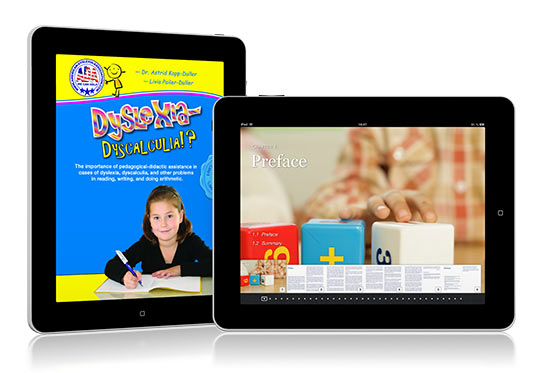
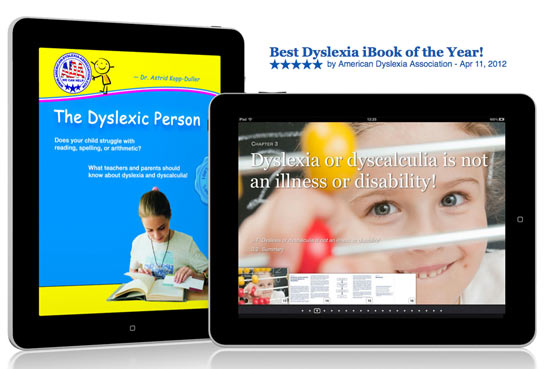
An interactive iBook for the iPad shows solutions for persons with dyslexia and dyscalculia. It is on sale for only $1.99 .
In this inspiring publication Dr. Astrid Kopp-Duller and Livia R. Pailer-Duller show again that they are experts on the subject of dyslexia and dyscalculia. With incredible insight they show the necessity of helping people with dyslexia and dyscalculia on an educational-didactic level. This is of preeminent importance for success when helping people who have difficulties with reading, writing, or calculating.
Despite being bullied in school, Steven Spielberg didn’t let dyslexia prevent him from becoming a Hollywood legend. Read his encouraging words for people with learning disabilities. READ ON
Think all dyslexics write their letter reversed? Or that they never learn to read, or have less than average intelligence? Wrong. Husband-and-wife-team Bennett and Sally Shaywitz are pediatric neurologists at Yale University who have dedicated their lives to understanding and advancing treatment for dyslexia. READ ON
Parents of children with dyslexia are often looking for ways to improve the child’s concentration and help him or her do better in school. Dyslexia affects the way a child performs in reading and other studies, and even the smartest child may be affected by it. The learning disability also affects memory, and many children have difficulty learning even simple tasks. Although dyslexia is a learning disability, researchers are finding out that diet may play a key role in managing this disorder.
If your child has been diagnosed with dyslexia, chances are he or she is also affected by attention deficit hyperactivity disorder, also known as ADHD. Nearly half of all children who have dyslexia also suffer from ADHD. Researchers have found similar connections between the two disorders and have noted that certain foods may trigger symptoms of both. Consuming some of these foods may worsen the effects of both ADHD and dyslexia.
When a child exhibits signs of dyslexia, the pediatrician or nutritionist may recommend changing the child’s diet. It may be a good idea to eliminate or reduce the amount of refined sugar in a dyslexic child’s diet. In addition, the dyslexic child should refrain from the consumption of all caffeinated beverages, including cola and iced tea. Eliminating chocolate and chocolate drinks may also be beneficial to the child affected by dyslexia. All of these have stimulating effects on the brain, which may make thought processing more difficult for children with dyslexia.
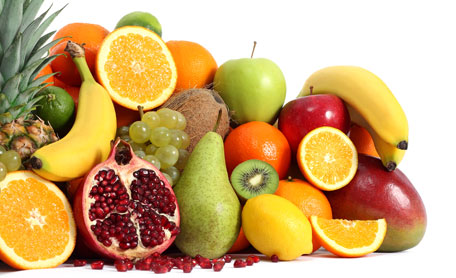
Although it is uncertain why, some children with dyslexia or attention deficit disorders may have a negative reaction to orange juice. Switching to other fruit juices such as apple or grapefruit, may be a better alternative. When eliminating orange juice from the dyslexic child’s diet, be sure to supplement with other sources of vitamin C.
In addition to removing foods and beverages that may produce negative effects, the dyslexic child may also be helped by supplementing his diet. This may be done by the use of nutritional supplements, such as omega-3 fish oil. Cod liver oil supplements may also be given to improve concentration in dyslexic children.
As a recommendation, children affected by dyslexia should incorporate at least two to three servings of fish or seafood into their diet every week. Salmon and sardines are excellent choices for a dyslexia diet. Tuna fish is another good choice for the dyslexic child, although you might limit it to one serving per week. In addition, choose foods that have moderate amounts of iron, as iron deficiency may worsen the effects of dyslexia. Foods rich in iron include calf liver, egg yolks, and spinach.
Foods rich in zinc may improve the concentration of children with dyslexia. Try incorporating foods such as roast beef, pumpkin seeds, lamb, and crab into the child’s diet for noticeable results. Actually, any type of meat or seafood should supply adequate amounts of zinc, thereby helping to improve concentration.
It is important to note that a child’s diet should not be modified or changed drastically without consulting with his or her pediatrician. Your child’s doctor may recommend a change in diet, although he may also emphasize other lifestyle changes. When considering new supplements, always consult with your child’s physician, especially if he or she is taking other medications.
About the author: Noami Esterly divides her time between managing a house of three boys (her husband and two kids) and a newborn baby girl, volunteering in her community center, and writing.
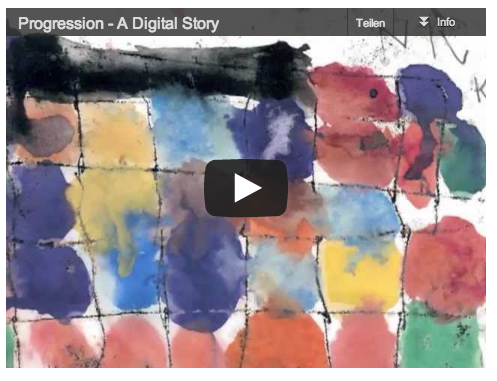
My name is Nick Damato, and I would like to share my story about my struggles growing up with dyslexia. I hope to help shine some light on our society and evaluative school system, as well as give hope to other learning-disabled students. I hope to speak to parents and students in the future, promoting that we can make it together with the help and support of one another. This video below is my 2-minute digital short story told through my eyes:
An interactive Apple iBook for the iPad shows solutions for dyslexic persons. It is on sale for only $1.99.
In this inspiring publication, Dr. Astrid Kopp-Duller and Livia R. Pailer-Duller perpetuate their title as the authority on the subject as they delineate the necessity of intervention with incredible insight at the educational-didactic level. Which is of preeminent importance for success in the training of those who have difficulties with reading, writing, or calculating.
Fun Foods for Kids & Grownups: Your essential guide to family fun & good health by Linda Davis Kyle introduces its menu highlights through a fantasy story, “Adventures in Abunda Gardens,” that not only intrigues youngsters to try the recipes from the magical gardens, but also brings families together for the joy of reading, bonding, and exchanging ideas. With its smart-start recipes, it helps avoid “good-for-you” and “bad- for-you” traps, fosters a rational attitude about foods, and enhances high self-esteem and emotional stability.
It offers tips for staying trim and encourages adults to model the beauty of exercise and fitness for their children. It also nurtures learning with fun facts and historical data, shares a wealth of additional reading materials, includes a useful appendix, a handy index, and outlines sample menu ‘highlights’ for two weeks. Most of all, it reminds its readers to make every day a celebration of life and good health.
Equine Therapy is an experiential, evidence-based therapy involving horses. The client works with the horses, along with a certified horse specialist and therapist, to help achieve the client’s goals. EAP is appropriate for individuals of all ages, as well as groups, families, and couples.
Ideal for kids and families struggling with:
Addiction
ADHD
Autism
Eating Disorders
Family Conflict
Learning Disabilities
Social Anxieties
Through a series of activities, participants identify with the horses and learn how to better communicate with others. Participants work on problem-solving games, such as moving the horse through an obstacle course. Activities help clients learn to trust their thought processes as well as work in a team to think and act outside their comfort zone.
Equine Therapy increases empathy through grooming activities and caring for the horses. The horses keep the participants in the moment, focused on a task, and completely honest. All EAP sessions are facilitated by a licensed therapist or a Marriage and Family Therapist Intern under the supervision of a BBS licensed supervisor.
BIG Heart Ranch in Malibu, California, is a facility specializing in healing youth and adults struggling with mental health and everyday issues through Equine Assisted Psychotherapy (EAP) and Equine Assisted Growth and Learning (EAGL). Cofounder Suzi Landolphi is certified in EAP, and cofounder and Program Director Brian Goldberg is a Certified Equine Specialist. Together with their staff and animals, they provide various animal-assisted therapies.
For those enveloped in a world of chaos, confusion and misunderstanding, Dyslexia Dyscalculia ?! is the new “iconic” global position system for minds that aspire for a better understanding to guide those suffering from dyslexia.
In this awe-inspiring publication, renowned authors, Dr. Astrid Kopp-Duller and Livia R. Pailer-Duller, perpetuate their title as the authority on the subject as they delineate the necessity of intervention with incredible insight at the educational-didactic level. Which, is of preeminent importance for success in the training of those who have difficulties with reading, writing or calculating.
Infused with the key ingredients for successful training, the authors’ erudition of the most complex aspects of the pedagogic processes have been simplified in an epicurean recipe for the successful teachings of a misunderstood and somewhat unchartered methodology. “We’re entering a new era of learning and this publication is without a doubt at the forefront of modern teachings.” — K. Cole
“A benvolent addition to any serious literary resource collecton.” — B. Dalton
As an Amazon Associate I earn from qualifying purchases.