Category: News

  • Dyslexia, Bilingualism, and Learning a Second Language by Francois Grosjean, Ph.D.

    Dyslexia, Bilingualism, and Learning a Second Language by Francois Grosjean, Ph.D.

    Dyslexia in bilinguals and second language learners.

    Interview conducted by François Grosjean for his Psychology Today blog “Life as a Bilingual”: https://www.psychologytoday.com/us/blog/life-bilingual

    The National Institute of Neurological Disorders and Stroke (NINDS) defines dyslexia as a brain-based type of learning disability that specifically impairs a person’s ability to read (see here). The British National Health Service (NHS) gives a fuller definition: it is a common learning difficulty that can cause problems with reading, writing, and spelling. The NHS also lists a number of problems that people with dyslexia have: they read and write very slowly, confuse the letters of words, put letters the wrong way round, have poor or inconsistent spelling, have difficulty with information that is written down, etc. (see here).

    Dyslexia is the most common learning disability and has been the object of much research published in books, chapters, and articles. Psychology Today has also reported on this work through its bloggers, such as Dr. J. Richard Gentry (see here for an example). Unfortunately, we know much less about dyslexia in bilinguals, in second language learners, or in students schooled in a second language. The latter can be in immersion or bilingual school programs, or can come from minority language groups being educated in the majority language. Dr. Fred Genesee, Professor Emeritus at McGill University, is one of the leading experts on this topic, and he has very kindly agreed to answer a few of our questions. We thank him wholeheartedly.

    Are there more dyslexics among bilinguals than among monolinguals?

    There is no evidence that dyslexia is more common among bilinguals than among monolinguals.

    Does being bilingual cause dyslexia or increase the probability of becoming dyslexic?

    Again, there is no evidence that bilingualism causes dyslexia. Dyslexia is linked to neurocognitive factors that are inherited. It is thought that children with dyslexia have an inherited impairment in processing the sounds of language. This means that children born with the genetic profile that is linked to dyslexia will have difficulty learning to read, whether they are bilingual or monolingual.

    When talking about dyslexia in children, shouldn’t one insist on something that you have put forward in your writings—the distinction between reading impairment and difficulty learning to read?

    Yes, this is crucial. Reading impairment is due to underlying neurocognitive factors mentioned in my previous answer, whereas difficulty learning to read is linked to other factors, such as the child’s learning environment, motivation, quality of instruction, or general health. For example, some children have difficulty learning to read in school because the quality of instruction they receive is not always optimal; because they have an undetected visual impairment, which makes it difficult to see and process written language; or because they are uninterested in learning to read because they find the reading materials in school boring. These children’s difficulties are not genetic in nature and are not true dyslexia.

    Concerning children who are in the process of learning a second language, can they be at greater risk for difficulty learning to read than children learning through their first language?

    Yes, this may be the case because they are still learning the language that is being used to teach reading in school, and some teachers may not have modified instruction to take this into account. Second language learners might also have greater difficulty than monolingual students learning to read because the cultural content of the reading material is unfamiliar, or because the teacher’s cultural expectations of how they should behave in class are foreign or even difficult for them.

    Unfortunately, tests that assess progress in learning to read can make it appear that bilingual children have an impairment because they do not consider the linguistic level of the children. But none of these factors are symptomatic of reading impairment or dyslexia per se.

    Going back to actual dyslexia, what are the difficulties faced by second language learners who are dyslexic?

    The core difficulties faced by second language learners who are dyslexic are the same as those of monolingual children with dyslexia. The core problem for these children is difficulty learning to decode written words accurately and fluently so that they can make sense of them and understand written text. If children’s word-reading skills are impaired, then their comprehension of written text will also be impaired because they cannot read the individual words accurately and fluently enough to create meaningful text.

    In addition, second language learners with dyslexia face the challenges encountered by all second language learners—limited vocabulary and grammatical competence and lack of familiarity with the cultural or social context of the text. In this respect, their challenges are different from monolingual children.

    Can the effects of dyslexia in bilinguals be stronger in one language than in the other?

    Dyslexia in bilinguals is evident in both languages. This is the case because the impairment that underlies dyslexia is part of the learner’s genetic profile and, thus, its effects will influence the child’s ability to learn to read in any language. Of course, since many bilinguals are more proficient in one language than the other, the magnitude of their impairment will be more evident in their weaker language.

    A bilingual child who has a reading problem in only one of his/her languages does not have dyslexia. This child has difficulty learning to read in one of his/her languages that is due to other factors, as we discussed earlier.

    It is often recommended that the parents of children who are thought to be dyslexic stop using the home language on the assumption that this will make it easier for their child to overcome their dyslexia. What is your opinion on this?

    There is no evidence to support this assumption. If the child is from a minority language community where the language is important for communication with parents, extended family members, or others in the community, parents should continue to use the home language. There are many reasons for this. First, proficiency in the home language is important if the child is to become an engaged and well-adjusted member of his family and community. In addition, parents of minority language children are often more proficient in the home language and, thus, they are better able to assume their full parental responsibilities if they interact with their child in that language.

    What are the other reasons?

    To continue reading, please access the original post here.

    Article originally posted on Mar 01, 2019 in https://www.psychologytoday.com/us/blog/life-bilingual/201903/dyslexia-bilingualism-and-learning-second-language

    by Francois Grosjean
    Université de Neuchâtel
    Suisse/Switzerland
    [email protected]
    Website: www.francoisgrosjean.ch
    Blog: http://www.psychologytoday.com/blog/life-bilingual

    François Grosjean, Ph.D., is Emeritus Professor of psycholinguistics, Neuchâtel University, Switzerland. His domains of interest are the perception, comprehension and production of language, be it speech or sign language, in monolinguals and bilinguals. He also has interests in biculturalism, applied linguistics, aphasia, sign language, and natural language processing. He is better known for his work on bilingualism in which he has investigated the holistic view of bilingualism, language mode, the complementarity principle, the processing of code-switching and borrowing, as well as the bilingualism of the Deaf.

    He is the author of numerous articles and of seven books on bilingualism: Life with Two Languages (Harvard University Press, 1982), Studying Bilinguals (Oxford University Press, 2008), Bilingual: Life and Reality (Harvard University Press, 2010), The Psycholinguistics of Bilingualism (with Ping Li; Wiley-Blackwell, 2013), Parler plusieurs langues: le monde des bilingues (Albin Michel, 2015), The Listening Bilingual: Speech Perception, Comprehension, and Bilingualism (with Krista Byers-Heinlein; Wiley-Blackwell, 2018) and A Journey in Languages and Cultures: The Life of a Bicultural Bilingual (Oxford University Press, 2019).

  • Two Blind Mice – In A Squeaky Drawer by Robert Z. Hicks

    Two Blind Mice – In A Squeaky Drawer by Robert Z. Hicks

    Mouse in the Manger was illustrated and formatted by Ashley Otis.  She incorporated the following elements that would be appropriate for children, and make it easier for them to read:

    • Colored font that is simple and enlarged.  Arial font is a good choice.
    • The lines should be spaced apart, so the eye tracks on each line.
    • There should be no “breaks” or hyphens in words at the end of a line.
    • No right justification that might create irregular spacing between words. 

    Using short simple sentences is how rhyming stanzas are constructed, so a rhyming story is already kid-friendly.

    I write by inspiration, so how did I get started on Mouse in the Manger? I remembered the mangers in the stalls in Grandpa’s barn where I released two baby mice.  Here’s the whole story:

    Upstairs in the big farmhouse where I grew up there was a large storage room. Halfway down the long spooky dark hall was a door on the left with a step down into the storage space.

    A pile of old mattresses way back in the corner gave me a place to curl up to read or dream, or listen to the blowflies buzzing by the window. I was lying on the mattresses reading a Dick Tracey Big Little Book when I heard a faint squeaking. I traced the sound to a chest of drawers on the other side of the room.

    The squeaking stopped when I slowly pulled the bottom drawer way out. There it was! Tucked way in the back of the bottom drawer was a wad of shredded paper, wool, and cloth bits fashioned into a perfect rectangle so it exactly fit the space. I hoped the shredded paper wasn’t one of my favorite comic books!  Was this a mouse nest in our chest of drawers?

    I carefully parted one end of the nest, and pulled the top back to see inside. Wow! There, nestled in the smooth interior compartment were two tiny baby mice. Their pink skin had no fur, and their eyes were not yet open.

    Oh, oh! We had caught a mouse in a trap in the work room downstairs. Could that have been their mother? I called Mom to see. Mom told me that it didn’t matter if mother mouse was gone or not, because now that I had touched the nest, my scent would be there, and she would not return.

    Obviously, mice were too destructive to have living in the house.  And, it would be impossible to feed such tiny things, even if we did want to save them.

    I didn’t figure on Mom’s incredible compassion for little creatures, and her ingenuity. My sister had a baby doll with its own little baby bottle that actually worked. With Mom’s patience and steady hand, she managed to entice the baby mice to drink a milk and honey formula from that little bottle. Daddy just shook his head in disbelief. Mom nursed and cared for those tiny mice until their fur had grown, their eyes were open, and they were trying to climb out of their box.

    I let them go in the barn next to the mangers in the stalls where Grandpa had kept the big work horses. The barn was the perfect place. They could do no harm, and there was no one to harm them. They scampered free to live happily ever after!

    Hmmmm, a mouse in the manger. A rhyme popped into my head. What would a mouse be doing in the manger? Looking for food, of course.  As the story developed, I wondered if there were too many children’s books about the Christmas story. Researching, I discovered mine was different; it was in rhyme, scripturally correct, and reasonably credible.

    My books have study guides with questions and answers which the Executive Director of the American  Dyslexia Association told us also helped dyslexic children with comprehension and retention.

    Ashley Otis began working on the illustrations, formatted the book, and got it ready to print.

    You can preview and purchase the book on Amazon.

  • Ross Linnett’s Journey from Struggling Student to International Business Owner of Recite Me

    Ross Linnett’s Journey from Struggling Student to International Business Owner of Recite Me

    Ross Linnett, Founder and CEO of Recite Me, can still remember his first day of school with surprising clarity.

    He recalls, “I was way ahead of everyone else in regard to reading. I think I was reading from around the age of 2, but from age 4 and 5 I was in a special reading class. You had to be pretty bad at English to get into this class!”

    At that point, growing up in the mid 80s in north east England, Ross and his parents had never heard of dyslexia. Perhaps his teachers didn’t either. Knowledge of dyslexia still had a long way to go, but it quickly became known that Ross needed extra help.

    Ross explains, “It was a less pressured environment, so I didn’t feel like I was getting into trouble. If a teacher really took their time with me, I could excel. It was obvious then that I needed an adjustment.”

    Despite the clear signs that Ross needed extra assistance in the classroom and even dyslexia testing, support from his school was minimal. Ross recalls, “One teacher even told me, ‘Don’t be stupid, you don’t have dyslexia,’ and a dyslexia specialist himself once looked at my school essay and told me I didn’t have dyslexia.”

    During this disorienting time in school, Ross credits his talent in sports for building his confidence in school despite his struggles with reading and writing. “You never really get bullied at school if you’re good at sport, and it also gives you a lot of confidence,” Ross says, “But the thought of reading aloud used to send shivers down my spine. I’d be dreading it all day. It was the equivalent of jumping off a 100ft cliff.”

    It wasn’t until Ross became President of the Students’ Union at Northumbria University that he forced himself to speak publicly and face his dyslexia head-on. As he explains, “I was presenting at the Students’ Union when somebody pointed out that their father specialized in dyslexia and suggested I get tested for it. I got myself tested at university, and they confirmed I had dyslexia.”

    Ross soon learned that he wasn’t alone. As one of the most common learning disabilities in the world, common vision impairments and learning disabilities mean that millions of people around the world struggle with web accessibility, leading them to miss out on the valuable resources of the Internet, including career development, socialization, learning tools, and engaging with businesses.

    The need for portable, cloud-based software that would make online content accessible to a variety of needs, including dyslexia and common vision impairments, became crucial. It was from this experience that Recite Me was born.

    “We were involved with the Disability Discrimination Act as a Student Union at the time, but I was very aware that employers had to make the adjustments. It meant that every organization, under the Disability Discrimination Act in the United Kingdom, had the responsibility to cater to people with dyslexia or visual impairments, in the same way that buildings had to install ramps for people with physical disabilities. Everyone had to do it, but nobody was because the technology wasn’t there, so that’s when I came up with Recite Me.”

    Since its early days, Recite Me’s software has been improving the web experience for millions of customers around the world who live with vision impairments, disabilities, or dyslexia. As businesses continue to move their operations online, and with an aging population, we expect our software to become even more vital in the future.

    Ross adds, “When you get diagnosed later in life, you tend to question things more. It made me realize how negatively dyslexia had shaped my life up until that point.” Despite a difficult time at school, Ross has certainly not let dyslexia hold him back.

    After much success in the UK, Recite Me is now expanding its operations to the US. Part of this expansion plan included opening a new office in nearby Naples, inside the Naples Accelerator. Despite our growth, our original mission remains at the forefront: to support and aid those with dyslexia or impairments around the world.

    http://www.reciteme.com

    Article written by Rachel Holbrook

  • Danny the Dragon by Robert Z. Hicks

    Danny the Dragon by Robert Z. Hicks

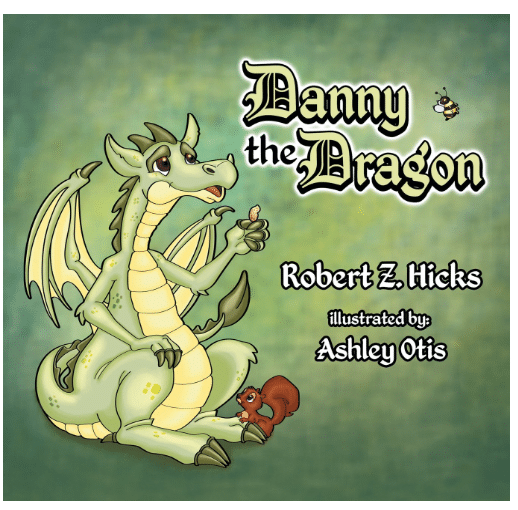
    My children’s rhyming story picture book, Danny the Dragon, was at the Page Design department of my publisher when I picked up the Winter Bulletin of the Society of Children’s Book Writers and Illustrators. (SCBWI) An article by Dr. Theodore Cohen, PhD, “Are Authors Giving Up On 20% of Their Readers?” caught my attention.

    Dr. Cohen discussed things that helped children with language-based learning disabilities, especially those with dyslexia.

    Some of the things that Dr. Cohen mentioned, like a font that keeps space between letters (sans serif) spacing out lines of text, and enlarging the text, I had already implemented in my previous books. These readability elements help any child, not just those struggling to read. Prompted by his article, I informed our publisher we wanted Arial font, which is sans serif, and no right justification which can create irregular spacing between words.

    An email to the American Dyslexia Association asking for suggestions for making my book “dyslexic friendly” resulted in a response confirming our choice of font, and giving a suggestion to avoid “noise” behind letters, such as text over artwork. I was pleased that the American Dyslexia Association offered to look at my books.

    I was delighted to receive a message from American Dyslexia Association with the information that they had “tested” my books on school children, especially one girl said “she was delighted.”  In fact, the girl asked for two of the books to be read again! My books, especially Danny the Dragon, are now approved by the American Dyslexia Association.

    A serendipity occurred when I went online to see what Open Dyslexic font looked like. I found an article by dyslexia expert Dr. Guinevere Eden, a professor at Georgetown University and director of its Center for the Study of Learning. In the context of discussing the lack of research validating “dyslexic friendly” fonts, Dr. Eden stated: “The fundamental problem of dyslexia is in mapping the shapes of letters to the right sound units or phonemes.”

    The ”right sound units or phonemes” jumped out at me, because I had already learned that rhyming helps children make the connection for phonemic awareness!  And, my books are stories in rhyme!

    Another search of rhyming and dyslexia uncovered research by Usha Goswami, Professor of Cognitive Developmental Neuroscience at Cambridge. Dr. Goswami asserts: “Children who are dyslexic struggle with speech rhythm.” She suggests that children can overcome dyslexia by learning nursery rhymes, dancing, and singing, because the condition is caused by a lack of rhythm patterns in the brain.

    Rhyming with rhythm is what I do!

    Danny the Dragon is a rhyming story picture book with a rhythmic beat!

    “Danny the Dragon” is available on Barnes and Noble, and Amazon: https://www.amazon.com/dp/1641912839?tag=legasthenie0c-20

    To preview Robert’s books, visit his website at www.robertzhicks.com.

    Robert Z. Hicks

    “Mr. Bob”

  • DocLexi™ – Learn Reading with Fun!

    DocLexi™ – Learn Reading with Fun!

    All new comprehensive app to improve children’s reading and spelling skills, based on proven therapeutic concepts

    DocLexi™ has been developed with the objective of helping children learn how to read, spell, and write with fun. It focuses on helping struggling readers and those with early signs of dyslexia. DocLexi™ has been built based on proven therapeutic concepts and delivers a comprehensive software to improve children’s spelling, reading, and writing skills. It was developed by dyslexia specialists based on their extensive experience and continuously tested with children during development. The games and activities are currently aimed at 5 to 7 year olds (up to grade 2 reading/writing skills). There is a consumer version available for children and their parents, as well as a professional version for specialists, therapists, and teachers. The professional version provides for a seamless integration with a therapist by allowing them to customize the app to meets the child’s needs and track progress by logging into the administration tool in their browser.
    Lori Johnston (M.A., CCC-SLP, Licensed Speech Language Pathologist), who developed the concept for DocLexi™, says: ”My 25+ years of experience in working with children who have reading and writing difficulties has enabled me to help create an app called DocLexi™. It has always been my dream to provide children with a tool that makes it easier and more fun for them to overcome their learning difficulties. DocLexi™ is the result of that dream and I am excited to see it come to life.”
    The program utilizes a multi-sensory approach by incorporating the following skills: visual scanning and tracking, visual spatial, recall, sequencing, phonological processing, and phonics (encoding and decoding).
    The exercises are embedded into the exciting DocLexi™ story. The children help the heroes achieve a happy ending by solving the individual learning tasks.
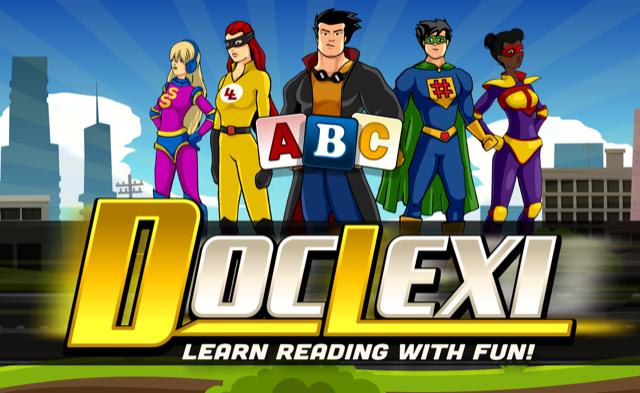
    The DocLexi™ team developed a machine that helped children learn to read, spell, & write. The Outer Space Mixer Monsters stole the machine, broke it apart and hid the pieces all over the world. The DocLexi™ Team is traveling and completing tasks to find the parts to the machine. On all their missions, the children are accompanied by DocLexi™ and his friends. In each game, the children can earn coins to customize their own avatar friend, give him a name, and change his looks and outfits. It’s seriously fun!
    DocLexi™ is available in English and German at launch.
    DocLexi™ covers a broad array of skills to help children learn reading and writing:
    • • Sequencing tasks (letters and numbers)
    • • Identifying letters and numbers
    • • Syllables (number of syllables in a word)
    • • Blending – find words (by sounds or picture)
    • • Building words (unscrambling words using phonics patterns)
    • • Reading order (tracking left to right, top to bottom)
    For a sneak preview check out this video and visit https://doclexi.com/ for more information.
  • Can Rhyming Help Children Learn to Read Better? by Robert Z Hicks

    Can Rhyming Help Children Learn to Read Better? by Robert Z Hicks

    Robert Z Hicks, known as “Mr. Bob” is an award-winning author and publisher of children’s rhyming picture books.  

    Coming from a career of teaching college, how did you get started writing children’s books?  Had you always dreamed of someday writing children’s books?


    No, it never occurred to me to write children’s books.  I thought I was retired after teaching speech communication for 24 years at the University of Hawaii. But, after watching my wife Betty chase a green tree toad around the living room trying to capture it under a paper cup, I started reminiscing about critters I enjoyed as a child growing up on my grandfather’s farm in Michigan in the 40’s.  I felt inspired to write a rhyming poem based on my memories. 

    A friend encouraged me to write more stories, and there followed a flood of inspiration of rhyming stories triggered by memories of my childhood experiences.

    How many stories did you write?

    About 40. We took manuscripts of Tommie Turtle’s Secret, Mouse in the Manger, and several other stories to the Florida Christian Writers’ Conference in 2005 to find out what writing and publishing books entailed.  Surprised and encouraged that the stories won Best Submission for Children’s Writing, we decided to publish my first book, “Tommie Turtle’s Secret”.

    What makes your books different from other children’s books out there?

    The stories are written in rhyme, and each stanza is accompanied by an illustration that helps the child visualize the story and what the words are saying.

    As a teacher, I add value to my books by including a study guide with questions to test comprehension, and comments to highlight things to be learned.

    I discovered research that early learning of rhymes increases phonemic awareness and improves the ability to read. Reading nursery rhymes and rhyming stories to babies and young children helps establish the ear-brain connection for discriminating sound units. 

    I asked Crystal Bowman, my mentor, friend, mother, and successful children’s author, what she thought of rhyme, which she uses in her books.

    Crystal Bowman’s perspective on rhythm, rhyme, and reading:

    “I know that babies are born with a strong sense of rhythm. They respond to rocking, repetition, and music. They naturally clap their hands and move to music and rhythm.
     
    Text written with repetition and rhyme is a help to a struggling reader because the repetition helps them learn new words, and the rhyme helps them with pronunciation. (they know what the word needs to sound like).”

    I was excited to learn that rhyming helps children read more effectively.  It gave purpose and direction for the inspiration of the stories God gave me, and for my gift for rhyme. I wasn’t looking for another career, but I am delighted to have a new purpose and cause to pursue in my life.

    What is Tommie Turtle’s secret?

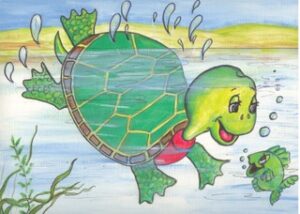
    Tommie’s secret is the story of the day he raced Speedy Hoppy Bunny to teach the bunny valuable lessons about friendship.  A surprise twist at the end highlights moral values of forgiveness, and that being nice, not bragging and teasing, is the way to make friends. 

    Questions and commentary at the end of the book test comprehension, stimulate critical thinking, and provide a basis for discussion of the effect of bragging and teasing on relationships. Parents can also point out that by focusing on the abilities Tommie had, not on what he couldn’t do, Tommie could still enter the race.

    “Tommie Turtle’s Secret,” won Best Children’s, and Book of the Year in the 2008 Florida Writer’s Royal Palm Awards competition.


    How many books have you published?

    I’ve published three picture books, “Tommie Turtle’s Secret,” “Mouse In the Manger,” and “Danny the Dragon,” and an ebook, “Once I Was A Kid, With the Wild Things On The Farm”.  

    Are you going to publish more children’s books?

    Absolutely! My heart’s desire is to use my gift of rhyme to help children learn to read and to develop a love for reading!

    “Tommie Turtle’s Secret” is available on  Amazon.

    To preview Robert’s books, visit his website at www.robertzhicks.com

  • Children’s Book “The Uncooperative Flying Carpet” by Michele Clark McConnochie to Raise Funds for American Dyslexia Association

    Children’s Book “The Uncooperative Flying Carpet” by Michele Clark McConnochie to Raise Funds for American Dyslexia Association

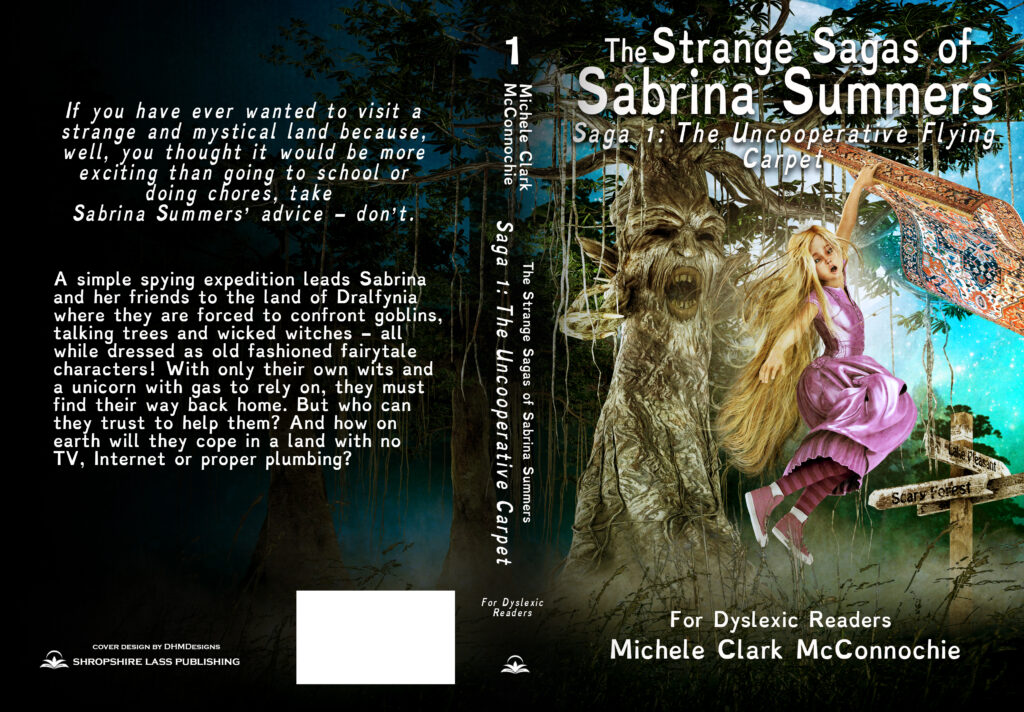
    Michele Clark McConnochie is not dyslexic, nor does she have a loved one who is dyslexic. What she is is a teacher and children’s author who passionately believes that all young people are entitled to books with stories that they love and characters that they can identify with.

    Growing up in Europe, she was a bookworm who dreamed of becoming a writer. After a career in education, she finally achieved that dream, and her first middle-grade children’s novel—The Uncooperative Flying Carpet—is scheduled for publication in August 2018 by Morgan James Publishing. However, Michele wanted to make her book available to all readers, including those who are dyslexic. She realized that there would need to be a version especially for dyslexic children. With the permission of Morgan James, Michele has arranged for The Uncooperative Flying Carpet to be available on Amazon.com in a special dyslexia-friendly version.

    These versions are printed in dyslexie font, a special font created in the Netherlands, which is designed to make reading easier for the dyslexic brain. They also have cream, rather than glaring white paper, and a ragged right-hand margin. The feedback from readers has been really positive, with dyslexic children saying they found these versions much easier to read.

    From the get-go, The Uncooperative Flying Carpet was written for avid and reluctant readers alike. Each chapter is short, suitable for those who find reading taxing, but most end with a cliff-hanger to encourage the child to read ‘one more chapter.’ There is plenty of humor and a fast pace to keep readers engaged; the feisty central character is Sabrina Summers, a leader who is a great role model for girls, and her brother Rory is a dyslexic boy who goes on to prove that the creative way of thinking that he credits to his dyslexic brain can save the day.

    One dollar of every copy of The Uncooperative Flying Carpet for Dyslexic Readers sold will be donated by Michele to the American Dyslexia Association, Inc.

    To buy a copy, visit: https://www.amazon.com/dp/0473317001?tag=legasthenie0c-20


  • KAZ – SEN/Dyslexia Typing Software

    KAZ – SEN/Dyslexia Typing Software

    If individuals with dyslexia are equipped with the correct tools, they stand a far greater chance of reaching their full potential.

    Trials and feedback from special needs teachers across the world have proven that touch typing and using a computer are formidable and even life-changing tools that open doors for individuals with dyslexia, as they present a new and powerful medium for learning and communicating – introducing them to a new, accessible academic world they can cope with and even excel in!

    The disturbances experienced by dyslexics make writing and producing a piece of work extremely challenging. The level of concentration and effort involved can be exhausting and can affect the overall structure and quality of a piece of work.

    The skill of typing can help eliminate many of these challenges and frustrations, and early acquisition familiarizes users with the keyboard, allowing them to fully appreciate the tools available to them through typing and using a computer.

    When typing:

    • The need for neat handwriting is no longer a priority.
    • Errors can be easily edited/corrected without messy crossings out, resulting in neat and presentable work.
    • Spell checkers highlight mistakes and offer alternatives.
    • Reassurance with the above automatically boosts confidence – promoting experimentation with vocabulary and spelling, and allows concentration to be focused on content.
    • Quick and accurate typing can reduce the amount of time spent on a piece of work and often increases the amount of work produced.
    • Physical dexterity is enhanced, helping with handwriting skills.
    • Reading, spelling, and vocabulary are ingrained in memory – with ‘muscle memory’, spellings become a series of finger movements and patterns on a keyboard, reducing the likelihood of transposing or misspelling words.
    • The working memory is not overloaded. Students can work at their own pace in a non-linear fashion, where they can process their thoughts first and structure them later.

    KAZ’s NEW SEN/Dyslexia typing software was developed with advice and guidance from the British Dyslexia Research Trust.

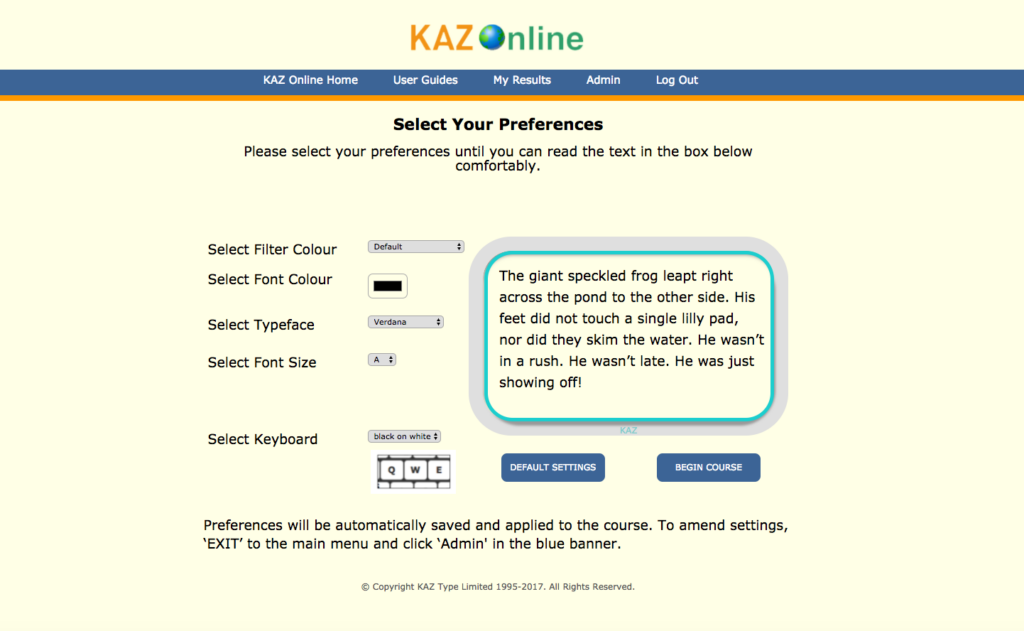
    Incorporating a multi-sensory approach throughout and available with US and UK accents and keyboards, it teaches typing skills whilst minimizing disturbances related to visual stress, by means of a unique ‘Preference Screen’ – tailoring the course to individual’s needs.

    Preferences include:-

    • A choice of colored background/filter screens – for reducing white screen glare.
    • A choice of 2 specific research-based background/filter colors – for steadying letter movement and blurring.
    • A choice of dyslexic friendly typefaces – for ease of reading.
    • A choice of font colour – for contrast from background screen colour.
    • A choice of font size – for optimum visibility, comfort and to minimize fusing and crowding of letters.
    • A choice of Keyboard for optimum visibility comfort.

    Once the user has selected their preferences and can read the sample text comfortably, these options are applied throughout the course, ensuring the learning experience is a comfortable and enjoyable one. No other typing tutor works in this way.

    The program uses a unique and proven ‘accelerated learning’ teaching method. Incorporating both ‘muscle memory’ and ‘brain balance’, it engages the major senses of sight, sound, and touch simultaneously, radically enhancing memory retention and recall, which is why it is so effective.

    Using specific combinations and progressions of just 11 words in 5 scientifically structured phrases, the method trains the fingers on both hands to work symmetrically and simultaneously – a direct result of both hemispheres of the brain working at the same time – ‘brain balance’.

    With repetition, reading, spelling, and vocabulary are ingrained to memory and with ‘muscle memory’ spellings become a series of finger movements and patterns on a keyboard, reducing the likelihood of transposing and misspelling words.

    The Course is presented in a structured but light-hearted manner to make learning fun and enjoyable. It solely focuses on teaching typing and does not include gaming or try to teach typing with other subjects, as research has proven that this splits concentration and may overload the ‘working memory’.

    The program offers both spoken and written instruction and includes ‘speaking keys’ covering the a-z keys. It is delivered in 5 short modules, in order to hold interest and concentration, and once again, avoid overloading the working memory. The student is allowed to progress at their own pace, acquiring the skill and gaining speed and accuracy without even realizing it. Additionally, a visual of the keyboard is always on the screen, encouraging the user to look up at the screen and not down at their fingers (so there is no need to cover hands or keyboard).

    The combination of KAZ’s unique ‘Preference Screen’ and its proven accelerated learning teaching method delivers a simple, yet dynamic course.

    The software is suitable for ages 6+ and is available in ‘Junior’, ‘Adult’ and ‘Corporate’, editions  – Online, as a Download, or via SCORM for LMS.

    Since launch, it has received wonderful reviews and is now promoted by the British Dyslexia Association and many SEN resellers across the world.

    www.kaz-type.com

  • Are Authors Giving Up On 20% Of Their Readers? by Theodore Jerome Cohen, PhD

    Are Authors Giving Up On 20% Of Their Readers? by Theodore Jerome Cohen, PhD

    I DON’T KNOW of any industry that purposely would give up 20% of its potential markets without a fight. Yet, mistakes we make in the selection of typefaces, formats, and backgrounds can indeed have that effect.

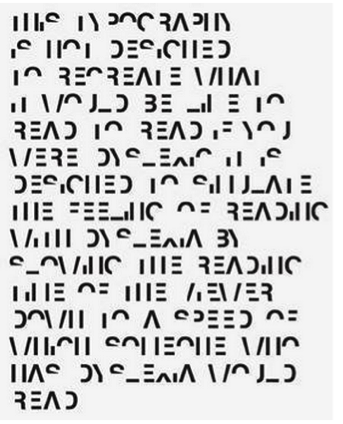
    What I am speaking of is the fact that one in five students, or 15-20% of the population, has a language-based learning disability, with dyslexia being the most common of the language-based learning disabilities. Importantly, approximately the same percentage of males and females have dyslexia. For clarity, kids with dyslexia have trouble reading accurately and fluently. They may also have trouble with reading comprehension, spelling, and writing (see goo.gl/dAFaeP). Not being dyslexic myself, I sought insight into the problem from someone who was: UK graphic designer Daniel Britton. What he revealed was startling. What Britton did was to design a typeface intended to recreate for non-dyslexic readers the frustration and embarrassment people with dyslexia experience when they attempt to read newspapers, books, and other literature most people are able to read every day of their lives (http://danielbritton.info/dyslexia). An example of simple text rendered in this typeface is shown below:

    Typeface Britton

    Not a pretty picture, is it?! Were you able to decipher it?

    Take heart. The situation is not hopeless. It was Britton’s work that inspired me to move forward with the creation of a special edition of my YA novel, The Hypnotist, for readers with dyslexia. Here, I completely reformatted the text using the free, OpenDyslexicAlta typeface (http://opendyslexic.org/). Bottom heavy, with unique character shapes, the OpenDyslexicAlta typeface helped make it more difficult for the reader to confuse letters. I also eliminated the text’s right justification, which confuses dyslexics. The final text was sufficiently “dyslexic friendly” as to win the endorsement of the American Dyslexic Association and the Wisconsin Institute of Learning Disabilities/Dyslexia (WILDD).

    Admittedly, changing the typeface for your paperback book to meet a subset of your potential readership is a time-consuming effort, and there is no guarantee the return on investment will prove worthwhile. (NB An Open Dyslexic typeface is available on all Kindle readers; check availability on other eReaders you are considering.) But there are other things you can be doing as you prepare your books, including your eBooks, for publication that will help those suffering from language-based learning disabilities.

    1. I’ve already mentioned dropping right-justification in your text. This will help the reader maintain line-to-line continuity.
    2. Use a sans serif typeface (e.g., Arial, Comic Sans, Verdana, and others). For my series of illustrated children’s storybooks in verse, I use Segoe Print.
    3. Increase the spacing of the letters and/or the lines over that normally used.
    4. If you are embedding text within your images/graphics, as many do in children’s storybooks today, especially for eReader presentation, be careful to ensure the text is not masked or “entangled” in the artwork.
    5. Be careful about changing letter colors or font sizes within the same sentence . . . it can be confusing.

    Finally, as for students with dyslexia who use eReaders, have them experiment with typefaces as well as with letter and background colors (e.g., try using blue-colored text on a white background or even black text on a light blue/pink/yellow background). You and they may be pleasantly surprised with the results.

    The items cited above are things we, as authors, can do to help students suffering from language-based learning disabilities. Best of all, many are easy to implement.

    Theodore Jerome Cohen, PhD, authored and illustrated the children’s series Stories for the Early Years. He also writes YA novels under the pen name Alyssa Devine. You can visit him at www.theodore-cohen-novels.com or www.alyssadevinenovels.com. Member, SCBWI.

    This article originally appeared in the Winter, 2018, edition of BULLETIN, the journal of the Society of Children’s Book Writers & Illustrators (SCBWI). Reprinted by permission of the author.

    Available on Amazon: The Hypnotist: Special Edition for Readers With Dyslexia

    More by Theodore Jerome Cohen on Amazon

    The Antarctic Murders Trilogy, drawn from the diary he kept on the 16th Chilean Expedition to the Antarctic, 1961-62:

    Antarctic and South American short stories:

    Other series:

    See all books by Theodore Jerome Cohen