Every Tuesday, we open up one lesson of the Dyslexia Trainer Certification Program here on the blog, all 48 of them, one week at a time. Whether you are a teacher, a parent, or an education professional, this series shows you exactly what certified dyslexia trainers learn, and how the program works from the inside.
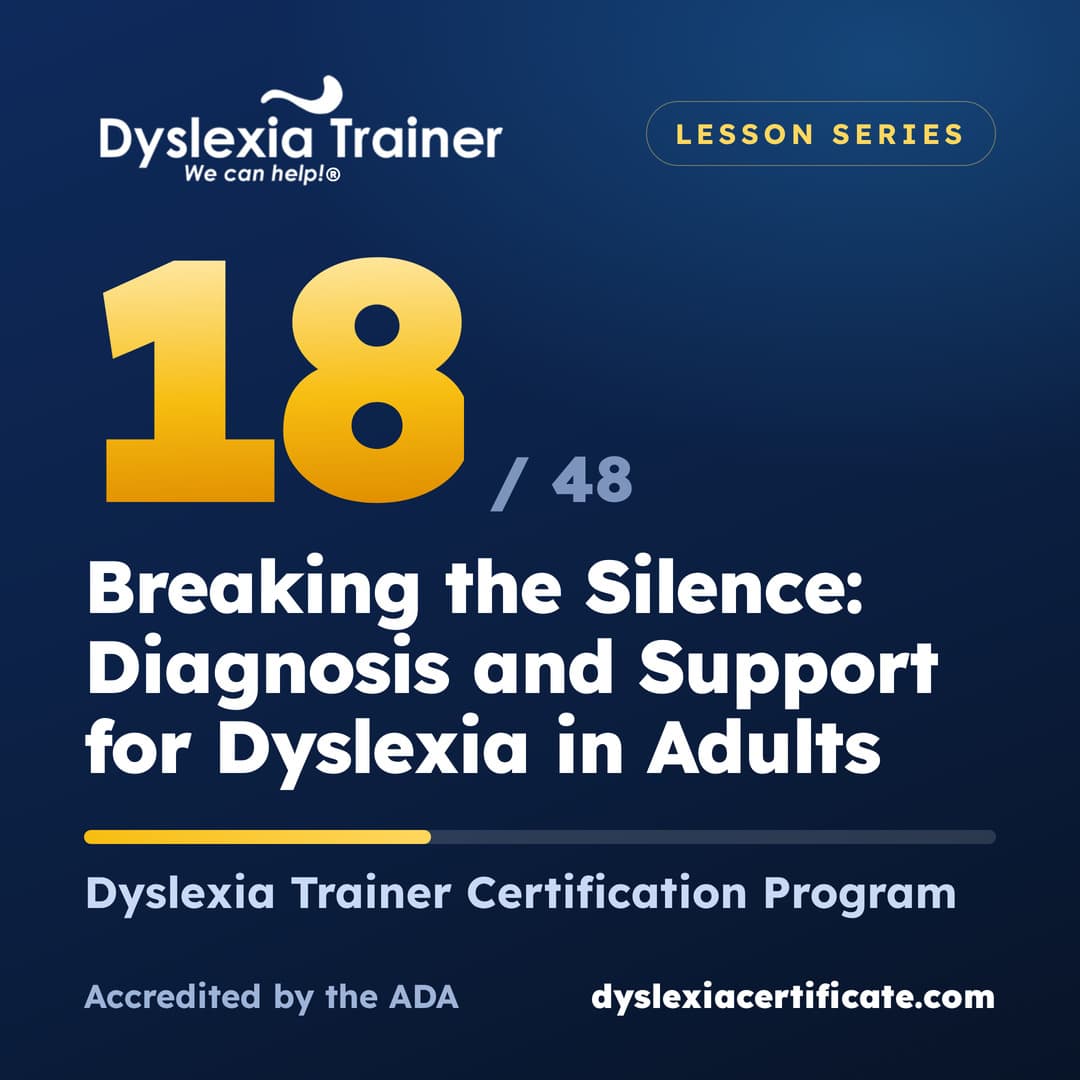
This week: Breaking the Silence: Diagnosis and Support for Dyslexia in Adults
Dyslexia does not end with childhood. Many adults have spent years believing they are simply bad at reading or terrible spellers, never knowing their challenges have a name. This lesson covers diagnosis through case history and error analysis, training approaches adapted for adult learners, and the role of modern accommodations and technology. Meaningful improvement is possible at any age.
What this lesson is about
Dyslexia does not end with childhood, it persists into adulthood. For many, the lack of support in school leaves lingering struggles with reading, spelling, and writing. Some adults have lived for years believing they are “bad at reading” or “terrible spellers,” unaware that their challenges have a name. Others may have built careers and families but still feel anxious when asked to read aloud, complete forms, or write emails.
The good news is that adults can make meaningful improvements. Training looks different than with children, but when motivation, patience, and individualized strategies come together, progress is possible at any age. This lesson explores the specific approaches for adult dyslexia training, including attention (A) and symptom (S) work, diagnosis through case history and error analysis, and the use of modern accommodations and technology.
Dyslexia does not simply “go away” with age. It persists throughout life, with outcomes shaped by the support received in childhood. With effective intervention, individuals can learn strategies to manage letters, words, and text more successfully.
What you will learn in Lesson 18
- How dyslexia shows up in adults who were never diagnosed
- Diagnosis through case history and error analysis
- How adult training differs from working with children
- Modern accommodations and technology that help
About the Dyslexia Trainer Certification Program
Since 1997, more than 17,000 dyslexia trainers in 64 countries have been certified. The certification gives you more than knowledge: all the tools you need to actually work with dyslexic children are included as well. Worksheets, training programs, assessment materials, everything ready to use in your practice. You get the whole package.
The program is accredited by the American Dyslexia Association (ADA) and follows the training standards of the International Federation of Dyslexia and Dyscalculia Associations (IFDDA).
Catch up and start free
Lesson 1 is free for everyone. Register in a minute and see the program from the inside: dyslexiacertificate.com
You can find all published lessons of this series under the tag Lesson Series.
