Tag: dyslexia

  • Understanding dyslexia: Learn how to best help your child

    Understanding dyslexia: Learn how to best help your child

    Just what is dyslexia?

    There are many misconceptions out there.
    familymagazineletters

    “Dyslexia is a type of specific learning disorder that impacts reading,” said Dr. Sheldon H. Horowitz, director of learning disability resources at the National Center for Learning Disabilities. “It is not a disease, nor is it contagious. It is not something that goes away — you don’t outgrow it — and it is not the result of watching too much TV, laziness, vision or
    hearing problems, or low intelligence.

    “The medical community refers to it as a disorder, and the educational community refers to it as a specific learning disability. Others are dyscalculia if the area of weakness is math, dysgraphia if the problem is writing and written expression.”

    Because dyslexia is not a disease, there is not “one treatment for dyslexia. It can’t be cured, especially because dyslexia is not a medical or psychological problem,” said Livia R. Pailer-Duller, executive director of the American Dyslexia Association. “It needs to be addressed through training of the attention span, of sensory perceptions, and the practice of reading and spelling on the educational level.”

    Rather, “dyslexia is a genetic disposition, which means that dyslexia is inherited,” she said. “Dyslexic individuals have different sensory perceptions. These different sensory perceptions are the reason why the attention of dyslexic people diminishes when they come in contact with letters, which in turn causes them to make errors in reading and spelling.”

    What it is

    There is no one profile of dyslexia, but typically, people have trouble sounding out words, blending letter sounds into words while reading, mastering the rules of spelling and grammar, and expressing what they know in written formats, Horowitz said.
    “Some people with dyslexia are accurate readers at a slower pace but struggle to understand what they have read because they expend all of their mental resources figuring out what the words are and keeping track of what they are reading,” he said. “Others are slow, labored readers, but do OK with comprehension.

    “People with dyslexia do not have vision problems that are causing them to struggle in reading. The problem stems from the way that printed text and the sounds of the language are processed in their brains. It’s not that their brains can’t do this processing; it’s that it is done in ways that are inefficient.”

    Also, dyslexia is not intelligence-related.

    “Dyslexics are not less intelligent than non-dyslexics — quite the opposite is often true,” Pailer-Duller said. “However, dyslexics often score low on intelligence tests because these tests attempt to measure intelligence by measuring sensory perceptions. But these are different in dyslexic individuals, which does not make them stupid, just that the test is inadequate.”

    How to help

    For people with dyslexia, “parents are absolutely critical and family support is hugely important,” Horowitz said. “Remember: dyslexia is what the child has, not who they are. They have areas of strength and interest just like everyone else, and in some cases, because they work so hard to compensate for their areas of challenge, they can be very high achievers and role models for their peers and for the general community.
    Parents need to understand as much as they can about dyslexia, abandon any feelings of guilt, and help their child to become a strong and effective self-advocate.”

    Schools are not required to give dyslexics extra help, but in some states, an individualized education plan is possible where dyslexic students receive help on standardized testing, Pailer-Duller said.

    As an example, “a dyslexic child with reading problems can receive additional assistance for reading instructions to solve math problems.
    However, dyslexic students have to do the reading portion of the standardized test themselves — without help.
    So this partial help does not go a long way,” she said.

    Teachers who are knowledgeable about dyslexia can do a lot within the school setting to help a dyslexic child.

    “Examples are that grading focuses on content and expression, and not on spelling. Teachers should avoid calling on dyslexic children to read aloud in front of the whole class if the child is not comfortable with it,” Pailer-Duller said. “It is very important to understand that the schoolteacher can only do so much. A dyslexic child will always need additional individualized training, either with a specialist or with parents.”

    Written by Melissa Erickson from Family Magazine, April 2014 issue, Gatehouse Media
  • Symbol Sudokus for children

    Symbol Sudokus for children

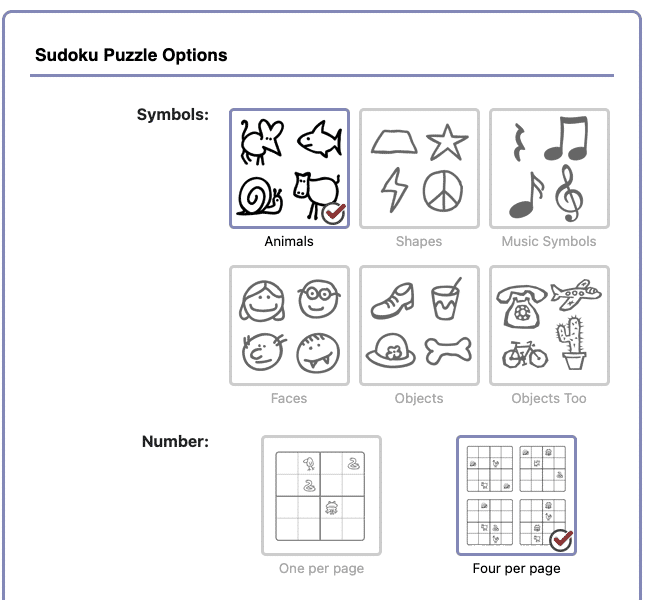
    Sudokus are everywhere: in almost every shop to buy, and on the internet as free printables or to play online. So why another post about Sudokus? Because it is not easy to find good Sudoku puzzles for children, and it is even less easy to find Sudokus with symbols. Worksheetworks.com, however, offers a free symbol Sudoku generator. Simply choose the symbols, how many Sudoku puzzles you want (one or four per page), choose the difficulty level, and click “create worksheet”. You get a PDF which you can save or print. Both a solution and an explanation of the solution are included.

    We like symbol sudokus very much. Young children can solve them as well and are very proud of being able to do the same kind of puzzles as adults. Older children like the extra challenge of drawing the symbols – this trains creativity and visual perception. What more can you wish?
    Access the Symbol Sudokus here

  • Animals and objects

    Animals and objects

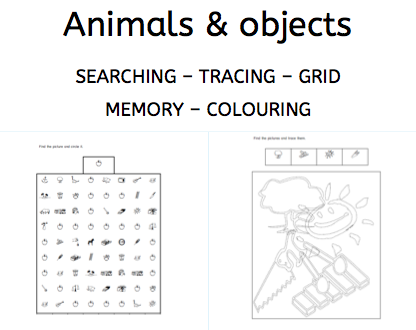
    A cold, rainy day? Still 10 minutes to fill? Children with special educational needs? You simply cannot have enough worksheets. That’s why we offer you a file (24 pages) with animals and objects: searching, tracing, drawing, coloring, memory – all for free, of course! The exercises train attention, visual, and spatial perception.
    DOWNLOAD
    We hope you enjoy them!

  • Mazes

    Mazes

    Mazes have always fascinated humanity. Think about the Cretan Labyrinth from Greek mythology. But even today, mazes are very popular. In “The Goblet of Fire,” Harry Potter has to go through a maze to win the Triwizard Tournament. Once Harry finds the way through the maze, things turn out completely different from what was expected. But that is another story you’d better read yourself.
    Children are also fascinated by mazes. Therefore, mazes are perfect for training attention and perception. Here is a good way to do mazes with your children:

    • Give your children a maze.
    • First, the children should try to find the way ONLY using their eyes.
    • If that is too difficult, or if they found the way with their eyes, they should trace the way with their fingers.
    • If that works well, they should trace the way with a pen. They shouldn’t touch the walls of the maze.

    Important: Take care that the mazes are not too difficult, but also not too easy.
    We created some worksheets with mazes in varying levels of difficulty.

    DOWNLOAD

    Check out our other freebies

  • Einstein’s riddle

    Einstein’s riddle

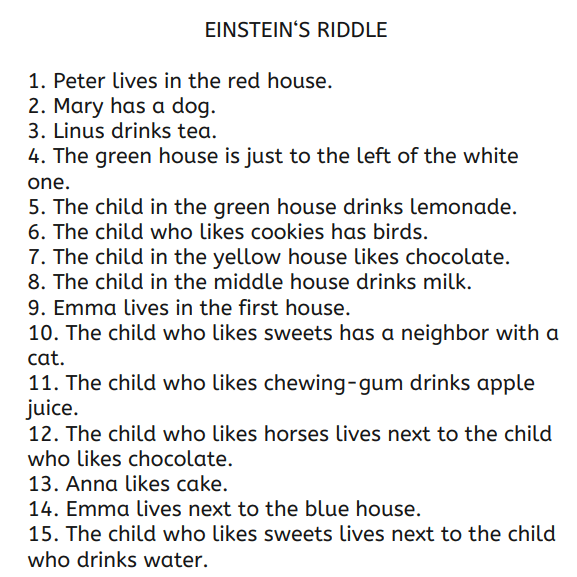
    Einstein is said to have claimed that only 2 percent of the world can solve this puzzle. There is no evidence he wrote it, and no evidence for the 2 percent either. We will make the opposite claim: anyone who reads carefully and combines patiently can solve it. Children can too, with a little help depending on age and reading experience.

    We rewrote the classic riddle in a version for children. No smoking and no alcohol, sweets and soft drinks instead. The question stays the same: who owns the fish?

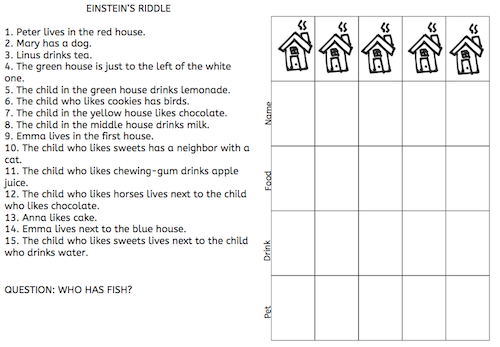
    Einstein's riddle in a child-friendly version, a free printable logic puzzle

    Download the riddle as a free PDF

    What kind of puzzle is this?

    It is a logic grid puzzle, sometimes called a zebra puzzle. You are given five houses in a row, each with a different color, a different owner, a different drink, a different sweet, and a different pet. A list of clues tells you how these things relate to one another. Nothing is guessed. Every single answer can be derived from the clues, and there is exactly one solution.

    How to solve it

    The trick is not cleverness. It is a system. Anyone who works through it in order will get there.

    1. Draw the grid. Five columns for the five houses, one row for each category. Everything you learn goes into the grid, never into your head.
    2. Start with the clues that fix a position. Any clue that names a specific house, or the middle, or the first one on the left, is a free answer. Fill those in first.
    3. Then use the clues that link two things. If the person who drinks milk sits next to the green house, you may not know where yet, but you know they are neighbors.
    4. Cross out what is impossible. This is the part most people skip and it is where the puzzle is actually won. Every time you place something, five other options die.
    5. Go around again. Each new entry unlocks a clue that was useless a moment ago. Read the whole list again after every entry.

    Why we put a logic puzzle on a dyslexia blog

    Because of what it asks for. Reading a clue exactly as it is written, holding several conditions in mind at once, working in an ordered sequence, and staying with a task long enough to finish it are the same skills that carry reading and arithmetic. A puzzle trains them without any of it looking like schoolwork, and a child who has spent the school day being corrected gets to be the one who is right.

    Read the clues aloud together if the reading itself is the hard part. The point of the exercise is the combining, not the decoding, and there is no reason a child should fail at the first step for the wrong reason.

    More puzzles and printables

    If this went down well, there is plenty more. Our free printable worksheets cover attention and perception training, and the spot the difference puzzles work on the same careful looking in a lighter format. The American Dyslexia Association also publishes more than 1,500 free worksheets for dyslexia and dyscalculia.

    Have fun combining.

  • Monster reading

    Monster reading

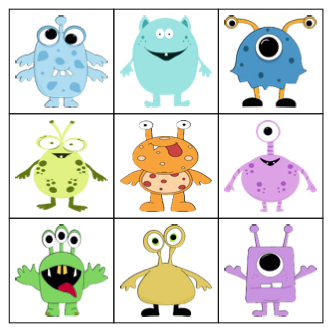
    Today’s freebie is monster reading puzzles. First, the children cut out the pictures. Then, they read the instructions and place the images in the correct place. This trains attention, visual and spatial perception, and accurate reading. Cutting and gluing the pictures is good for fine motor skills. An alternative is to read the instructions to the children. This trains careful listening.
    We like these reading puzzles a lot, because children practice different perceptions and accurate reading or listening. Also, the children have great fun and are happy when all the pictures are in the correct place.

    DOWNLOAD (3,8 MB)

    Check out our other freebies

  • Debunking the Myths about Dyslexia

    Debunking the Myths about Dyslexia

    There are many signs or clues to dyslexia, which are discussed in depth on this website; however, it is also important to be aware of the misconceptions and myths surrounding the disorder. There are several myths regarding dyslexia. We have highlighted some of the more common ones.

    Myth: Smart people cannot be dyslexic or have a learning disability.
    Fact: Dyslexia and intelligence are NOT connected. Many dyslexic individuals are very bright and creative, and they will accomplish amazing things as adults.
    Myth: Dyslexia does not exist.
    Fact: There has been 30 years of documented, scientific evidence and research proving the existence of dyslexia. It is one of the most common learning disabilities to affect children.
    Myth: Dyslexia is rare.
    Fact: In the United States, NIH research has shown that dyslexia affects 20%, or 1 in every 5 people. Some people may have milder forms, while others may experience it more severely. Dyslexia is one of the most common causes of reading difficulties in elementary school children because only 1 in 10 dyslexics will qualify for an IEP and special education that will allow them to get the help in reading that they need.

    CONTINUE READING

  • Visual sequencing

    Visual sequencing

    Visual sequencing, perception, dyslexia, worksheets, parents, children

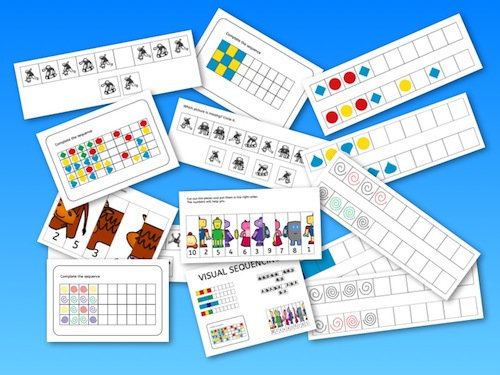
    Visual sequencing is the ability to organize visual impressions in a certain order. This is an important prerequisite for good writing, reading and arithmetic. Children who have difficulties with visual sequencing often exchange letters while writing or have difficulties with writing down numbers. Today we are offering a freebie containing various exercises to train visual sequencing.

    DOWNLOAD

    Check out our other freebies

  • Early signs of dyslexia

    Early signs of dyslexia

    While browsing the web we came across this story:

    A DYSLEXIA STORY – Early signs of dyslexia

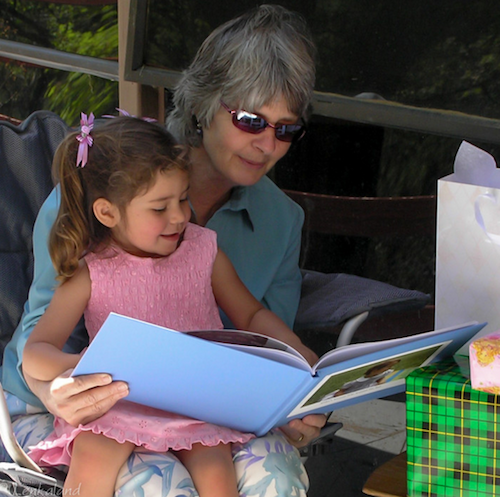
    I looked forward to reading with my daughter. We would cuddle together with a stack of books, and she would say, “Again, again, again,” and we would lose ourselves in our favorite stories.

    I was shocked when that never happened. What is it about reading to children, I thought, that’s so complicated? Reading together is overrated.

    Because, with her, she had only a passing interest in books. When we did sit together, she pulled the book out of my hands to flip through pages at random. Beginning, end, middle. Whatever. Done.

    We were most successful with books filled with random words and images, such as cat, dog, horse, and cow. Why did so many books have stories?

    CONTINUE READING