Tag: parents

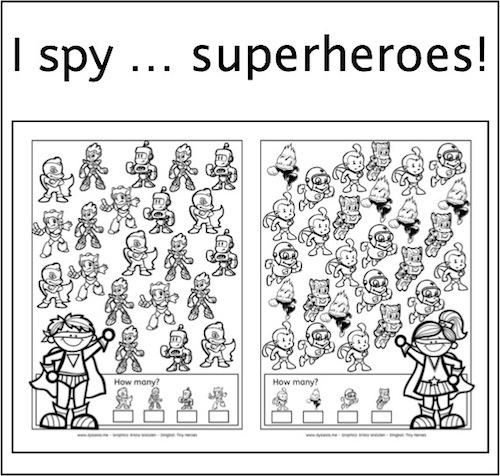
  • New freebie: I spy … superheroes!

    New freebie: I spy … superheroes!

    New freebie: I spy ... superheroes, I spy, dyslexia, dyscalculia, AFS-method, perception, visual perception, spatial perception, worksheet, parents, children, homeschooling, freebie

    Here is another “I spy…” freebie. Children simply love them. This time it is about “I spy … superheroes”. Print them out, color, count and simply enjoy all the fun. At the same time, children train attention, visual perception and fine motor skills.

    Grab this freebie here: I spy … superheroes

    More freebies

  • New freebie: I spy … spring

    New freebie: I spy … spring

    I spy ... spring, freebie, dyslexia, worksheet, parents, children, download, homeschooling, free, ADA, American Dyslexia Association

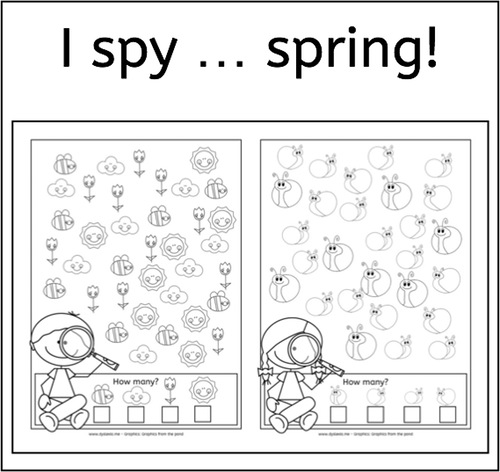
    Spring is in the air, so we thought it was about time for a new freebie. Give your children some coloring pencils and let them color and search. Then they count how many they found of each object. Use this opportunity to talk about “more than…”, “less than…”, etc. This exercise trains attention, visual and spatial perception and fine motor skills – important skills for reading, writing and arithmetics.

    Grab this freebie here: I spy … spring! (ca. 3,9 MB)

    More freebies

  • Symbol sudokus for children

    Symbol sudokus for children

    Sudoku, symbol, children, parents, logical thinking, perception, dyslexia, dyscalculia

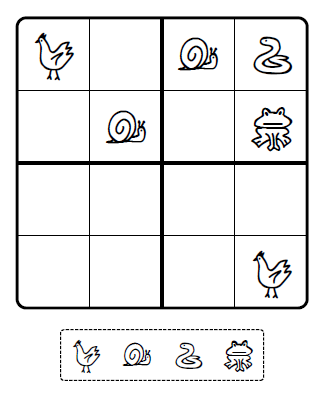
    Sudokus are everywhere: in about every shop to buy and on the internet as free printables or to play online . So why another post about sudokus? Because it is not easy to find good sudokus for children and it is even less easy to find sudokus with symbols. Worksheetworks.com, however, offers a free symbol sudoku generator . Simply choose the symbols, how many sudokus you want (one or four per page), choose the difficulty level and click “create worksheet”. You get a PDF which you can save or print. A solution and explanation of the solution are included.

    We like symbol sudokus a lot. Young children can solve them as well and are very proud for being able to do the same kind of puzzles as the adults. Older children like the extra challenge of drawing the symbols – this trains creativity and visual perception. What more can you wish?
    Access the symbol sudokus here

  • Animals and objects

    Animals and objects

    Animals and objects, perception, freebie, parents, children, dyslexia, dyscalculia

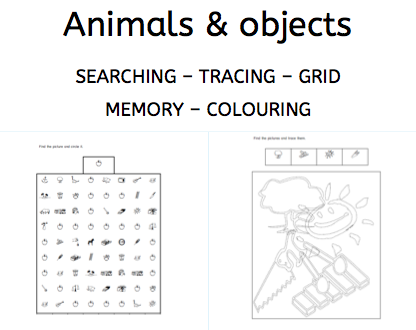
    A cold rainy day? Still 10 minutes to fill? Children with special educational needs? You simply cannot have enough worksheets. That’s why we offer you a file (24 pages) with animals and objects: searching, tracing, drawing, colouring, memory – all for free, of course! The exercices train attention, visual and spatial perception.
    DOWNLOAD
    We hope you enjoy them!

  • Open your ears!

    Open your ears!

    The American Dyslexia Association offers a different educational approach to help people with dyslexia and dyscalculia. This approach is called the AFS-Method, which is a multi-sensory method to help people who have difficulties with reading, writing and/or calculating. The “F” stands for “Function” which means the different sensory perceptions you need to learn reading, writing, and calculating. One important sensory perception is the acoustic area:

    • acoustic recognition: Can the child recognize different sounds?
    • acoustic memory: Can the child remember what he/she has heard?
    • acoustic sequencing: Can the child remember a sequence of sounds?

    We offer 12 sound sequences to train acoustic perception. Access them here. The audio clips have different degrees of difficulty. The child should recognize whether the sounds are the same or different, loud or soft, how many different sounds there are, and so on. According to the age and skills of your child, you can do the exercises with closed headphones. The headphones have the advantage that the child can completely focus on the sounds. The trainer or parent then also needs headphones and a dual adapter. If you do the exercises without headphones, then the child also hears the normal daily sounds around and learns how to filter out noise even better.
    We also made some worksheets to accompany these exercises, which you can download here: DOWNLOAD.
    Access the audio clips here.
  • Mazes

    Mazes

    Mazes have always fascinated humanity. Think about the Cretan Labyrinth from Greek mythology. But even today, mazes are very popular. In “The Goblet of Fire,” Harry Potter has to go through a maze to win the Triwizard Tournament. Once Harry finds the way through the maze, things turn out completely different from what was expected. But that is another story you’d better read yourself.
    Children are also fascinated by mazes. Therefore, mazes are perfect for training attention and perception. Here is a good way to do mazes with your children:

    • Give your children a maze.
    • First, the children should try to find the way ONLY using their eyes.
    • If that is too difficult, or if they found the way with their eyes, they should trace the way with their fingers.
    • If that works well, they should trace the way with a pen. They shouldn’t touch the walls of the maze.

    Important: Take care that the mazes are not too difficult, but also not too easy.
    We created some worksheets with mazes in varying levels of difficulty.

    DOWNLOAD

    Check out our other freebies

  • Number decomposition

    Number decomposition

    We are offering simple templates to practice number decomposition. The number houses are designed entirely neutrally. Therefore, they can be used in conjunction with any material, such as tiles, beads, or counting rods. Number decomposition up to 10 is an important prerequisite for calculating beyond 10. The templates are in A4 format. Use your printer options to print multiple originals on one sheet.

    DOWNLOAD

    Check out our other freebies

  • I can count

    I can count

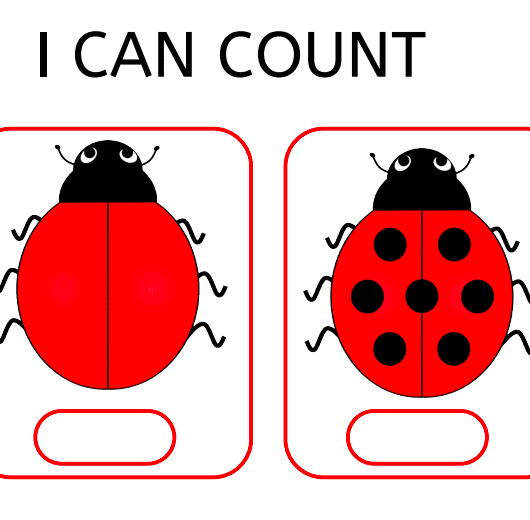
    Here, we offer a fun freebie: I can count!

    Many children with dyscalculia have trouble with exact counting. This booklet will help them. The children will count the dots on the ladybug and write the amount. The file is presented as a mini notebook, but you can also cut out and laminate the cards. It might be a good idea to give these booklets as homework.

    DOWNLOAD

    The ladybug pictures are from edupic.net

    Check out our other freebies!

  • Einstein’s riddle

    Einstein’s riddle

    Einstein's riddle, reading, logical thinking, dyslexia, parents, children, freebie

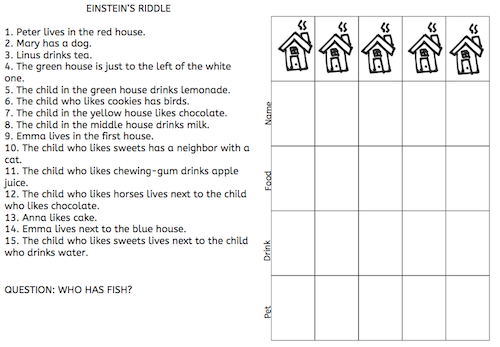
    A lot is said about Einstein. Much of it cannot be proved. Such as the theory that Einstein is the inventor of the logical puzzles, also called “Einstein’s Puzzle”. Whether this is true or not, is not important here. There are many variations of the Einstein puzzle. Einstein is said to have claimed that only 2% of the world population can solve this puzzle. We make the bold antithesis that anyone who can read and combine carefully, can solve this puzzle. Even children – although they just might need some help according to age and reading experience.
    We have converted the Einstein riddle into a child-friendly version. There is no smoking and no drinking alcohol, but there are sweets and non-alcoholic beverages. The question remains the same: Who has fish?

    DOWNLOAD

    Have fun combining!