Every Tuesday, we open up one lesson of the Dyslexia Trainer Certification Program here on the blog, all 48 of them, one week at a time. Whether you are a teacher, a parent, or an education professional, this series shows you exactly what certified dyslexia trainers learn, and how the program works from the inside.
This week: When Theory Meets the Child. Case Studies in Dyslexia Training
Frameworks provide structure, but every learner’s story is unique. In this lesson you follow two very different children: Mark, a 12-year-old with long-standing dyslexia complicated by early medical issues and an overprotective parent, and Emma, an 8-year-old just starting her literacy journey but already showing resistance and avoidance. Their cases show how attention, perception, and symptom training must be balanced differently for each child.
Case studies bring theory to life. While frameworks like AFS provide structure, every learner’s story is unique, shaped by personal history, environment, and emotional context. By looking closely at real examples, trainers learn how to translate assessment results into practical strategies.
Mark was born on July 24, 2013. His mother works as an office employee, and his father is an engineer. The parents are separated, and Mark lives with his mother. He has no siblings.
What you will learn in Lesson 17
Mark, 12: long-standing dyslexia, medical history, an overprotective parent
Emma, 8: early literacy struggles, resistance, and avoidance
Balancing attention, perception, and symptom training per child
Translating assessment results into practical strategies
About the Dyslexia Trainer Certification Program
Since 1997, more than 17,000 dyslexia trainers in 64 countries have been certified. The certification gives you more than knowledge: all the tools you need to actually work with dyslexic children are included as well. Worksheets, training programs, assessment materials, everything ready to use in your practice. You get the whole package.
The program is accredited by the American Dyslexia Association (ADA) and follows the training standards of the International Federation of Dyslexia and Dyscalculia Associations (IFDDA).
Catch up and start free
Lesson 1 is free for everyone. Register in a minute and see the program from the inside: dyslexiacertificate.com
You can find all published lessons of this series under the tag Lesson Series.
Every Tuesday, we open up one lesson of the Dyslexia Trainer Certification Program here on the blog, all 48 of them, one week at a time. Whether you are a teacher, a parent, or an education professional, this series shows you exactly what certified dyslexia trainers learn, and how the program works from the inside.
This week: Tech Meets Training. Practical Computer Use for Dyslexia
Computers and tablets feel natural to children, and that affinity can be turned into meaningful practice. Properly guided, digital tools capture attention, give instant feedback, and allow endless repetition without judgment. This lesson shows how to weave technology into the AFS framework, with clear guidelines: 10 to 15 minutes of focused use per session, a balance of guided and independent practice, and a sharp eye for which tools build skills and which just distract.
Technology is no longer an optional add-on in dyslexia training, it is part of the daily reality of children’s lives. Computers, tablets, and smartphones feel natural and intuitive to learners, and this affinity can be leveraged for meaningful practice. Properly guided, digital tools become powerful allies: they capture attention, provide instant feedback, and allow for endless repetition without judgment.
This lesson explores how to weave technology into the AFS framework. From perception games to reading practice to writing supports, computers make training more engaging and help children feel successful. At the same time, trainers must apply clear guidelines: 10–15 minutes of focused use per session, a balance of guided and independent practice, and a careful eye on which tools truly build skills versus which are just distractions.
Very few children, especially children with dyslexia, resist the pull of computers, tablets, or smartphones. These devices are already part of children’s everyday lives, and they often feel more natural to them than books or paper. Technology offers an intuitive, interactive entry point, which makes it an excellent ally in training.
What you will learn in Lesson 16
Where technology genuinely helps in dyslexia training
The 10 to 15 minute guideline for focused digital practice
Balancing guided and independent computer work
Telling skill-building tools apart from distractions
About the Dyslexia Trainer Certification Program
Since 1997, more than 17,000 dyslexia trainers in 64 countries have been certified. The certification gives you more than knowledge: all the tools you need to actually work with dyslexic children are included as well. Worksheets, training programs, assessment materials, everything ready to use in your practice. You get the whole package.
The program is accredited by the American Dyslexia Association (ADA) and follows the training standards of the International Federation of Dyslexia and Dyscalculia Associations (IFDDA).
Catch up and start free
Lesson 1 is free for everyone. Register in a minute and see the program from the inside: dyslexiacertificate.com
You can find all published lessons of this series under the tag Lesson Series.
Every Wednesday, we take you inside the AFS-Test, the standardized assessment that allows Certified Dyslexia Trainers to definitively diagnose and categorize dyslexia and dyscalculia. This is week 12 of 25.
This week: Auditory Sequencing
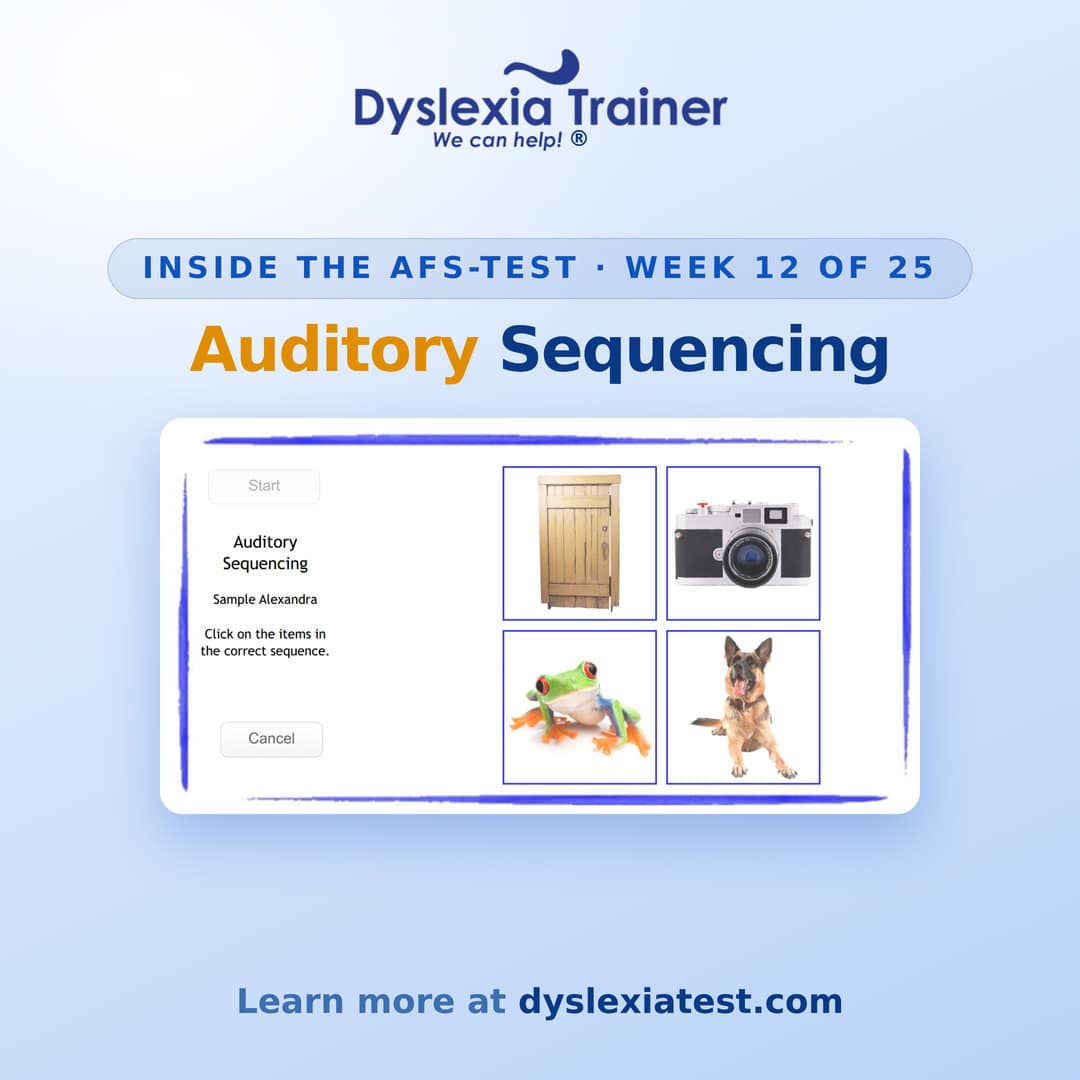
Auditory sequencing keeps sounds in the right order within a word. When it is underdeveloped, a child hears all the sounds of a word but assembles them differently: letters get swapped, syllables disappear, endings change. The standardized AFS-Test checks auditory sequencing with exercises built around sound order. Identifying and categorizing this area correctly matters, because sequencing errors look like carelessness but respond only to targeted function training.
The standardized Attention-Function-Symptom Test has been used worldwide for more than 25 years. It examines the attention span, the sensory perceptions, and the error symptoms of a child, and turns the results into an individualized training plan following the AFS-Method.
Find a Certified Trainer
Certified Dyslexia Trainers conduct the standardized AFS-Test in your area or remotely. Learn more and find a Certified Trainer near you: dyslexiatest.com
You can find all published articles of this series under the tag AFS-Test Series.
Every Tuesday, we open up one lesson of the Dyslexia Trainer Certification Program here on the blog, all 48 of them, one week at a time. Whether you are a teacher, a parent, or an education professional, this series shows you exactly what certified dyslexia trainers learn, and how the program works from the inside.
This week: Symptom Training for Math. Dyscalculia and Other Arithmetic Differences
Dyscalculia training is not tutoring in higher mathematics. It builds foundational numeracy: stable counting, mapping quantities to numerals, secure place value, and mastery of the four operations. This lesson also draws the important line between genetic dyscalculia, which needs the full attention-function-symptom approach, and acquired arithmetic difficulties, which respond to targeted practice. Trainers learn to read error patterns and choose the right levers.
Dyscalculia training lives squarely in AFS Symptom Training for arithmetic. We are not tutoring higher mathematics; we build foundational numeracy: stable counting, mapping quantities to numerals, secure place value, and mastery of the four operations (add, subtract, multiply, divide). The Attention (A) and Function/Perception (F) phases prepare focus and sensory processing so the Symptom (S) phase, where arithmetic is actually practiced, can stick.
Within this lens, we distinguish dyscalculia (genetic, sensory-perception differences requiring A+F+S) from acquired/transient arithmetic difficulties (AR) (typically addressed through targeted S-practice once readiness is adequate). Your role as a trainer is to read the error patterns, choose the right AFS levers, and deliver precise, stepwise practice that converts small wins into lasting competence.
If persistent difficulties with arithmetic occur over an extended period, six months or longer, this may indicate dyscalculia or another math learning difficulty. Importantly, math problems are rarely related to a lack of intelligence.
What you will learn in Lesson 15
What dyscalculia training actually covers: foundational numeracy
Counting, place value, and the four operations
Dyscalculia vs. acquired arithmetic difficulties
Reading math error patterns and choosing the right practice
About the Dyslexia Trainer Certification Program
Since 1997, more than 17,000 dyslexia trainers in 64 countries have been certified. The certification gives you more than knowledge: all the tools you need to actually work with dyslexic children are included as well. Worksheets, training programs, assessment materials, everything ready to use in your practice. You get the whole package.
The program is accredited by the American Dyslexia Association (ADA) and follows the training standards of the International Federation of Dyslexia and Dyscalculia Associations (IFDDA).
Catch up and start free
Lesson 1 is free for everyone. Register in a minute and see the program from the inside: dyslexiacertificate.com
You can find all published lessons of this series under the tag Lesson Series.
Every Wednesday, we take you inside the AFS-Test, the standardized assessment that allows Certified Dyslexia Trainers to definitively diagnose and categorize dyslexia and dyscalculia. This is week 11 of 25.
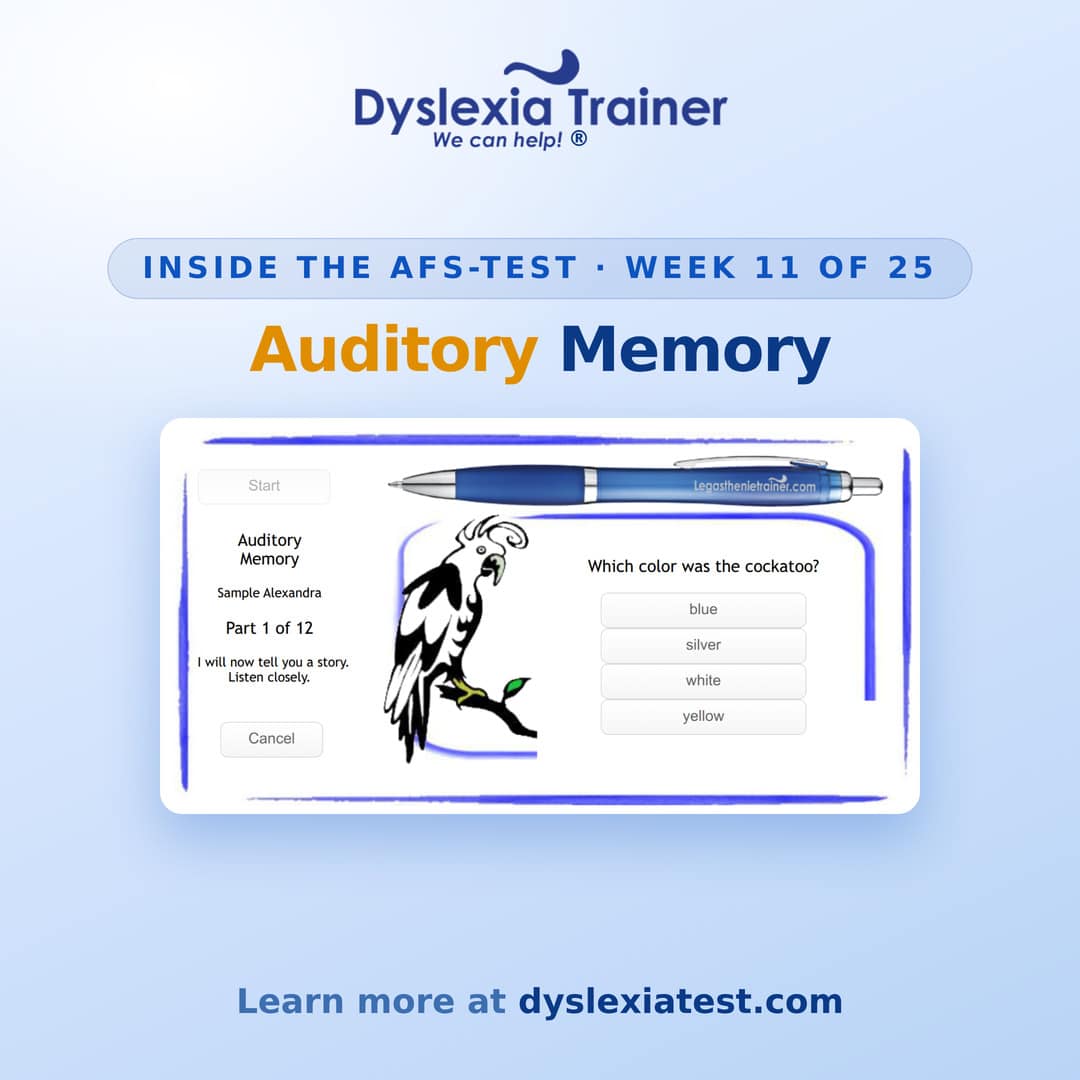
This week: Auditory Memory
Auditory memory stores what we hear: instructions, dictated sentences, the sound of words. A child with underdeveloped auditory memory loses parts of a dictation on the way to the paper, forgets multi-step instructions, and struggles to hold new vocabulary. This has nothing to do with effort or intelligence. The standardized AFS-Test measures auditory memory precisely, so that training can strengthen exactly this storage system with daily, playful exercises.
The standardized Attention-Function-Symptom Test has been used worldwide for more than 25 years. It examines the attention span, the sensory perceptions, and the error symptoms of a child, and turns the results into an individualized training plan following the AFS-Method.
Find a Certified Trainer
Certified Dyslexia Trainers conduct the standardized AFS-Test in your area or remotely. Learn more and find a Certified Trainer near you: dyslexiatest.com
You can find all published articles of this series under the tag AFS-Test Series.
Every Tuesday, we open up one lesson of the Dyslexia Trainer Certification Program here on the blog, all 48 of them, one week at a time. Whether you are a teacher, a parent, or an education professional, this series shows you exactly what certified dyslexia trainers learn, and how the program works from the inside.
This week: Reading Made Easier. Structured Strategies for Dyslexic Children
For many dyslexic children, reading feels like a locked door: decoding each symbol takes so much effort that guessing and skipping become habits. The good news is that accurate reading can be taught. The Easy Reading Method slows the process down just enough for the brain to receive clear, error-free input, and combined with multisensory, structured phonics it takes students from hesitant decoding to confident, meaningful reading.
Reading is often described as the gateway to learning, but for many dyslexic children, it feels more like a locked door. While most students gradually build effortless connections between letters and sounds, dyslexic learners must expend far more effort decoding each symbol. This extra work often causes them to guess, skip, or misread words, which then weakens both comprehension and spelling.
Anyone who reads well and who understands what has been read automatically learns the rules of correct spelling. Precise, accurate reading is a prerequisite for writing and learning.
What you will learn in Lesson 14
Why decoding overloads dyslexic readers
The Easy Reading Method and the Easy Reading Card
Combining it with multisensory, structured phonics
Accuracy first, then fluency and comprehension
About the Dyslexia Trainer Certification Program
Since 1997, more than 17,000 dyslexia trainers in 64 countries have been certified. The certification gives you more than knowledge: all the tools you need to actually work with dyslexic children are included as well. Worksheets, training programs, assessment materials, everything ready to use in your practice. You get the whole package.
The program is accredited by the American Dyslexia Association (ADA) and follows the training standards of the International Federation of Dyslexia and Dyscalculia Associations (IFDDA).
Catch up and start free
Lesson 1 is free for everyone. Register in a minute and see the program from the inside: dyslexiacertificate.com
You can find all published lessons of this series under the tag Lesson Series.
The Africa Dyslexia Organisation (ADO) from Ghana is the newest member of the International Federation of Dyslexia and Dyscalculia Associations (IFDDA).
It is IFDDA’s first member in sub-Saharan Africa.
Founder and Executive Director Rosalin Abigail Kyere-Nartey learned at 30 that she is dyslexic.
The ADO trains teachers, supports families, and runs a Dyslexia Advocate Fellowship in 38 African countries.
In the United States, the ADO is a registered 501(c)(3) non-profit (EIN 99-3270841).
The International Federation of Dyslexia and Dyscalculia Associations welcomes a new member: the Africa Dyslexia Organisation (ADO) from Ghana, our first member in sub-Saharan Africa.
Across much of Africa, children who learn differently are still called lazy or slow, and many leave school without anyone ever recognizing dyslexia. The Africa Dyslexia Organisation was founded to change that. Since its first nationwide awareness campaign in Ghana in 2020 [1], it has grown into a pan-African non-profit that works with schools, families, governments, and international partners so that learning differences are recognized and supported.
Who is the Africa Dyslexia Organisation?
The organization was founded by Rosalin Abigail Kyere-Nartey, who is also its Executive Director. Growing up in Suhum, Ghana, she could not read or write her own name until the age of 17. “I endured years of being called lazy and slow, of being punished for what I could not yet do. At 30 years old, I finally learned the truth: I am dyslexic,” she said at the Africa Dyslexia Conference 2025 [2]. That discovery did not limit her. It showed her strengths and turned into lifelong advocacy for others.
In their own words, from their membership application:
Africa Dyslexia Organisation is a pan-African nonprofit advancing the rights, inclusion and opportunities of people with dyslexia and related learning differences across Africa. We work through teacher training, early identification and screening, structured literacy, research, family support, advocacy, and inclusive education and workplace practices. Our vision is an Africa where no child is unseen and no talent is left behind.
The ADO has a team of about twenty educators, reading specialists, trainers, and counselors [3], and an international board that includes Lee Siang, CEO of the Dyslexia Association of Singapore, and Jennifer Topple of The Howard School in Atlanta [4]. In the United States, the organization is recognized as a 501(c)(3) tax-exempt non-profit under EIN 99-3270841 [5].
What does the ADO do?
In practice, the Africa Dyslexia Organisation:
trains teachers in early identification, screening, and structured literacy,
supports families and adults with dyslexia,
runs the Dyslexia Advocate Fellowship, which connects advocates in 38 African countries,
appoints Dyslexia Youth Ambassadors who lead awareness work in their own schools and communities [6],
and works with ministries, universities, and employers on inclusive education and workplace practices.
Two projects show the scale. In 2025, with a grant from UNESCO and support from the Ghana Commission for UNESCO, the ADO ran a training program for 500 teachers in Ghana on how to identify and support students with dyslexia [7]. In August 2025, it hosted the Africa Dyslexia Conference in Accra under the theme “Shifting Minds, Inspiring Action.” About 400 delegates came together: policymakers, educators, researchers, business leaders, and people with lived experience of dyslexia [2][8].
Why it matters for IFDDA
With the Africa Dyslexia Organisation, the federation gains its first member in sub-Saharan Africa and a partner whose network already spans much of the continent. Building awareness where dyslexia has long gone unrecognized is exactly the kind of work a federation should support. We look forward to giving the ADO a larger stage and to learning from its experience across so many countries.
The International Federation of Dyslexia and Dyscalculia Associations (IFDDA) is a non-profit federation incorporated in Florida in 2011. It connects dyslexia and dyscalculia associations worldwide, and its members exchange knowledge, methods, and experience across borders. The American Dyslexia Association, which publishes this blog, is a member; the ADA-accredited Dyslexia Trainer Certification Program follows the IFDDA training standards. For background on how the federation approaches training, read Approaches to Dyslexia Training.
The Africa Dyslexia Organisation (ADO) is a pan-African non-profit based in Ghana. It advances the rights and inclusion of people with dyslexia and related learning differences through teacher training, early identification, structured literacy, family support, and advocacy. Website: africadyslexia.org.
Who founded the Africa Dyslexia Organisation?
Rosalin Abigail Kyere-Nartey founded the ADO and serves as its Executive Director. She grew up in Suhum, Ghana, and learned at the age of 30 that she is dyslexic.
Is the Africa Dyslexia Organisation a registered non-profit?
Yes. In the United States, Africa Dyslexia Organization Inc is a 501(c)(3) tax-exempt organization with EIN 99-3270841, listed on ProPublica Nonprofit Explorer.
What is the Dyslexia Advocate Fellowship?
The Dyslexia Advocate Fellowship is an ADO program that connects dyslexia advocates in 38 African countries, strengthens local leadership, and builds a continental movement for learning differences.
How can an organization join IFDDA?
Non-profit dyslexia and dyscalculia organizations can apply for free membership at ifdda.org.
Sources
Citi Newsroom: Africa Dyslexia Organization launches nationwide awareness campaign, June 29, 2020. citinewsroom.com
Ghanaian Times: Founder of ADO advocates evidence-based understanding of dyslexia, August 27, 2025. ghanaiantimes.com.gh
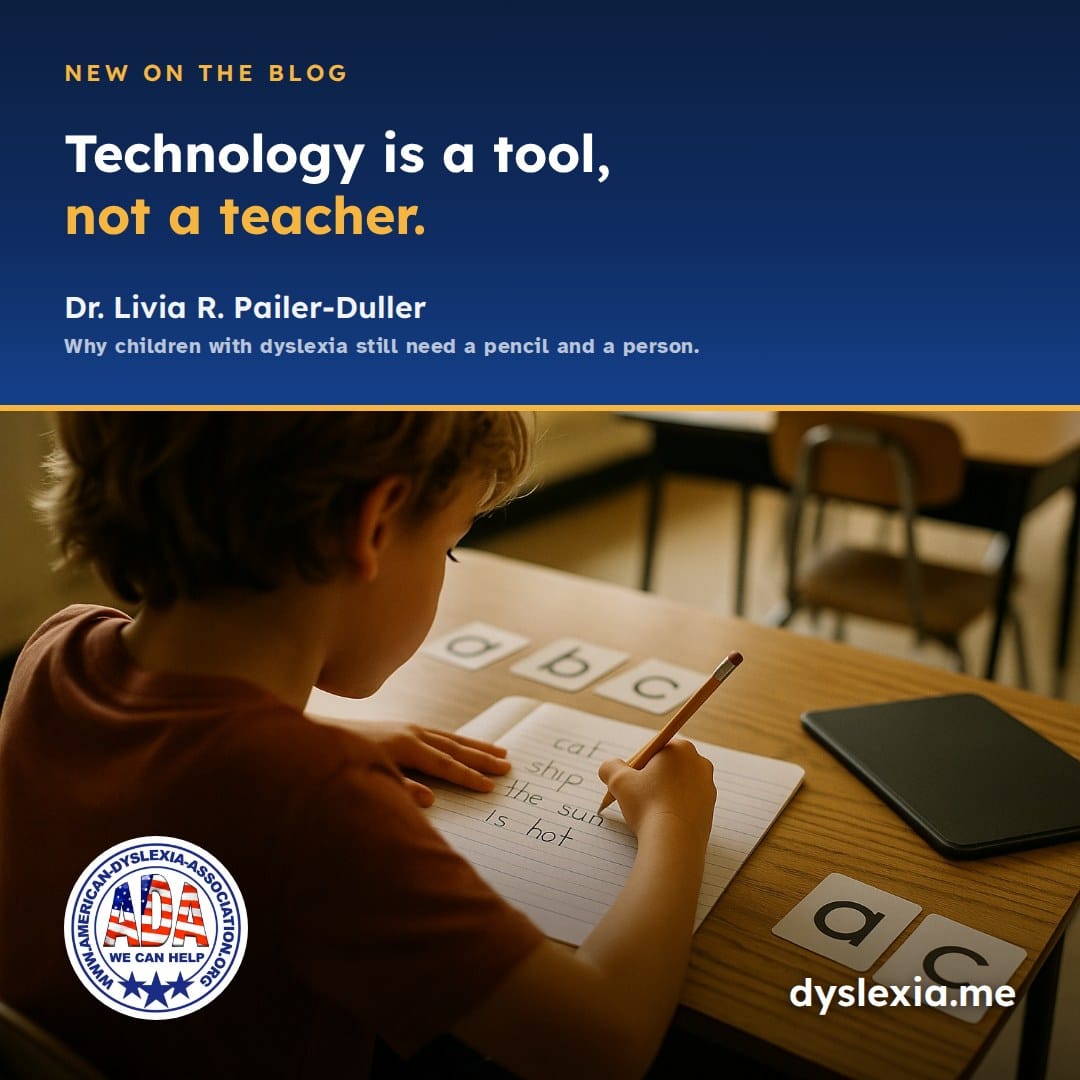
Technology helps children with dyslexia learn, and the research says so clearly. What it cannot do is notice why a child is stuck and decide what to try next. That job still belongs to a trained person. A new paper by Dr. Livia R. Pailer-Duller, originally written for Liberty University, looks at what the research says about screens, apps, handwriting, and the role of the educator. Here is what parents and teachers can take from it.
In short
Technology works. A review of 85 studies with 9,157 students found positive effects of mobile technology on learning.
Text-to-speech helps many readers, not all of them. The average effect on reading comprehension is positive, but results vary a lot from child to child.
Children with dyslexia need explicit, systematic instruction from a person, one-to-one or in small groups. 14 meta-analyses and systematic reviews point the same way.
The pencil still matters. Writing letters by hand activates the brain differently than typing them.
Use both. The best plan for a child often mixes a tablet, a pencil, and a Certified Dyslexia Trainer.
Watch: what children with dyslexia still need, in 82 seconds.
Yes, technology really does help
Digital tools improve learning when they are used well. Wang and colleagues (2023) reviewed 85 studies involving 9,157 students in primary and secondary school. They found positive effects of mobile technology on what students know, how they feel about learning, and how they behave in class.
For children with dyslexia, technology can remove barriers that have nothing to do with what they actually know. Think of text-to-speech, speech-to-text, audiobooks, spelling support, word processing, and larger or reformatted text. A child who understands a science chapter perfectly well should not fail the test only because decoding the words takes all their energy.
Wood and colleagues (2018) pooled the research on text-to-speech and read-aloud tools for students with reading difficulties. The overall effect on reading comprehension was positive, but outcomes varied across students and studies. In plain words: the tool helps, it just does not help every child the same way. Someone still has to find out whether it helps this child.
What children with dyslexia need: a person who notices
Children with dyslexia learn best with explicit, systematic instruction, given one-to-one or in small groups. Al Otaiba and colleagues (2023) looked across 14 meta-analyses and systematic reviews of literacy research. They found support for direct teaching, a planned sequence of skills, attention to both the sound code and the meaning of words, and enough time and intensity. Hall and colleagues (2023) reviewed 40 years of reading research for elementary students with or at risk for dyslexia and found that more training time went along with stronger results.
Explicit means the skill is taught directly instead of hoping the child will discover it alone. The trainer shows how it works, the child practices, and the trainer gives feedback right away. Systematic means one step builds on the next, and someone decides when the child is ready to move on.
A good dyslexia trainer looks at much more than right or wrong. They ask questions like these:
What kind of mistake was this?
Does the child understand the idea behind the task?
Is the child using the strategy we practiced, or guessing?
Does the child need more practice, or should we go back a step?
Would a different way of showing the material help?
A computer can record answers and even spot patterns. Only a person can put those patterns into the context of the whole child, including tiredness, frustration, motivation, and what happened last week.
Why the pencil still matters
Forming a letter by hand is a different learning experience than pressing a key. Over a hundred years ago, Maria Montessori (1912) described children who saw and touched sandpaper letters while hearing their sounds at the same time. She wanted learning to move “from sensations to ideas, from the concrete to the abstract.”
Brain research has since backed up the idea. James and Engelhardt (2012) worked with five-year-olds who could not yet read. The children printed, typed, or traced letters. Afterward, a reading-related network in the brain responded to the letters after handwriting practice, but not in the same way after typing or tracing. Askvik and colleagues (2020) used high-density EEG with 12-year-olds and young adults and also found different brain activity for handwriting and drawing compared with typing.
That matters for dyslexia, because good training often combines seeing a letter, saying its sound, and writing it. If schools drop handwriting only because typing is faster, children may lose one of their most useful ways to learn. Looking for practice pages? Try our Handwriting Worksheet Wizard or read When the “Different” Learner Meets Cursive.
Handwritten or typed notes? The honest answer
The research on note-taking is mixed, and that is worth knowing. In a well-known study, Mueller and Oppenheimer (2014) found that students who typed their notes wrote more and copied lectures word for word, while students who wrote by hand did better on conceptual questions. Their explanation: handwriting is slower, so you have to choose, summarize, and rephrase.
Then Urry and colleagues (2021) repeated the study and combined it with similar ones. Laptop users again wrote more and copied more word for word. But this time, handwritten notes did not lead to better immediate learning.
So handwriting does not always win, and laptops do not ruin learning. Handwriting and typing are simply different ways of working with information. For one child with dyslexia, writing by hand is the right practice. For another, typing or speech-to-text removes a barrier so they can show what they know. The method should follow the learning goal and the child, not the other way around.
Personalization is not the same as automation
An adaptive app personalizes by following programmed rules. A trainer personalizes by watching the child. Here are situations a dyslexia trainer sees every week:
A child keeps mixing up the same letters.
A child gives correct answers but is actually guessing.
Performance drops because the child is tired.
A child understands a story when it is read aloud but cannot decode it alone.
A pattern the child had mastered suddenly falls apart in a longer text.
Software may log every one of these. A person asks why it happened and decides what to do next. That is why the paper argues for professional and technology, not professional versus technology. Let the tablet handle repetition and access. Let the trained adult keep the responsibility for teaching decisions.
Questions parents and teachers can ask
Judge a learning program by what the child actually learns, not by minutes logged or exercises completed. Finishing an online activity does not prove that learning happened. Before adding another app, it helps to ask:
What learning problem are we trying to solve?
What does this technology do well for this child?
What still needs a trained person?
Is the child still writing by hand, working with real materials, and getting direct instruction?
Do grades and tests show what the child knows, or only how fast they read and write?
No. Apps are good at repetition, feedback, and access, but research on dyslexia points to explicit, systematic instruction given one-to-one or in small groups by a trained person. The best results come from combining both.
Should children with dyslexia still learn to write by hand?
Yes, in most cases. Studies by James and Engelhardt (2012) and Askvik and colleagues (2020) show that handwriting activates the brain differently than typing. For some children, typing or speech-to-text is the right accommodation for showing what they know, while handwriting stays part of their practice.
Where can I read the full paper?
The complete paper by Dr. Livia R. Pailer-Duller, including all references, is published on pailer-duller.com.
Sources
Al Otaiba, S., McMaster, K., Wanzek, J., & Zaru, M. W. (2023). What we know and need to know about literacy interventions for elementary students with reading difficulties and disabilities, including dyslexia. Reading Research Quarterly, 58(2), 313–332. https://doi.org/10.1002/rrq.458
Askvik, E. O., van der Weel, F. R. R., & van der Meer, A. L. H. (2020). The importance of cursive handwriting over typewriting for learning in the classroom: A high-density EEG study of 12-year-old children and young adults. Frontiers in Psychology, 11, 1810. https://doi.org/10.3389/fpsyg.2020.01810
Hall, C., Dahl-Leonard, K., Cho, E., Solari, E. J., Capin, P., Conner, C. L., Henry, A. R., Cook, L., Hayes, L., Vargas, I., Richmond, C. L., & Kehoe, K. F. (2023). Forty years of reading intervention research for elementary students with or at risk for dyslexia: A systematic review and meta-analysis. Reading Research Quarterly, 58(2), 285–312. https://doi.org/10.1002/rrq.477
James, K. H., & Engelhardt, L. (2012). The effects of handwriting experience on functional brain development in pre-literate children. Trends in Neuroscience and Education, 1(1), 32–42. https://doi.org/10.1016/j.tine.2012.08.001
Montessori, M. (1912). The Montessori method: Scientific pedagogy as applied to child education in “The Children’s Houses” (A. E. George, Trans.). Frederick A. Stokes Company.
Mueller, P. A., & Oppenheimer, D. M. (2014). The pen is mightier than the keyboard: Advantages of longhand over laptop note taking. Psychological Science, 25(6), 1159–1168. https://doi.org/10.1177/0956797614524581
Pailer-Duller, L. R. (2026). Technology as a tool, not a teacher: Meeting the learning needs of students with dyslexia in the 21st-century. Originally written for Liberty University, School of Education. https://www.pailer-duller.com/technology-as-a-tool-not-a-teacher/
Urry, H. L., et al. (2021). Don’t ditch the laptop just yet: A direct replication of Mueller and Oppenheimer’s (2014) Study 1 plus mini meta-analyses across similar studies. Psychological Science, 32(3), 326–339. https://doi.org/10.1177/0956797620965541
Wang, J., Tigelaar, D. E. H., Zhou, T., & Admiraal, W. (2023). The effects of mobile technology usage on cognitive, affective, and behavioural learning outcomes in primary and secondary education: A systematic review with meta-analysis. Journal of Computer Assisted Learning, 39(2), 301–328. https://doi.org/10.1111/jcal.12759
Wood, S. G., Moxley, J. H., Tighe, E. L., & Wagner, R. K. (2018). Does use of text-to-speech and related read-aloud tools improve reading comprehension for students with reading disabilities? A meta-analysis. Journal of Learning Disabilities, 51(1), 73–84. https://doi.org/10.1177/0022219416688170
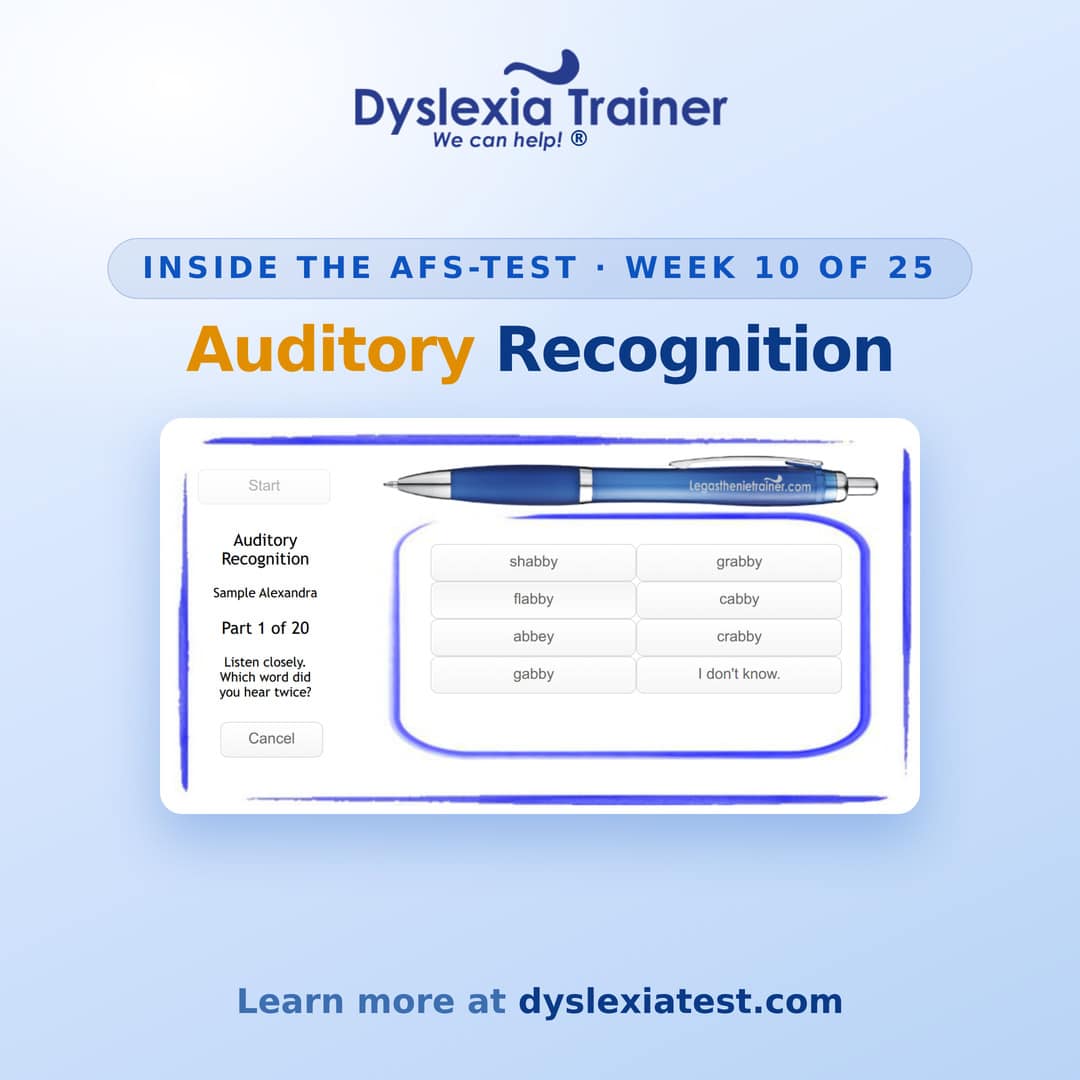
Every Wednesday, we take you inside the AFS-Test, the standardized assessment that allows Certified Dyslexia Trainers to definitively diagnose and categorize dyslexia and dyscalculia. This is week 10 of 25.
This week: Auditory Recognition
Auditory recognition lets a child pick the important sound out of everything they hear, and tell similar sounds apart: d and t, g and k, m and n. If these distinctions are not reliable, spelling by sound becomes a guessing game. The standardized AFS-Test checks auditory recognition with listening exercises that show whether the child truly hears the difference between similar sounds. Where it is needed, targeted hearing exercises build this foundation before spelling rules can do their work.
The standardized Attention-Function-Symptom Test has been used worldwide for more than 25 years. It examines the attention span, the sensory perceptions, and the error symptoms of a child, and turns the results into an individualized training plan following the AFS-Method.
Find a Certified Trainer
Certified Dyslexia Trainers conduct the standardized AFS-Test in your area or remotely. Learn more and find a Certified Trainer near you: dyslexiatest.com
You can find all published articles of this series under the tag AFS-Test Series.
As an Amazon Associate I earn from qualifying purchases.