Every Tuesday, we open up one lesson of the Dyslexia Trainer Certification Program here on the blog, all 48 of them, one week at a time. Whether you are a teacher, a parent, or an education professional, this series shows you exactly what certified dyslexia trainers learn, and how the program works from the inside.
This week: Beyond Screenings and Assessments: Why Only Comprehensive Testing Reveals Dyslexia
A child can score average on an achievement test and still struggle every single day. This lesson explains why screenings, reading tests, IQ tests, and phonological assessments alone cannot diagnose dyslexia, and what comprehensive testing has to cover instead. Trainers learn to see what standard instruments miss, and why an incomplete assessment so often leads to the wrong kind of help.
What this lesson is about
Accurate identification is the foundation of effective dyslexia support, but not all assessments serve the same purpose. Screenings are valuable for highlighting children who may be at risk, but they do not provide a diagnosis and cannot guide an intervention plan.
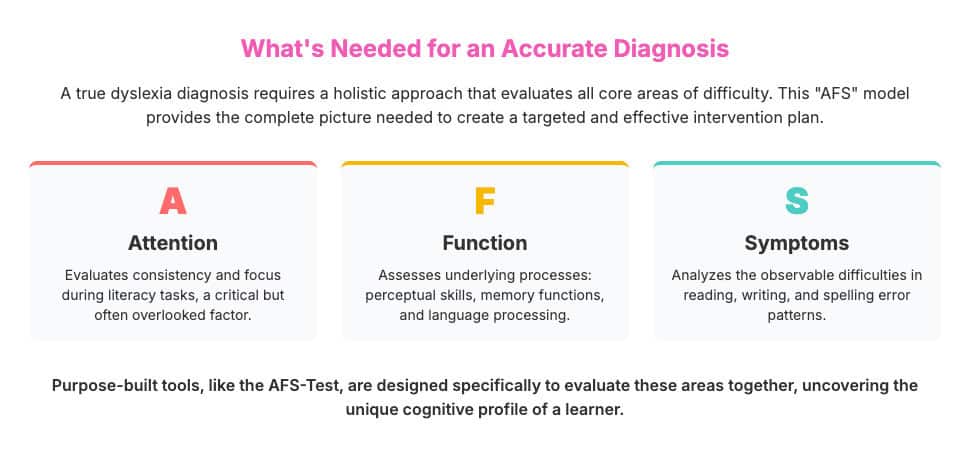
Similarly, standardized reading and spelling tests, intelligence tests, and phonological assessments are often misused in dyslexia evaluation. These tools were never designed to diagnose dyslexia, and when applied in this way they frequently produce misleading or incomplete results. A child may test “average” on an achievement test while still struggling daily, or may score poorly on an IQ test and be misclassified as having low intelligence rather than dyslexia.
As trainers, it is crucial to understand both the possibilities and the limits of these tools. Recognizing their shortcomings not only prevents misdiagnosis but also ensures that no child is denied the support they need. This lesson introduces the most common screenings and assessments you will encounter in practice, while emphasizing the need for comprehensive evaluation methods that truly reflect the unique profile of dyslexic learners.
What you will learn in Lesson 5
- What screenings can do, and where they stop
- Why achievement and IQ tests are misused in dyslexia evaluation
- What comprehensive testing has to cover
- How incomplete assessment leads to the wrong help
About the Dyslexia Trainer Certification Program
Since 1997, more than 17,000 dyslexia trainers in 64 countries have been certified. The certification gives you more than knowledge: all the tools you need to actually work with dyslexic children are included as well. Worksheets, training programs, assessment materials, everything ready to use in your practice. You get the whole package.
The program is accredited by the American Dyslexia Association (ADA) and follows the training standards of the International Federation of Dyslexia and Dyscalculia Associations (IFDDA).
Catch up and start free
Lesson 1 is free for everyone. Register in a minute and see the program from the inside: dyslexiacertificate.com
You can find all published lessons of this series under the tag Lesson Series.