
Reading to children has been repeatedly shown to improve their reading, writing, and communication skills, logical thinking, concentration, and general academic aptitude… as well as inspire a love of reading. The Screen Actors Guild Foundation records well-known actors reading children’s books and makes graphically dynamic videos so that children around the world can be read to with just the click of a Storyline Online video book image. The videos are free, and there is no need to register. Enjoy!
Tag: parents
-
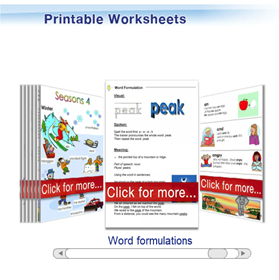
1500 free worksheets
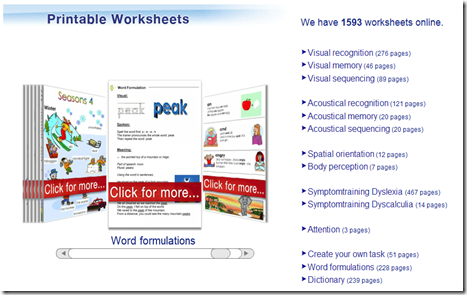
The American Dyslexia Association offers more than 1,500 free worksheets on its website. They are built on the AFS method, the approach used worldwide in individualized dyslexia and dyscalculia training. Everything is free to download, and you may use it at school, at home, or in tutoring.
Why working on the mistakes is not enough
When a child has dyslexia or dyscalculia, correcting the errors alone changes very little. The errors are the visible end of a longer chain. A child also has to be able to hold attention through a whole page, and the senses that carry reading, writing, and calculating have to be trained alongside the schoolwork itself. That is the reasoning behind the way these worksheets are organized.
What the worksheets cover
AFS stands for Attention, Function, and Symptom, and the collection follows those three areas.
- Attention. Short, focused exercises that ask a child to stay with one task and notice detail. Find the shape, spot the difference, match the pair, complete the pattern.
- Function. Training for the sensory perceptions that reading and arithmetic rest on: visual and spatial perception, visual and auditory sequencing, differentiation, and memory. This is the part most worksheet collections leave out entirely.
- Symptom. The schoolwork itself. Letter recognition, reading, spelling patterns, number decomposition, counting, and the four basic operations.
Who they are for
Most sheets suit children in kindergarten through the elementary grades, roughly ages 5 to 11, and many work well with older children who need to rebuild a foundation without being handed material that looks babyish. Parents, classroom teachers, homeschooling families, tutors, and Certified Dyslexia Trainers all use them. No account and no sign-up is required.
How to use them so they actually help
- Short and often beats long and rare. Ten focused minutes a day does more than an hour on Sunday.
- Take all three areas, not just the last one. A child who only ever practices spelling is practicing the symptom while the cause stays where it was.
- Stop while it is still going well. Ending on success is what makes a child willing to sit down again tomorrow.
- Watch how the child works, not only what the answer is. Where the eye jumps, where attention slips, and which errors repeat tell you more than a score.
- Print rather than fill in on screen where you can. Handling the paper, tracing, cutting, and coloring are part of the exercise.
More free material on this blog
The worksheet library is not the only free resource here. Our own printable freebies are published regularly and cover perception training, counting, tracing, and seasonal activities. For handwriting practice you can build your own sheets with the handwriting worksheet generator, and there is a matching tool for printable math worksheets if arithmetic is the harder subject at your kitchen table. The freebies overview page collects the lot.
If you want to work this way professionally
Worksheets support training, but they do not replace knowing which area a particular child needs. That is what the AFS-Test establishes and what trainers learn to read. If you work with children and want the full picture, the ADA-accredited certification for dyslexia trainers teaches the testing and the training together, and the first lesson is free to read.
Access all 1,500 free worksheets
More free material: our complete list of free dyslexia resources for parents and teachers covers worksheets, generators, daily exercises, a free math app, and a parents portal, plus how much daily practice a child needs.
-

Dyslexia – Information in 18 languages
The American Dyslexia Association promotes the interests of people with dyslexia and dyscalculia. It is important to inform people about these themes. Dr. Astrid Kopp-Duller, president of ADA, always stresses how important it is to help children with dyslexia and dyscalculia on a pedagogical-didactic level. Because it needs to be said time and again: THESE CHILDREN ARE NOT ILL OR DISABLED, they simply need another method to learn how to read, write, and calculate.
To reach as many people as possible, some basic information about dyslexia and dyscalculia is now available in 18 languages:
- Afrikaans
- Albanian
- Arabic
- Bulgarian
- Chinese
- German
- English
- French
- Croatian
- Persian
- Polish
- Russian
- Serbian
- Slovenian
- Spanish
- Czech
- Turkish
- Hungarian
Do you know an adult, a child, a family who may be interested? Please, hand them this information. The more people are informed and the earlier children are helped, the better!
-

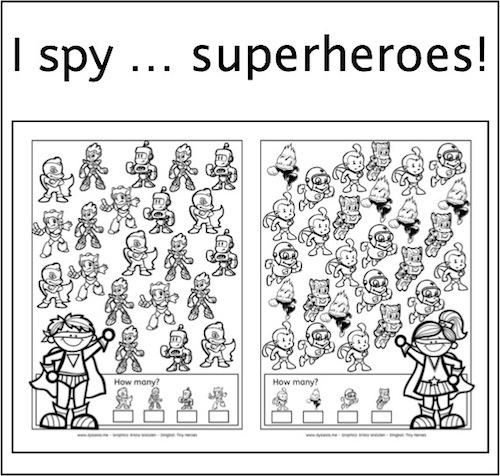
New freebie: I spy … superheroes!
Here is another “I spy…” freebie. Children simply love them. This time it is called “I spy … superheroes”. Print, color, count, and simply enjoy all the fun. At the same time, children train attention, visual perception, and fine motor skills.
Grab this freebie here: I spy … superheroes
-

New freebie: I spy … Spring!
Spring is in the air, so we thought it was about time for a new freebie. Give your children some coloring pencils and let them color and search. Then, they count how many they find of each object. Use this opportunity to talk about “more than…”, “less than…”, etc. This exercise trains attention, visual, and spatial perception, and fine motor skills – important skills for reading, writing, and arithmetic.
Grab this freebie here: I spy … spring! (ca. 3,9 MB)
-

Symbol Sudokus for children
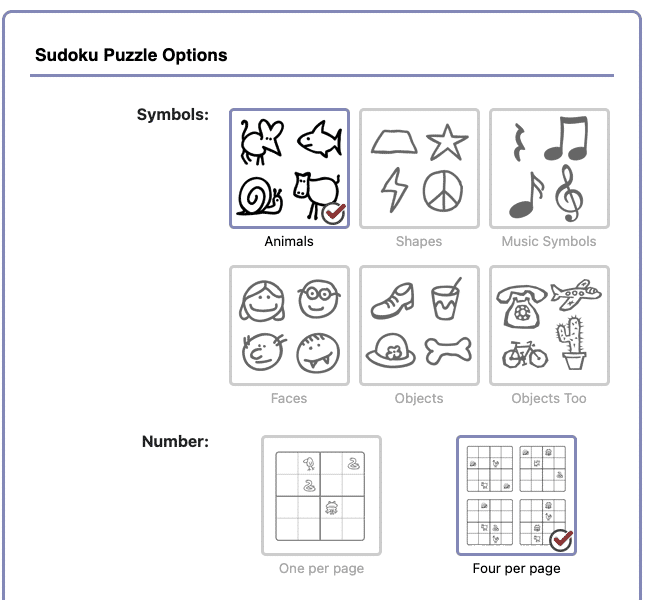
Sudokus are everywhere: in almost every shop to buy, and on the internet as free printables or to play online. So why another post about Sudokus? Because it is not easy to find good Sudoku puzzles for children, and it is even less easy to find Sudokus with symbols. Worksheetworks.com, however, offers a free symbol Sudoku generator. Simply choose the symbols, how many Sudoku puzzles you want (one or four per page), choose the difficulty level, and click “create worksheet”. You get a PDF which you can save or print. Both a solution and an explanation of the solution are included.
We like symbol sudokus very much. Young children can solve them as well and are very proud of being able to do the same kind of puzzles as adults. Older children like the extra challenge of drawing the symbols – this trains creativity and visual perception. What more can you wish?
Access the Symbol Sudokus here -

Animals and objects
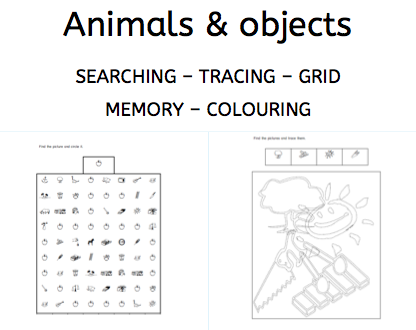
A cold, rainy day? Still 10 minutes to fill? Children with special educational needs? You simply cannot have enough worksheets. That’s why we offer you a file (24 pages) with animals and objects: searching, tracing, drawing, coloring, memory – all for free, of course! The exercises train attention, visual, and spatial perception.
DOWNLOAD
We hope you enjoy them! -

Open your ears!
The American Dyslexia Association offers a different educational approach to help people with dyslexia and dyscalculia. This approach is called the AFS-Method, which is a multi-sensory method to help people who have difficulties with reading, writing and/or calculating. The “F” stands for “Function” which means the different sensory perceptions you need to learn reading, writing, and calculating. One important sensory perception is the acoustic area:
- acoustic recognition: Can the child recognize different sounds?
- acoustic memory: Can the child remember what he/she has heard?
- acoustic sequencing: Can the child remember a sequence of sounds?
We offer 12 sound sequences to train acoustic perception. Access them here. The audio clips have different degrees of difficulty. The child should recognize whether the sounds are the same or different, loud or soft, how many different sounds there are, and so on. According to the age and skills of your child, you can do the exercises with closed headphones. The headphones have the advantage that the child can completely focus on the sounds. The trainer or parent then also needs headphones and a dual adapter. If you do the exercises without headphones, then the child also hears the normal daily sounds around and learns how to filter out noise even better.
We also made some worksheets to accompany these exercises, which you can download here: DOWNLOAD.
Access the audio clips here. -

Mazes
Mazes have always fascinated humanity. Think about the Cretan Labyrinth from Greek mythology. But even today, mazes are very popular. In “The Goblet of Fire,” Harry Potter has to go through a maze to win the Triwizard Tournament. Once Harry finds the way through the maze, things turn out completely different from what was expected. But that is another story you’d better read yourself.
Children are also fascinated by mazes. Therefore, mazes are perfect for training attention and perception. Here is a good way to do mazes with your children:- Give your children a maze.
- First, the children should try to find the way ONLY using their eyes.
- If that is too difficult, or if they found the way with their eyes, they should trace the way with their fingers.
- If that works well, they should trace the way with a pen. They shouldn’t touch the walls of the maze.
Important: Take care that the mazes are not too difficult, but also not too easy.
We created some worksheets with mazes in varying levels of difficulty.