Tag: science

  • Scientists May Have Found the Real Cause of Dyslexia—And a Way to Treat It

    iStock

    Dyslexia is often described as trying to read letters as they jump around the page. Because of its connections to reading difficulties and trouble in school, the condition is often blamed on the brain. But according to a new study published in Proceedings of the Royal Society B, the so-called learning disability may actually start in the eyes.

    As The Guardian reports, a team of French scientists say they’ve discovered a key physiological difference between the eyes of those with dyslexia and those without it. Our eyes have tiny light-receptor cells called rods and cones. The center of a region called the fovea is dominated by cones, which are also responsible for color perception.

    Just as most of us have a dominant hand, most have a dominant eye too, which has more neural connections to the brain. The study of 60 people, divided evenly between those with dyslexia and those without, found that in the eyes of non-dyslexic people, the arrangement of the cones is asymmetrical: The dominant eye has a round, cone-free hole, while the other eye has an unevenly shaped hole. However, in people with dyslexia, both eyes have the same round hole. So when they’re looking at something in front of them, such as a page in a book, their eyes perceive exact mirror images, which end up fighting for visual domination in the brain. This could explain why it’s sometimes impossible for a dyslexic person to distinguish a “b” from a “d” or an “E” from a “3”.

    These results challenge previous research that connects dyslexia to cognitive abilities. In a study published earlier this year, people with the condition were found to have a harder time remembering musical notes, faces, and spoken words. In light of the new findings, it’s unclear whether this is at the root of dyslexia or if growing up with vision-related reading difficulties affects brain plasticity.

    Continue reading article: https://www.dyslexia.me/?p=2283&preview=true

  • Dyslexia and the Brain

    Dyslexia and the Brain

    Researchers are continually conducting studies to learn more about the causes of dyslexia, early identification of dyslexia, and the most effective treatments for dyslexia.

    Developmental dyslexia is associated with difficulty in processing the orthography (the written form) and phonology (the sound structure) of language. As a way to understand the origin of these problems, neuroimaging studies have examined brain anatomy and function of people with and without dyslexia. These studies are also contributing to our understanding of the role of the brain in dyslexia, which can provide useful information for developing successful reading interventions and pinpointing certain genes that may also be involved.

    What is brain imaging?

    A number of techniques are available to visualize brain anatomy and function. A commonly used tool is magnetic resonance imaging (MRI), which creates images that can reveal information about brain anatomy (e.g., the amount of gray and white matter, the integrity of white matter), brain metabolites (chemicals used in the brain for communication between brain cells), and brain function (where large pools of neurons are active). Functional MRI (fMRI) is based on the physiological principle that activity in the brain (where neurons are “firing”) is associated with an increase of blood flow to that specific part of the brain. The MRI signal bears indirect information about increases in blood flow. From this signal, researchers infer the location and amount of activity that is associated with a task, such as reading single words, that the research participants are performing in the scanner. Data from these studies are typically collected on groups of people rather than individuals for research purposes only—not to diagnose individuals with dyslexia.

    Which brain areas are involved in reading?

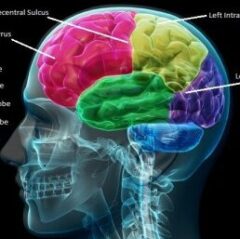
    Since reading is a cultural invention that arose after the evolution of modern humans, no single location within the brain serves as a reading center. Instead, brain regions that sub serve other functions, such as spoken language and object recognition, are redirected (rather than innately specified) for the purpose of reading (Dehaene & Cohen, 2007). Reading involves multiple cognitive processes, two of which have been of particular interest to researchers: 1) grapheme-phoneme mapping in which combinations of letters (graphemes) are mapped onto their corresponding sounds (phonemes) and the words are thus “decoded,” and 2) visual word form recognition for mapping of familiar words onto their mental representations. Together, these processes allow us to pronounce words and gain access to meaning. In accordance with these cognitive processes, studies in adults and children have demonstrated that reading is supported by a network of regions in the left hemisphere (Price, 2012), including the occipito-temporal, temporo-parietal, and inferior frontal cortices. The occipito-temporal cortex holds the “visual word form area.” Both the temporo-parietal and inferior frontal cortices play a role in phonological and semantic processing of words, with inferior frontal cortex also involved in the formation of speech sounds. These areas have been shown to change as we age (Turkeltaub, et al., 2003) and are altered in people with dyslexia (Richlan et al., 2011).

    What have brain images revealed about brain structure in dyslexia?

    Evidence of a connection between dyslexia and the structure of the brain was first discovered by examining the anatomy of brains of deceased adults who had dyslexia during their lifetimes. The left-greater-than-right asymmetry typically seen in the left hemisphere temporal lobe (planum temporale) was not found in these brains (Galaburda & Kemper, 1979), and ectopias (a displacement of brain tissue to the surface of the brain) were noted (Galaburda, et al., 1985). Then investigators began to use MRI to search for structural images in the brains of research volunteers with and without dyslexia. Current imaging techniques have revealed less gray and white matter volume and altered white matter integrity in left hemisphere occipito-temporal and temporo-parietal areas. Researchers are still investigating how these findings are influenced by a person’s language and writing systems.

    What have brain images revealed about brain function in dyslexia?

    Early functional studies were limited to adults because they employed invasive techniques that require radioactive materials. The field of human brain mapping greatly benefited from the invention of fMRI. fMRI does not require the use of radioactive tracers, so it is safe for children and adults and can be used repeatedly which facilitates longitudinal studies of development and intervention. First used to study dyslexia in 1996 (Eden et al., 1996), fMRI has since been widely used to study the brain’s role in reading and its components (phonology, orthography, and semantics). Studies from different countries have converged in findings of altered left-hemisphere areas (Richlan et al., 2011), including ventral occipito-temporal, temporo-parietal, and inferior frontal cortices (and their connections). Results of these studies confirm the universality of dyslexia across different world languages.

    Continue reading article: https://dyslexiaida.org/dyslexia-and-the-brain-fact-sheet/
  • What Do We Mean When We Talk About STEM?

    What Is STEM?

    STEM might win the award for the most talked about education buzzword of the last 10 years or so. It’s gotten to the point where, similar to the organic and low fat labels in the food industry, STEM could mean very little if you see it on toys or educational products. So how do we talk intelligently about STEM education and where it needs to go? The first step is understanding the history of this term and what it means for schools.

    What is STEM?

    STEM stands for sciencetechnologyengineering, and math. STEM curriculum blends those subjects in order to teach “21st-century skills,” or tools students need to have if they wish to succeed in the workplace of the “future.” The idea is that in order to be prepared for jobs and compete with students from different parts of the world, students here in the US need to be able to solve problems, find and use evidence, collaborate on projects, and think critically. Skills, the thinking goes, that are taught in those subjects.

    Still, STEM can be hard to define. It’s such a popular term that it means a lot of different things to a lot of different people. Although the science (biology, chemistry, etc.) and math (algebra, calculus, etc.) parts of the abbreviation might be easy to figure out, the technology and engineering parts might be less clear. Technology includes topics such as computer programming, analytics, and design. Engineering can include topics like electronics, robots, and civil engineering. The key term, when talking about STEM, is integration. STEM curriculum intentionally melds these disciplines. It’s a blended approach that encourages hands-on experience and gives students the chance to gain and apply relevant, “real-world” knowledge in the classroom.

    Continue reading article here:

    https://www.weareteachers.com/what-is-stem/

  • Why Ages 2-7 Matter So Much for Brain Development

    Rich experiences—from play to the arts and relationships—fundamentally shape a young child’s development.

    June 24, 2020
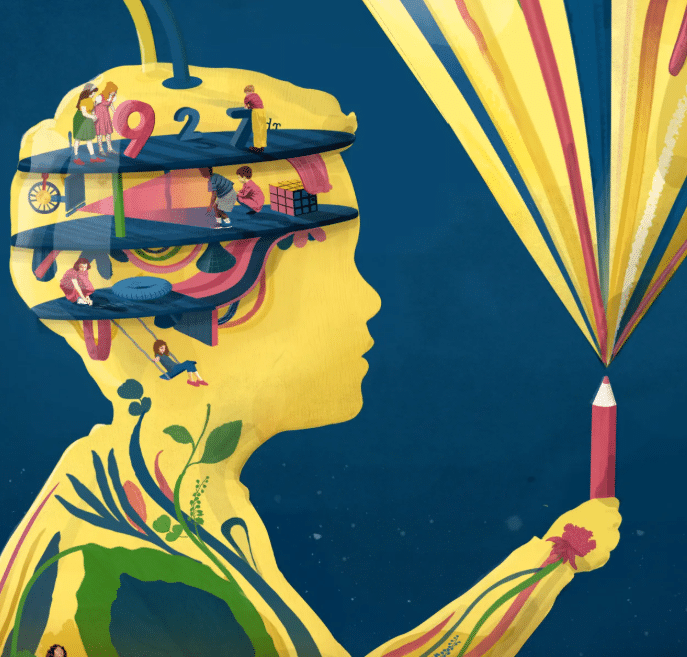
    An illustration concept of a child internalizing knowledge

    When Albert Einstein was a child, few people—if any—anticipated the remarkable contributions he would make to science. His language development was delayed, worrying his parents to the point of consulting a doctor. His sister once confessed that Einstein “had such difficulty with language that those around him feared he would never learn.” How did this child go from potential developmental delays to becoming, well, Einstein?

    Part of the answer to that question is symbolized in two gifts that Einstein received from each of his parents when he was 5 years old. When Einstein was in bed all day from an illness, his father gave him a compass. For Einstein, it was a mysterious device that sparked his curiosity in science. Soon after, Einstein’s mother, who was a talented pianist, gave Einstein a violin. These two gifts challenged Einstein’s brain in distinctive ways at just the right time.

    Children’s brains develop in spurts called critical periods. The first occurs around age 2, with a second one occurring during adolescence. At the start of these periods, the number of connections (synapses) between brain cells (neurons) doubles. Two-year-olds have twice as many synapses as adults. Because these connections between brain cells are where learning occurs, twice as many synapses enable the brain to learn faster than at any other time of life. Therefore, children’s experiences in this phase have lasting effects on their development.

    This first critical period of brain development begins around age 2 and concludes around age 7. It provides a prime opportunity to lay the foundation for a holistic education for children. Four ways to maximize this critical period include encouraging a love of learning, focusing on breadth instead of depth, paying attention to emotional intelligence, and not treating young children’s education as merely a precursor to “real” learning.

    ENCOURAGE A LOVE OF LEARNING

    Young children need to enjoy the process of learning instead of focusing on performance. Educators and parents can emphasize the joys of trying new activities and learning something novel. We need to help children understand that mistakes are a welcome, normal part of learning.

    This period is also the time to establish a growth mindset—the belief that talents and abilities are developed through effort instead of being innately fixed. Educators should avoid labeling children or making universal statements about their ability. Even compliments such as “You’re so smart” are counterproductive. Instead, emphasize persistence and create safe spaces for learning. Children will learn to love learning if we show enthusiasm over the process rather than fixating on results.

    FOCUS ON BREADTH, NOT DEPTH

    One way to avoid focusing on results during this phase of development is to emphasize the breadth of skill development over depth. Exposing children to a wide variety of activities lays a foundation for developing skills in a range of fields. This is the time to engage children in music, reading, sports, math, art, science, and languages.

    In his book Range, David Epstein argues that breadth of experience is often overlooked and underappreciated. Focusing on excellence in a single activity may be appropriate at some point in life. But the people who thrive in our rapidly changing world are those who first learn how to draw from multiple fields and think creatively and abstractly. In other words, our society needs well-rounded individuals.

    Continue reading article here: https://www.edutopia.org/article/why-ages-2-7-matter-so-much-brain-development