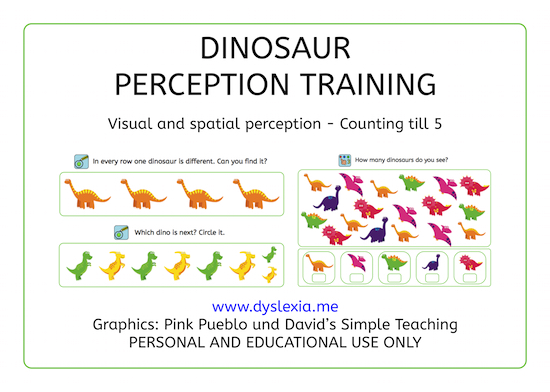
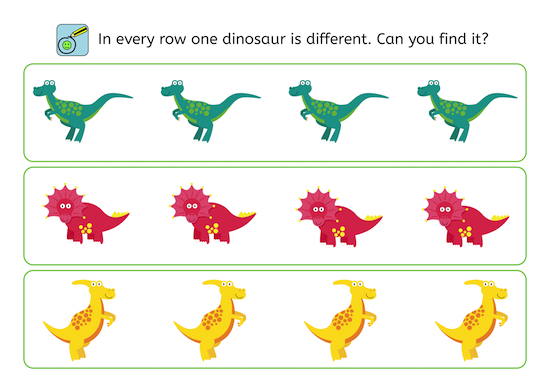
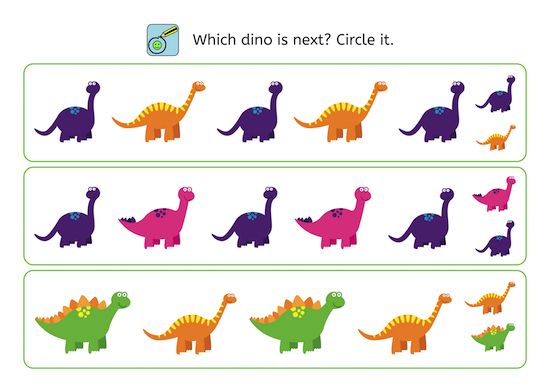
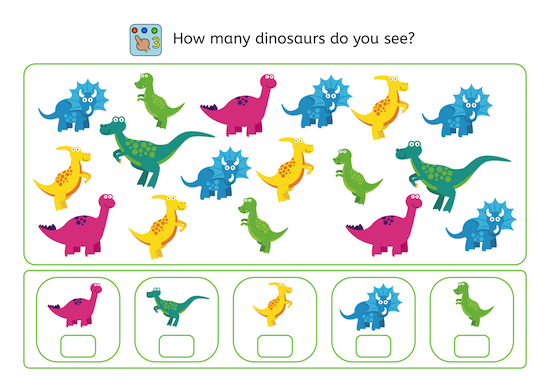
Kids + dinosaurs = fun! Enjoy our new free no-prep printables with dinosaurs. Kids will have fun and train their visual and spatial perception, patterning, and counting up to 5.
You want even more dinosaurs? Check out this free online game: Dinosaur – Find the pairs! You can choose different levels. The game can be played in any browser on any computer, smartphone or tablet.
The American Dyslexia Association offers more than 1,500 free worksheets on its website. They are built on the AFS method, the approach used worldwide in individualized dyslexia and dyscalculia training. Everything is free to download, and you may use it at school, at home, or in tutoring.
When a child has dyslexia or dyscalculia, correcting the errors alone changes very little. The errors are the visible end of a longer chain. A child also has to be able to hold attention through a whole page, and the senses that carry reading, writing, and calculating have to be trained alongside the schoolwork itself. That is the reasoning behind the way these worksheets are organized.
What the worksheets cover
AFS stands for Attention, Function, and Symptom, and the collection follows those three areas.
Attention. Short, focused exercises that ask a child to stay with one task and notice detail. Find the shape, spot the difference, match the pair, complete the pattern.
Function. Training for the sensory perceptions that reading and arithmetic rest on: visual and spatial perception, visual and auditory sequencing, differentiation, and memory. This is the part most worksheet collections leave out entirely.
Symptom. The schoolwork itself. Letter recognition, reading, spelling patterns, number decomposition, counting, and the four basic operations.
Who they are for
Most sheets suit children in kindergarten through the elementary grades, roughly ages 5 to 11, and many work well with older children who need to rebuild a foundation without being handed material that looks babyish. Parents, classroom teachers, homeschooling families, tutors, and Certified Dyslexia Trainers all use them. No account and no sign-up is required.
How to use them so they actually help
Short and often beats long and rare. Ten focused minutes a day does more than an hour on Sunday.
Take all three areas, not just the last one. A child who only ever practices spelling is practicing the symptom while the cause stays where it was.
Stop while it is still going well. Ending on success is what makes a child willing to sit down again tomorrow.
Watch how the child works, not only what the answer is. Where the eye jumps, where attention slips, and which errors repeat tell you more than a score.
Print rather than fill in on screen where you can. Handling the paper, tracing, cutting, and coloring are part of the exercise.
More free material on this blog
The worksheet library is not the only free resource here. Our own printable freebies are published regularly and cover perception training, counting, tracing, and seasonal activities. For handwriting practice you can build your own sheets with the handwriting worksheet generator, and there is a matching tool for printable math worksheets if arithmetic is the harder subject at your kitchen table. The freebies overview page collects the lot.
If you want to work this way professionally
Worksheets support training, but they do not replace knowing which area a particular child needs. That is what the AFS-Test establishes and what trainers learn to read. If you work with children and want the full picture, the ADA-accredited certification for dyslexia trainers teaches the testing and the training together, and the first lesson is free to read.
More free material: our complete list of free dyslexia resources for parents and teachers covers worksheets, generators, daily exercises, a free math app, and a parents portal, plus how much daily practice a child needs.
More on this topic: the worksheets are free because the American Dyslexia Association is a 501(c)(3) public charity, supported by donations and memberships. Read what ADA’s 501(c)(3) dyslexia charity status means.
New for Halloween: download 10 free Halloween worksheets that train seeing, hearing, counting, and reading, with an answer key for parents and teachers.
New for Thanksgiving: download 10 free Thanksgiving worksheets that train seeing, hearing, counting, and reading, with an answer key for parents and teachers.
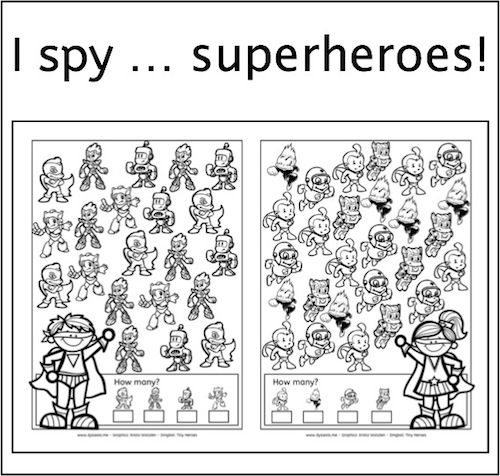
Here is another “I spy…” freebie. Children simply love them. This time it is called “I spy … superheroes”. Print, color, count, and simply enjoy all the fun. At the same time, children train attention, visual perception, and fine motor skills.
The American Dyslexia Association offers a different educational approach to help people with dyslexia and dyscalculia. This approach is called the AFS-Method, which is a multi-sensory method to help people who have difficulties with reading, writing and/or calculating. The “F” stands for “Function” which means the different sensory perceptions you need to learn reading, writing, and calculating. One important sensory perception is the acoustic area:
acoustic recognition: Can the child recognize different sounds?
acoustic memory: Can the child remember what he/she has heard?
acoustic sequencing: Can the child remember a sequence of sounds?
We offer 12 sound sequences to train acoustic perception. Access them here. The audio clips have different degrees of difficulty. The child should recognize whether the sounds are the same or different, loud or soft, how many different sounds there are, and so on. According to the age and skills of your child, you can do the exercises with closed headphones. The headphones have the advantage that the child can completely focus on the sounds. The trainer or parent then also needs headphones and a dual adapter. If you do the exercises without headphones, then the child also hears the normal daily sounds around and learns how to filter out noise even better.
We also made some worksheets to accompany these exercises, which you can download here: DOWNLOAD. Access the audio clips here.
Krokotak offers all kinds of ideas for parents and children to be creative: printables, recipes, drawing, experiments and many more ideas. How about making some windmills, rain mandalas, a car made from an egg carton, or monster cards? Go visit krokotak and be inspired!
Arrange dinos from small to big, find the dino that is exactly the same, and find pieces from a picture. These exercises train visual and spatial perception and attention – important skills for reading, writing, and calculating.
Today’s freebie contains 3 worksheets. Children have to find a given shape. They can color or circle the shape. These exercises train attention and visual perception – important skills for good reading, writing, and calculating.
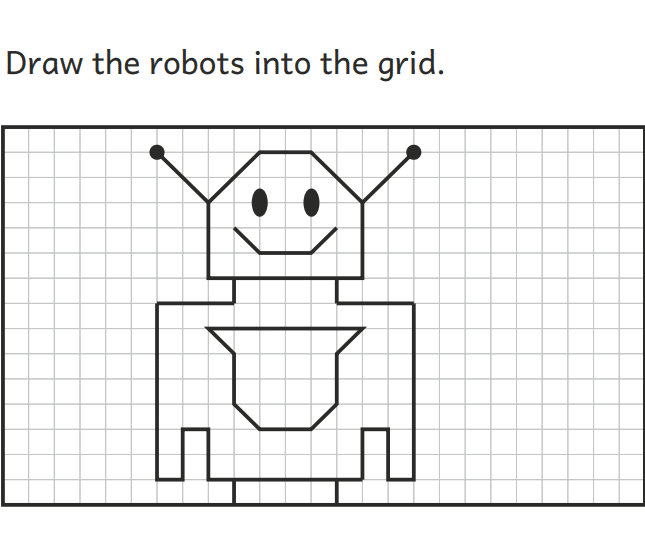
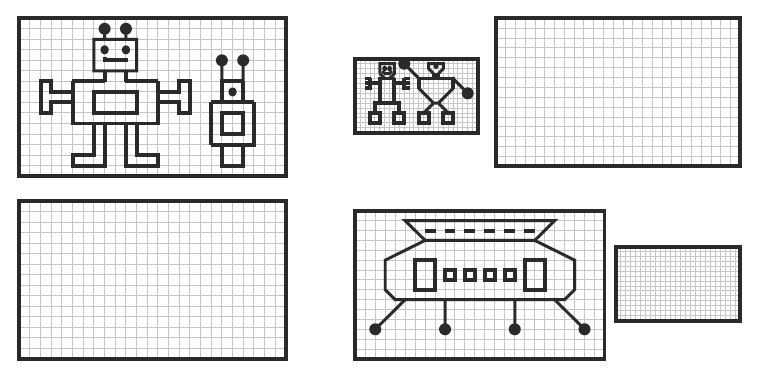
Today’s freebie offers you various robots and a spacecraft. Children have to draw these into the grid, mirror them or make them smaller or bigger. Children are counting, comparing up and down and left and right. This trains attention, eye-hand-coordination and visual and spatial perception – important skills for reading, writing and calculating.
Today’s freebie contains tracing and pattern exercises. Children can either trace the shapes or they can trace the shapes and complete the pattern. Let them use different pens and colors. You can also laminate the exercises. Children can do the tracing with a dry-erase pen. This is a good alternative for children who have difficulties with tracing. Knowing that they can erase their tracing seems helpful for them. Tracing and pattern exercises train attention and visual and spatial perception – important skills for reading, writing, and calculating.