As teachers, we know that when students have certain abilities,
they’re better prepared for school and life. Working memory is one of
those things. We know it when we see it: Students are organized, know exactly what to do after you’ve given directions, and are able to follow in-depth discussions.
On the flip side, there are students who need extra help to develop their working memory. As it turns out, working memory and dyslexia go hand in hand, and there’s a lot we can do to help students with dyslexia remember more.
What is working memory?
In short, our working memory helps us hold and use information. It’s the cognitive process we use to hold some information in our minds while we retrieve other information. It’s also involved with recalling information, from a set of directions to a story. We’re using our working memory across the day—completing step-by-step math problems, following a recipe after reading it, or doing tasks like identifying rhyming words or sounding out multisyllabic words.
Our working memory is small; only a few bits of information will fit at any time. That’s why, when you’re working through a math problem, you may have to refer back to it a few times to retrieve the information you lost. That’s also why it’s so frustrating for kids who struggle with poor working memory—everything seems to be passing them by.
Children with dyslexia have a higher rate of working memory concerns. The rate of poor working memory in students with dyslexia and other learning disabilities ranges from 20 to 50 percent , compared to 10 percent of students overall. So, it’s something that you’re likely to see in classrooms. Here’s how to help:
1. Give students personal reference charts.
Reduce the amount that students have to keep in their working memory with personal reference charts. This gives them the chance to actually think through higher-order tasks because they don’t have to take energy to recall basic information (math facts, vocabulary words, editing notations). It also helps them complete tasks faster because they aren’t relying solely on their memory to get information.
Teacher tip: Work with students to identify what information they have trouble recalling and show them how to create a personal reference chart. This teaches them to use this strategy throughout their lives.
2. Place anchor charts strategically.
Anchor charts are, really, a whole-class visual reference sheet, but they can also clutter your walls and make it difficult for students to identify which information they need to use now. Consider having rotating anchor charts at a specific space in your room where you can post the anchor chart that students should be using for the task at hand.
3. Embrace audiobooks.
For students with dyslexia, audiobooks remove the difficulty of sounding out words. This takes the pressure off their working memory so they can understand the story or content. Using a solution like Learning Ally, which provides kids with audiobooks that have options like highlighted text, lets kids enjoy books without taxing their working memory.
In 1987, two researchers in Wisconsin, Donna Recht and Lauren Leslie, constructed a miniature baseball field and installed it in an empty classroom in a junior high school. They peopled it with four-inch wooden baseball players arranged to simulate the beginning of a game. Then they brought in sixty-four seventh- and eighth-grade students who had been tested both for their general reading ability and their knowledge of baseball.
The goal was to determine to what extent a child’s ability to understand a text depended on her prior knowledge of the topic. Recht and Leslie chose baseball because they figured lots of kids in junior high school who weren’t great readers nevertheless knew a fair amount about the subject. Each student was asked to read a text
describing half an inning of a fictional baseball game and move the wooden figures around the board to reenact the action described.
Churniak swings and hits a slow bouncing ball toward the shortstop, the passage began. Haley comes in, fields it, and throws to first, but too late. Churniak is on first with a single, Johnson stayed on third. The next batter is Whitcomb, the Cougars’ left-fielder.
It turned out that prior knowledge of baseball made a huge difference in students’ ability to understand the text—more of a difference than their supposed reading level. The kids who knew little about baseball, including the “good” readers, all did poorly. And among those who knew a lot about baseball, the “good” readers and the “bad” readers all did well. In fact, the bad readers who knew a lot about baseball outperformed the good readers who didn’t.
In another study, researchers read preschoolers from mixed socioeconomic backgrounds a book about birds, a subject they had determined the higher-income kids already knew more about. When they tested comprehension, the wealthier children did significantly better. But then they read a story about a subject neither group knew anything about: made-up animals called wugs. When prior knowledge was equalized, comprehension was essentially the same. In other words, the gap in comprehension wasn’t a gap in skills. It was a gap in knowledge.
The implication is clear: abstract “reading ability” is largely a mirage constructed by reading tests. A student’s ability to comprehend a text will vary depending on his familiarity with the subject; no degree of “skill” will help if he lacks the knowledge to understand it. While instruction in the early grades has focused on “learning to read” rather than “reading to learn,” educators have overlooked the fact that part of “learning to read” is acquiring knowledge.
By: Judy Zorfass, Tracy Gray, and PowerUp WHAT WORKS
I grabbed my purse, stepped outside into the cold night air, and watched as a flake drifted to the ground. I started walking to my car, but I had to grab hold of a mailbox to keep from slipping.
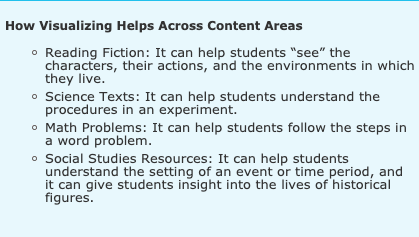
Did you picture a woman standing outside on a winter’s night watching the snow fall? Or maybe you pictured her taking a step and then slipping on the icy sidewalk as she headed to her car? If so, you were visualizing — a critical reading skill that is necessary to comprehend both informational texts and literature. Within the College and Career Readiness Standards for Reading, visualizing has a role to play in helping students identify key ideas and details and understand craft and structure.
Proficient readers scan and interpret text, forming a mental image of what is happening. Visualizing while reading adds texture to a scene by adding imagined details that the text may not spell out, and it is an indication of successful text comprehension.
By incorporating differentiated models, practicing visualization, and supporting your students as they visualize (drawing on principles for Universal Design for Learning), you can help them learn to use all of their senses to engage with and imagine the world of a text, and to bring that world to life as they read. See UDL Editions Visualize Strategy for a student-friendly explanation and rubric for visualizing.
Technology Tools for Visualizing
A range of tools (both low-tech and high-tech) can support your students’ ability to visualize. For example, you could encourage students to draw, use dramatizations, and/or create music. Students could use cameras to take photos, or they could search for photos, images, and other graphics. They could create their own videos or watch those produced by others; they could listen to music or use programs to create their own. A variety of software tools and apps are available that stimulate students’ visualizations and support their efforts to draw, diagram, and create images.
If students are reading digital text, they can access a variety of embedded supports to enhance visualization (e.g., audio explanations, photos, and images), including embedded prompts that encourage students to stop and visualize. All of these tools can help you to differentiate instruction. The video below provides ideas for using supports that are built into text to differentiate instruction.
HOW TO INSPIRE STUDENTS TO WRITE By Linda Davis-Kyle
As a youth, Lisa Shontea Nichols (b.d. May 18, 1966) endured from her speech teacher the words, “Miss Nichols, you should never speak in public,” and from her composition teacher, “Miss Nichols, you’re the weakest writer I ever met in my entire life.” 1
Rising above Denigrating Criticism
Yet, about three decades later, Lisa is a world-renowned transformational speaker who addresses audiences of 10,000 plus, and she is a bestselling author of six books with a seventh—Abundance Now: Amplify Your Life & Achieve Prosperity Today—ready for release at the time of this writing. As Lisa puts it, she “writes bestsellers, not books.” She is a co-author of Living Proof: Celebrating the Gifts That Came Wrapped in Sandpaper and the author of No Matter What! 9 Steps to Living the Life You Love and Unbreakable Spirit: Rise Above the Impossible. Not only is she a world-renowned speaker and bestselling author, but Lisa is also the founder and CEO of the multi-million dollar company Motivating the Masses, Inc.
Hearing Discouraging Comments May Be Quite Common
While aspiring writers can find a multitude of teachers and established writers making discouraging comments about and to youthful writers, I, as a contrarian on the matter, feel that it is important to encourage young learners to write as soon as they show any interest in writing. Some parents may see their very young children—who have enjoyed hearing stories read to them—sit with a notepad and draw wavy lines before the youngsters can read for themselves or even know the alphabet. When asked, “What are you doing?” they very well may say proudly, “I’m writing a story.” When such an action happens, parents I have known capitalize on that moment and encourage those efforts.
Appreciating Astute Parents, Grandparents, and Teachers
From the tiny bit I know from Richard Bandler, the great and wonderful co-creator of Neuro-Linguistic Programming, I suspect he would praise the parent or teacher who fosters the growth of thought in youngsters and their keen desire to put pencil to paper to write. Bandler likely would say that the words spoken are of supreme importance to young and mature alike who are inspired to write. To make it clear, neither Bandler nor I are talking about false praise. I’m referring to looking for and finding something good in the young writers’ compositions, theme papers, articles, stories, poems, songs, and books. Some careless comments can, in a sense, “hypnotize” and devalue the efforts of youthful writers.
Acknowledging the Impact of Positive Effort and Encouragement
Some who seem to tell youngsters they are not experienced enough to write, they have not seen enough of the world to write, they have no voice or style to write, may be wholly and completely correct in their assumption. I believe, though, that offering constructive criticism with thoughtful suggestions is totally welcome. Young writers learn to write by writing and being nurtured in their efforts. Giving harsh criticism can crush the spirit of some young writers. It is akin to pulling on a sprouting plant, uprooting it, and killing it before it has a chance to develop strong roots and flourish. Thoughtful communication and correction are to the students as water and sunlight are to the emerging sprouts. Why destroy enthusiasm in any eager writers—young or mature—who choose to share their talent with the world? Why try to stymy the love of a budding talent that needs only attention, direction, and their own devotion to their worthy goal?
Encouraging and Fostering the Love of Writing
One learns by taking lessons, by observing others doing their chosen activity, and by diving into the activity with passion. I prefer to encourage young writers. I say to young and mature writers alike that “no matter what anyone says to try to dissuade you or what anyone does to put obstacles in your path, keep studying and reading and working to improve your craft.”
Motivating with Encouraging Words from the Heart
Not all teachers are like Lisa’s. Encouragement can come from the hearts of caring teachers, parents, grandparents, and mentors. Reading and writing daily can keep would-be writers energized. Practicing step by step can help eager writers-in-the-making conquer obstacles that arise not only in writing but also in life. Adults who choose to be their mentors can guide and support teens to improve their writing through serious application of some fun ways of looking at writing. If your teens choose to continue to use some of the modest approaches to writing, such as warm-ups (which seasoned writers may or may not use) while exploring and learning more complicated techniques to polish their talents, all the while, who knows where their writing will lead them as they go forth into the world?
Looking Inside the Writing World of Some Teens
Had Jake Marcionette’s mother not encouraged Jake, he would not be a triumphant author with his published books, such as Just Jake #1 and Just Jake: Dog Eat Dog #2. His mother “encouraged” him. Actually, he explains that she “forced” him to write an hour and a half each day. As a successfully published author, though, force is no longer part of the equation. Marcionette says he “loves writing” now. Rachel Parent’s family encouraged Rachel with her passion to help bring the important anti-GMO message to her peers, her country, and the world. Had her parents not supported her efforts, Rachel would not have had the opportunity to meet with Canada’s Health Minister Rona Ambrose to speak her mind.
Sure. It’s good to have a handle on grammar and the parts of speech before one dives right in to write. The late Gary Provost says, “…you cannot write well without [the rules of grammar].” And, as I say in The Busy English Teacher… “recognizing parts of speech and how writers put the words to work can contribute to great fun and relevant learning for eager scholars. An abundance of practice researching, reading, and noting spelling awaits them around every corner. When given a little nudge in the right direction to motivate them, teens may be amazed at their own power. Young learners can experience the joy of learning. They can stretch their thinking when given fun challenges and exciting opportunities to explore. They can accept challenges they have not even thought of accepting before if presented in a non-threatening and fun way.” by
Writing Even before Becoming Supersaturated in Rules
Making a bold effort to keep the joy of writing alive, some educators do not intrude on the creative process for quite some time. Montessori schools, with which I am familiar, maintain an initial hands-off policy and just let budding writers write. After the young learners are comfortable with their masterpieces, their teachers, known as guides, gently introduce patterns and rules of spelling and grammar while still managing not to stifle the creativity of the young writers. Some students may excel in spite of harsh criticism, or even because of it, as Lisa has. Nevertheless, some teachers may choose to nurture rather than negate the writing of young students to help them achieve their dreams. If they wish, teachers can leave a legacy of kindness. Their kindness can live to connect with the hearts of their students to help sustain their inner power long after the teachers have gone.
Sources
1 Nichols, Lisa. “Questions That Will Stir Your Soul,” YouTube ~ https://www.youtube.com/watch?v=JuKCwS8wmls 24:32. 2 ldk, The Writer’s Friend, p. 14. 3 Marcionette, Jake. http://www.cbsnews.com/news/thirteen-year-old-author-writes-own-success-story/ 4 Provost, Gary. 100 Ways to Improve Your Writing. New York: Mentor, 1985, p. 107. 5 ldk, The Busy English Teacher’s Fun Activities & Exercises for Pre-Teens: Grammar Mind Maps, Fitness Games & More. Amazon Kindle Book.
About the Author
Linda Davis-Kyle, MA, has been published in North America, Europe, Africa, Asia, and Australia in professional journals such as Modern Drama in Canada, Chem Matters in the USA, Jewish Affairs in the Republic of South Africa, and Studies in English Literature in Japan, and in magazines such as Common Ground in Canada and Green Farm Natural Health in the United Kingdom. She is also the author of “Exploring ‘Treasure Storehouses’ of the World,” found on the American Dyslexia Association website. Davis-Kyle’s Amazon Kindle book, The Busy English Teacher’s Fun Activities & Exercises for Pre-Teens, is the perfect time-saving gift for overworked educators. It is overflowing with fun learning exercises that nurture the minds, bodies, and spirits of young learners.