Tag: dyscalculia

  • 5 Surprising Truths About Dyslexia

    5 Surprising Truths About Dyslexia

    Beyond the Myths: 5 Surprising Truths About Dyslexia

    When most people hear “dyslexia,” they picture a child confusing ‘b’ and ‘d’ or struggling to spell. While these can be signs, this common understanding barely scratches the surface of a much more complex reality. For years, myths and misconceptions have created frustration for parents, educators, and especially for individuals with dyslexia themselves.

    As someone who has been training dyslexia specialists since 1996, I’ve seen firsthand how a deeper understanding can transform a child’s learning journey from struggle to empowerment. Let’s move beyond the myths and explore five truths that challenge common assumptions and offer a more accurate, helpful perspective.

    1. It’s Not Always ADHD—It’s Often Cognitive Overload

    It’s a common scenario: a child is restless, fidgets constantly, and can’t stay focused during reading or writing tasks. The immediate suspicion is often ADHD. However, for many dyslexic learners, these behaviors are not signs of a pervasive attention disorder—they’re a situational response to cognitive overload.

    This is a key diagnostic differentiator known as situational inattentiveness. The behaviors are tied specifically to symbol-based tasks because decoding letters and numbers requires immense mental effort, leading to rapid exhaustion.

    Here’s what’s important: many of these same children can focus deeply on tasks that don’t involve written symbols—building, drawing, or problem-solving. While ADHD involves challenges with regulating attention across all situations, situational inattentiveness from dyslexia is about running out of cognitive fuel during specific tasks.

    The takeaway: Restlessness or inattentiveness during reading and writing isn’t automatically ADHD—it may reflect the stress and fatigue of struggling with dyslexia. Misdiagnosing this can lead to the wrong support, focusing on behavior management while failing to address the root literacy challenge.

    2. Why “Just Try Harder” Is Terrible Advice

    One of the most persistent and damaging myths is that dyslexia can be overcome with more effort. Well-meaning parents and teachers often believe that increased practice—more reading drills, more spelling lists—will solve the problem.

    For a dyslexic child, this approach rarely works and often creates immense frustration. Dyslexia isn’t just a problem with reading and writing symptoms; it’s rooted in differing sensory perceptions and how the brain processes symbols. Piling on more drills without addressing these underlying functions is like asking someone to run faster without ever teaching them proper form.

    A-F-S Method  AFS Method

    Effective support must be comprehensive. The AFS Method is built on three essential pillars that must be addressed together:

    • A – Attention training: Building the capacity for sustained, flexible focus
    • F – Function training: Strengthening sensory perceptions (visual, auditory, spatial processing)
    • S – Symptom training: Practicing reading, writing, and arithmetic skills

    Only when all three pillars are addressed can a child build the necessary pathways for efficient learning. This shifts the focus from blaming a child’s effort to providing the right kind of individualized support.

    3. The Goal Is Flexible Attention, Not Intense Concentration

    This may seem counter-intuitive, but forcing a dyslexic child to concentrate intensely on reading is often counterproductive. There’s a crucial difference between attention and concentration.

    Attention is a flexible state of focus. It allows a learner to stay on task while remaining aware of their surroundings and receptive to guidance. An attentive child can focus on words on the page but still hear a teacher’s prompt or notice a helpful cue.

    Concentration is a narrow, intense focus that excludes everything else. For a dyslexic learner, it can lead to rapid mental exhaustion, block out helpful feedback, and create unnecessary tension.

    The goal of effective training is to strengthen flexible attention—a balanced mental state that supports learning without causing fatigue and stress. This shift in thinking is a game-changer, helping learners engage with difficult tasks in a more sustainable way.

    4. It’s Not a Deficit—It’s a Different Operating System

    For too long, dyslexia has been framed solely as a disability. While the challenges are real, this perspective overlooks the unique strengths that often accompany this different way of processing information.

    Research and experience show that dyslexic individuals often exhibit above-average creativity, problem-solving skills, and big-picture thinking. Many of the world’s most successful innovators and leaders are dyslexic:

    • Hans Christian Andersen’s dyslexia likely contributed to the simple, accessible language that made his tales universally beloved
    • Leonardo da Vinci’s highly visual thinking allowed him to excel as both artist and engineer

    By shifting the narrative from “disability” to “different ability,” we help dyslexic individuals unlock their full potential. This perspective profoundly boosts a child’s confidence and motivation, allowing them to develop their considerable talents while receiving targeted support for their challenges.

    5. IQ Tests Can Be Deceptively Wrong

    Traditional intelligence testing can be highly misleading for individuals with dyslexia. Many IQ subtests rely heavily on the very skills that are challenging for dyslexics: rapid visual processing, symbol manipulation, and visual memory.

    Consequently, a bright dyslexic individual might score poorly and be misclassified as having “borderline intellectual ability.” The evaluator may conclude that academic struggles are due to low overall intelligence—tragically overlooking the real issue.

    A sharp split between different cognitive abilities—such as strong verbal reasoning versus slower processing speed—is often a hallmark pattern of dyslexia, not an indicator of low intelligence. The danger of misdiagnosis is immense: it can lead to recommendations for basic life skills training instead of the targeted academic support they truly need.

    Conclusion: Seeing the Whole Picture

    Understanding dyslexia means looking beyond mixed-up letters and frustrating homework sessions. It means recognizing that:

    • The child who can’t sit still may be cognitively exhausted
    • “Trying harder” is often the wrong advice
    • Comprehensive support addressing attention, sensory functions, and symptoms is essential
    • Flexible attention beats forced concentration
    • Dyslexia comes with unique strengths worth celebrating
    • IQ scores should never limit a child’s potential

    What potential could we unlock if we started seeing dyslexia not as a barrier to overcome, but as a different way of seeing the world?


    Frequently Asked Questions

    What are surprising symptoms of dyslexia?

    Beyond the well-known reading and spelling difficulties, dyslexia can show up in unexpected ways:

    • Left-right confusion – Difficulty distinguishing left from right, even into adulthood
    • Time management struggles – Trouble estimating how long tasks will take or being chronically late
    • Difficulty following sequences – Challenges with steps, directions, or remembering the order of things
    • Word retrieval problems – Knowing a word but being unable to recall it in the moment (“it’s on the tip of my tongue”)
    • Trouble with phone numbers and dates – Mixing up or forgetting numerical sequences
    • Poor short-term memory – Forgetting instructions moments after hearing them
    • Difficulty with organization – Messy backpacks, lost homework, cluttered spaces
    • Mispronouncing words – Especially longer or unfamiliar words
    • Avoiding reading aloud – Even when the person is otherwise confident

    These symptoms often go unrecognized because they don’t fit the stereotypical image of dyslexia.

    What are the 4 D’s of dyslexia?

    The “Four D’s” refer to four related learning differences that often overlap:

    • Dyslexia – Affects reading, writing, and spelling
    • Dyscalculia – Affects mathematical understanding and number sense
    • Dysgraphia – Affects handwriting, spelling, and putting thoughts on paper
    • Dyspraxia – Affects motor coordination and movement planning

    Each presents unique challenges, but they share common roots in how the brain processes information. It’s not uncommon for someone to experience more than one of these conditions.

    Is Bill Gates dyslexic?

    There is no confirmed public statement from Bill Gates indicating that he has dyslexia. While many successful entrepreneurs and innovators are dyslexic, it’s important not to assume or misattribute this condition. What we do know is that Gates has spoken about the value of different thinking styles in innovation and technology.

    Who else is dyslexic?

    Many highly successful people have openly shared their dyslexia, proving that it’s no barrier to achievement:

    • Richard Branson – Founder of Virgin Group
    • Steven Spielberg – Award-winning filmmaker
    • Whoopi Goldberg – Actress and TV host
    • Keira Knightley – Actress
    • Orlando Bloom – Actor
    • Jamie Oliver – Celebrity chef
    • Tom Cruise – Actor
    • Jennifer Aniston – Actress
    • Muhammad Ali – Boxing legend
    • Albert Einstein – Physicist (widely believed, though not formally diagnosed)
    • Agatha Christie – Best-selling author
    • John Lennon – Musician

    These individuals succeeded not despite their dyslexia, but often because of the unique strengths it gave them.

    What should you NOT say to a dyslexic person?

    Certain phrases, even when well-intentioned, can be hurtful or dismissive:

    • “Just try harder” – Dyslexia isn’t about effort; it’s about how the brain processes information
    • “You’re just lazy” – Dyslexic individuals often work twice as hard to achieve the same results
    • “You don’t look dyslexic” – Dyslexia has no physical appearance
    • “Everyone struggles with reading sometimes” – This minimizes a real neurological difference
    • “You’ll grow out of it” – Dyslexia is lifelong, though strategies can help manage it
    • “Why can’t you just remember?” – Memory challenges are part of dyslexia for many people
    • “Maybe you’re just not a reader” – With the right support, dyslexic individuals can enjoy reading
    • “Are you sure you’re not just making excuses?” – This undermines their genuine struggles

    Instead, offer understanding, patience, and ask how you can help.

    What are dyslexics best at?

    Dyslexic individuals often excel in areas that leverage their unique brain wiring:

    • Creative thinking – Seeing possibilities others miss
    • Problem-solving – Finding unconventional solutions
    • Big-picture thinking – Understanding complex systems and connections
    • Visual-spatial skills – Excelling in design, architecture, engineering, and art
    • Storytelling – Communicating ideas in engaging, memorable ways
    • Entrepreneurship – An estimated 35% of entrepreneurs are dyslexic
    • Empathy – Having overcome challenges often creates deep understanding of others
    • Innovation – Thinking outside the box comes naturally
    • Verbal communication – Many dyslexics are excellent speakers and persuaders

    Dyslexia often comes with remarkable gifts—the key is recognizing and nurturing them alongside targeted support for challenges.


    Want to Learn More?

    Are you a teacher, tutor, parent, or education professional who wants to make a real difference for dyslexic learners? Understanding dyslexia at a deeper level is the first step toward providing truly effective support.

    Our comprehensive certification program teaches you the AFS Method and equips you with the knowledge and practical tools to help children with dyslexia thrive.

    👉 Learn more at DyslexiaTrainer.com

    Whether you’re looking to expand your professional skills or simply want to better support a child in your life, education is the key to unlocking their potential.

  • Relaunch Announcement: The ADA-Accredited Dyslexia Trainer Certification Program Returns Stronger Than Ever

    Relaunch Announcement: The ADA-Accredited Dyslexia Trainer Certification Program Returns Stronger Than Ever

    The American Dyslexia Association (ADA) is pleased to announce the relaunch of the ADA-accredited Dyslexia Trainer Certification Program (www.dyslexiacertificate.com), an internationally recognized professional training for educators, specialists, and tutors who want to make a meaningful and immediate difference in the lives of learners with dyslexia.

    This updated and expanded program reflects decades of research, practical experience, and global collaboration—bringing together the proven strengths of the AFS Method, the standardized AFS Dyslexia Test, and the pedagogical expertise of the Dyslexia Research Center USA (DRC) and its partners.

    Become a certified dyslexia trainer

    For educators passionate about supporting diverse learners, this program offers a powerful pathway to deepen skills, strengthen confidence, and create lasting impact in classrooms and communities.


    Why ADA Accreditation Matters

    Accreditation by the American Dyslexia Association signifies that a program meets rigorous standards in research-based content, practical applicability, and professional ethics.

    The Dyslexia Trainer Certification Program by DRC USA is one of the few international dyslexia training programs to achieve ADA accreditation. This ensures that participants receive:

    • Instruction aligned with current scientific understanding of dyslexia
    • Practical tools that can be applied immediately in real educational settings
    • A consistent framework based on the cognitive foundations of reading, writing, and attention
    • A trusted and internationally recognized credential
    • A professional pathway that aligns with ADA’s mission to support individuals with dyslexia through evidence-based practice

    ADA accreditation is not merely a seal—it is a commitment to quality and outcomes. Educators can be confident that the skills they learn will support learners effectively and ethically.


    A Program Designed for Educators Who Want to Make a Difference

    The updated Dyslexia Trainer Certification Program focuses on practical, hands-on training grounded in research. This is not theoretical learning—it is actionable, accessible education that empowers participants to begin helping learners immediately.

    Key features include:

    The Standardized AFS Dyslexia Test

    Participants gain access to a widely used, research-supported screening instrument that helps identify dyslexia-related challenges with clarity and consistency.

    The AFS Method

    A structured, neurological approach to supporting foundational skills such as attention, visual perception, auditory processing, and spatial orientation—areas known to influence reading and writing success.

    Immediate Practical Application

    Each lesson includes methods and exercises educators can start using right away with learners of all ages.

    Flexible Online Learning

    Designed for busy educators, the program can be completed from anywhere, at your own pace, with ongoing support and guidance.

    International Recognition

    Graduates receive a certification that is respected and accepted worldwide through ADA partnerships.


    Who Should Enroll?

    The program is ideal for:

    • Classroom teachers
    • Special education professionals
    • Learning specialists
    • Tutors and educational therapists
    • Psychologists and school counselors
    • Homeschool educators
    • Anyone passionate about supporting individuals with dyslexia

    If your goal is to understand dyslexia deeply and help learners thrive, this certification is a powerful next step.


    Free Preview Lesson Now Available

    To support transparency and help educators experience the program firsthand, the first lesson is available for free. This preview provides an authentic look into the teaching style, structure, and practical value of the certification.

    Educators consistently report that Lesson 1 alone gives them insights they can begin using immediately.

    Sign up for your free lesson here: www.dyslexiacertificate.com


    Enrollment Is Open Now

    Enrollment is now officially open, and we invite educators worldwide to secure their place in the newly relaunched Dyslexia Trainer Certification Program and join educators from 65 countries worldwide who have already completed the certification.

    Demand for this ADA-accredited training is expected to be high, and early enrollment ensures immediate access to:

    • The introductory module
    • Program orientation
    • Bonus materials
    • The free preview lesson
    • Early community access

    This is an excellent opportunity to advance your professional skills and join a global network of dyslexia-focused educators.


    A Shared Mission: Helping Learners Thrive

    At the American Dyslexia Association, our mission is clear:

    To support individuals with dyslexia and related learning differences through understanding, research, and practical, effective education.

    The relaunch of this certification program aligns strongly with that mission.

    We are proud to endorse and accredit a program that equips educators with the tools they need—not only to teach, but to inspire, uplift, and create lasting change for learners who need it most.


    We approve and support this program.

    American Dyslexia Association


    Are you ready to enroll and help dyslexic children effectively? Join here: www.dyslexiacertificate.com

  • Close the Learning Gap: Learnedy now for free!

    Close the Learning Gap: Learnedy now for free!

    CLOSE THE LEARNING GAP: Just because one should / must stay at home at the moment does not mean that learning and practicing should also stop!

    The Dyslexia Research Center has 25 years of experience with distance learning and, in cooperation with the American Dyslexia Association, wants to help parents to design meaningful lessons for their children at home!

    We offer the new online learning platform Learnedy free of charge for parents. Learnedy is an educationally useful online diagnosis and learning platform for English Language Arts and mathematics in the early and elementary school yearsSuccess in three steps: educational diagnosis, individual program with exercises for practicing and regular re-testing.

    Parents can now gain free access to Learnedy until the start of the next school year, so that lessons can be meaningfully continued at home over the summer. Most of the time, parents don’t know where to start. With Learnedy, the child can continue learning exactly where he/she stands.

    Parents can register here free of charge: https://parents.learnedy.com/register/

  • Dyslexia – Dyscalculia!?

    Stacks Image 0
    The authors, Dr. Astrid Kopp-Duller and Dr. Livia R. Pailer-Duller, describe in this publication the necessity of intervention at the educational-didactic level, which is of preeminent importance for success in the training of people who have problems with reading, writing, or calculating.
    Information on ordering is found here: https://www.dyslexia-dyscalculia.com/
    Available in English, German, and Spanish.
    It is a fact that many people who simply have problems with learning how to read, write, or do arithmetic continue to undergo only psychological or medical therapy, and don’t receive the educational-didactic assistance which they actually need. In cases of problems with reading, writing, or calculating, only the specially trained educator will be able to help these people using educational methods which have been developed through educational-didactic research.
  • The Difference Between Dyslexia and Dyscalculia

    Peg Rosen

    Both dyslexia and dyscalculia can make it hard to learn math. It’s possible to have both, but they’re very different.

    Dyslexia is better known than dyscalculia. That may be why some people call dyscalculia “math dyslexia.” This nickname isn’t accurate, though. Dyscalculia is not dyslexia in math.
  • Dyscalculia and Brain Activity-The Connection, by Shradha Kalyani Kabra

    The fear of Mathematics and numbers is called Dyscalculia which is a learning disability also termed as number blindness. Extensive studies have recorded that nearly 7% of the population with average intelligence have the problem. The innate number sense of the human brain is not in sync in dyscalculics as numerical ability relies on special brain networks.

    The theory that separates Dyscalculia from other deficiencies of memory, language and memory is that the approximate number sense gets severely affected. Common symptom that defines the problem is the inability to recognize the place value system. The mathematical ability of people who are unable to grasp the recognition pattern of small numbers is impaired significantly.

    Brain Function In Dyscalculia Sufferers

    The inability to properly estimate and grasp quantifiable figures is the hallmark of Dyscalculia.The disability signifies the inability or impaired ability to recognize small numbers. The brain scans of persons suffering from this issue show that the intraparietal sulci show less activity and are less connected with the greater brain when dealing with numbers.

    Other learning disabilities like dyslexia and aligned problems like ADHD and autism spectrum disorder is also common in dyscalculics.  The treatment becomes a little complex as it is difficult to separate the issues. These comorbidities often make the diagnosis difficult.  The neuronal basis of Dyscalculia is not widely studied due to this phenomenon. Several neuroimaging studies have detailed the representation and processing of numerical information, but no comprehensive and conclusive findings are available. There are many forms of Dyscalculia, and some of them are associated with demonstrated alteratiometabolism, brain structure and function.

    dyscalculia brain scan

    Image Source: dyscalculiamathdisability.weebly.com


    Developmental Dyscalculia

    Developmental Dyscalculia tends to present as abnormalities in the parietal cortex and involves the cortical and subcortical regions. Recent studies have given clarity on brain activity during number processing as well as calculation. The IPS or intraparietal sulcus is known to be the centre for numerical processing. Research has illustrated that the IPS is activated when mathematical tasks and even simple counting exercises are carried out.

    Memory, perceptual, spatial and motor functions are also involved in the process. Attention is also a key factor. The cognitive processes that are involved in calculation tasks add to the complexity. Developmental Dyscalculia (DD) demonstrates deficits in core brain regions associated with number processing. The brain activation pattern is also not adequate in children afflicted with DD. The gap is bridged with the child resorting to finger counting and memory to compensate.

    The need for remediation measures and education for children with special needs is the need of the hour. There are some steps taken in this direction by experts, but the gap is much more significant than the remedy. Urgent intervention is needed to collate research findings and create practical special education resources to help children suffering from DD.

    Practical Application of Research in Educational Processes for Special Needs

    The first step is to recognize that the child has a problem. Unfortunately, the children suffering from Developmental Dyscalculia are not even diagnosed in time to help them. They are often labelled as slow or below average and are left to fend on their own. The need of the hour is to educate parents and educationists alike about the existence of DD and how it affects the child.

    Academic and emotional negligence often tortures the otherwise intelligent child. They are special and hence need proper guidance and help, more than the other children. They may be subjected to bullying and rampant ignoring in the classroom. Teachers need to be sensitized about the occurrence and issues related to Dyscalculia as they are prone to dismiss the condition as a lack of general intelligence. There are few practical steps that can be taken to ensure that the child finds a way to cope with the problem and even overcome it to a certain extent.

    Continue reading here: https://numberdyslexia.com/dyscalculia-and-brain-activity-the-connection/


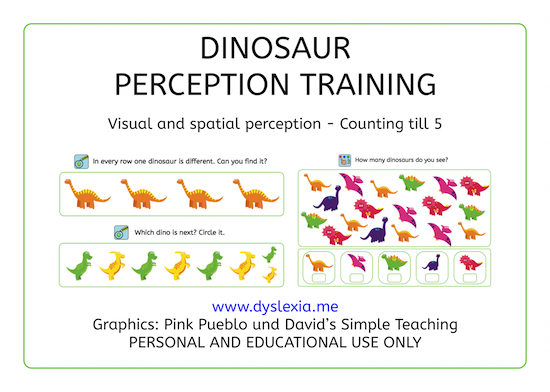
  • Dinosaur perception training

    Dinosaur perception training

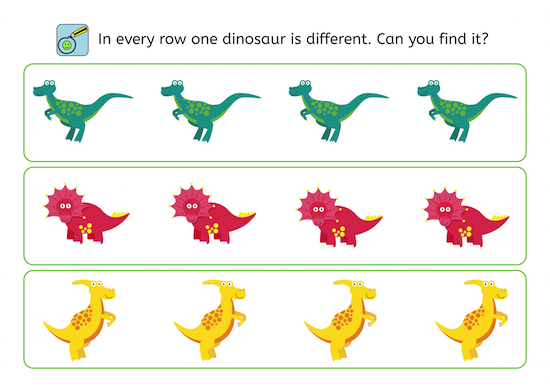
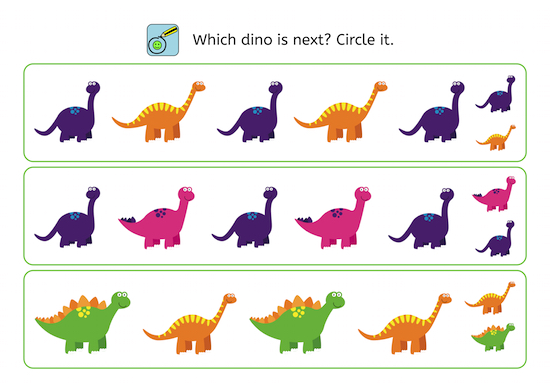
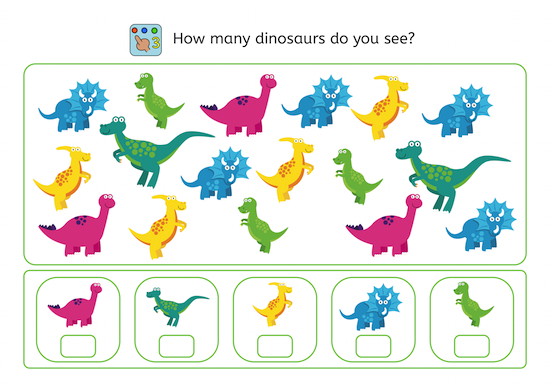
    Kids + dinosaurs = fun! Enjoy our new free no-prep printables with dinosaurs. Kids will have fun and train their visual and spatial perception, patterning, and counting up to 5.

    Dinosaur, perception training, children, freebie, no prep printable, parents, school, teacher, dyslexia, dyscalculia, AFS-method

    Visual and spatial perception:

    Dinosaur, perception training, children, freebie, no prep printable, parents, school, teacher, dyslexia, dyscalculia, AFS-method

    Patterning:

    Dinosaur, perception training, children, freebie, no prep printable, parents, school, teacher, dyslexia, dyscalculia, AFS-method

    Counting till 5:

    Dinosaur, perception training, children, freebie, no prep printable, parents, school, teacher, dyslexia, dyscalculia, AFS-method

    Download: Dinosaur perception training

    You want even more dinosaurs? Check out this free online game: Dinosaur – Find the pairs! You can choose different levels. The game can be played in any browser on any computer, smartphone or tablet.

  • New freebie: I spy … superheroes!

    New freebie: I spy … superheroes!

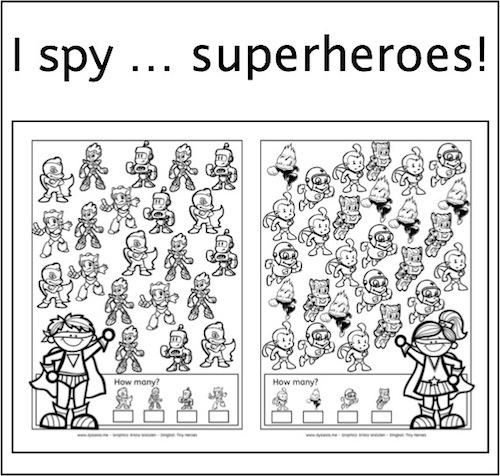
    Here is another “I spy…” freebie. Children simply love them. This time it is called “I spy … superheroes”. Print, color, count, and simply enjoy all the fun. At the same time, children train attention, visual perception, and fine motor skills.

    Grab this freebie here: I spy … superheroes

    More freebies

  • Understanding dyslexia: Learn how to best help your child

    Understanding dyslexia: Learn how to best help your child

    Just what is dyslexia?

    There are many misconceptions out there.

    familymagazineletters

    “Dyslexia is a type of specific learning disorder that impacts reading,” said Dr. Sheldon H. Horowitz, director of learning disability resources at the National Center for Learning Disabilities. “It is not a disease, nor is it contagious. It is not something that goes away — you don’t outgrow it — and it is not the result of watching too much TV, laziness, vision or
    hearing problems, or low intelligence.

    “The medical community refers to it as a disorder, and the educational community refers to it as a specific learning disability. Others are dyscalculia if the area of weakness is math, dysgraphia if the problem is writing and written expression.”

    Because dyslexia is not a disease, there is not “one treatment for dyslexia. It can’t be cured, especially because dyslexia is not a medical or psychological problem,” said Livia R. Pailer-Duller, executive director of the American Dyslexia Association. “It needs to be addressed through training of the attention span, of sensory perceptions, and the practice of reading and spelling on the educational level.”

    Rather, “dyslexia is a genetic disposition, which means that dyslexia is inherited,” she said. “Dyslexic individuals have different sensory perceptions. These different sensory perceptions are the reason why the attention of dyslexic people diminishes when they come in contact with letters, which in turn causes them to make errors in reading and spelling.”

    What it is

    There is no one profile of dyslexia, but typically, people have trouble sounding out words, blending letter sounds into words while reading, mastering the rules of spelling and grammar, and expressing what they know in written formats, Horowitz said.
    “Some people with dyslexia are accurate readers at a slower pace but struggle to understand what they have read because they expend all of their mental resources figuring out what the words are and keeping track of what they are reading,” he said. “Others are slow, labored readers, but do OK with comprehension.

    “People with dyslexia do not have vision problems that are causing them to struggle in reading. The problem stems from the way that printed text and the sounds of the language are processed in their brains. It’s not that their brains can’t do this processing; it’s that it is done in ways that are inefficient.”

    Also, dyslexia is not intelligence-related.

    “Dyslexics are not less intelligent than non-dyslexics — quite the opposite is often true,” Pailer-Duller said. “However, dyslexics often score low on intelligence tests because these tests attempt to measure intelligence by measuring sensory perceptions. But these are different in dyslexic individuals, which does not make them stupid, just that the test is inadequate.”

    How to help

    For people with dyslexia, “parents are absolutely critical and family support is hugely important,” Horowitz said. “Remember: dyslexia is what the child has, not who they are. They have areas of strength and interest just like everyone else, and in some cases, because they work so hard to compensate for their areas of challenge, they can be very high achievers and role models for their peers and for the general community.
    Parents need to understand as much as they can about dyslexia, abandon any feelings of guilt, and help their child to become a strong and effective self-advocate.”

    Schools are not required to give dyslexics extra help, but in some states, an individualized education plan is possible where dyslexic students receive help on standardized testing, Pailer-Duller said.

    As an example, “a dyslexic child with reading problems can receive additional assistance for reading instructions to solve math problems.
    However, dyslexic students have to do the reading portion of the standardized test themselves — without help.
    So this partial help does not go a long way,” she said.

    Teachers who are knowledgeable about dyslexia can do a lot within the school setting to help a dyslexic child.

    “Examples are that grading focuses on content and expression, and not on spelling. Teachers should avoid calling on dyslexic children to read aloud in front of the whole class if the child is not comfortable with it,” Pailer-Duller said. “It is very important to understand that the schoolteacher can only do so much. A dyslexic child will always need additional individualized training, either with a specialist or with parents.”

    Written by Melissa Erickson from Family Magazine, April 2014 issue, Gatehouse Media