Tag: homeschooling

  • 10 Ways to Help Kids Overcome Math Anxiety
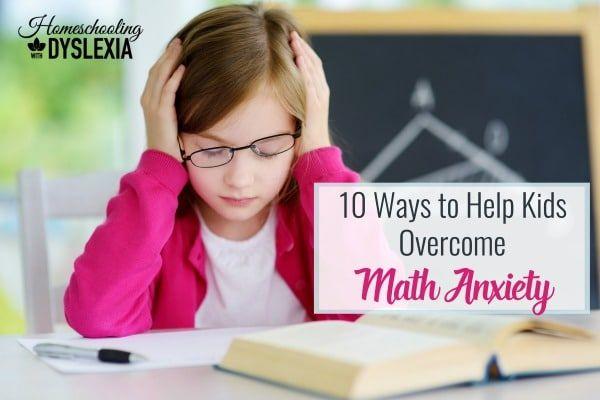
    10 Ways to Help Kids Overcome Math Anxiety

    For kids who struggle with math – the ones who have trouble with math no matter what they try – it is not uncommon to feel anxiety when even simply thinking about math. As the mom of a handful of kids who struggle with math, sometimes called dyscalculia, I have had a ton of practice helping them not only to figure out how to solve math problems but to overcome their unnecessary worrying about math. Whether your child is six or 16, these 10 tips will help them to build their confidence and ability in math class.

    10 Ways to Help Kids With Math Anxiety

    Overcome Math Anxiety

    Normalize their challenges.  I often laughingly refer to myself as my kids’ life coach.  How encouraging is it to a struggling learner to hear that many students have a hard time with math. Research shows that up to 50% of students nationwide are experiencing some degree of math difficulty.  Remind kids that “All kids can learn math, we just need to figure out how you learn best.”

    Continue reading here: https://homeschoolingwithdyslexia.com/help-kids-math-anxiety/

  • Making the Impossible Possible with Homeschooling

    Making the Impossible Possible with Homeschooling

    Wolsey Hall Oxford: The Homeschooling College

    For many dyslexic children the one-size-fits-all approach of traditional classrooms doesn’t work and can leave them feeling frustrated, singled out and upset. This experience can affect the whole family and you may be left feeling helpless with little choice.

    Homeschooling is an increasingly viable option for many families. While the idea may initially seem daunting, you can tap into your child’s strengths to aid their learning and best of all, the whole process is led by them. At home they can learn at a pace to suit them and in an environment they are comfortable with. If a new concept requires several different approaches before it’s really embedded in their mind, then you have the time and space to enable that creativity. You can also explore a wide range of technology to support their learning that isn’t permitted in mainstream schools. Homeschooling is flexible and that’s key.

    Kailash’s son Innes has dyslexia and homeschools with Wolsey Hall Oxford: “Homeschooling with Wolsey Hall has been fantastic for Innes. With Wolsey designing the yearly study plan, Innes has been able to tailor his schedule of work to accommodate his dyslexia. He immerses himself in a subject for days at a time, finishes an assignment and then moves on to the next topic. This pattern of working is very effective for Innes, as his short term memory is not very good – the knowledge is placed in his long term memory, giving him a very high retention rate.”

    For many dyslexic students their low self-esteem is also a major issue. The nurturing approach of homeschooling builds this up, giving them the confidence to try new things without the ridicule of their peers should they fail.

    Becoming your child’s home educator can feel overwhelming at the start, but many parents use a combination of approaches. From finding free resources on the internet and borrowing library books to meeting up with local homeschooling groups who often organize activities and trips. Online forums are a great resource for answering tricky questions, and the many Facebook groups offer a network of support from families in a similar boat.

    While homeschooling often means one parent losing their potential income, many families run home-based businesses alongside home educating. You could also sign up for some homeschooling courses online, where your child will have their own tutor and learning support. At Wolsey Hall Oxford, we help parents to identify the best ways they can support their child in order to unlock their potential. We pride ourselves on the learning support we offer students and their families including a mentoring service and development of personal learning plans. Your Student Progress Manager is with you every step of the way to answer your queries, and your tutor will follow the pace set by your child.

    Alfie, who has dyslexia, has been homeschooling for the past three years. Last year, he achieved four IGCSEs and is now studying another four IGCSEs this year. His mum, Helen explains why it works for them: “I can honestly say that Wolsey Hall was a fantastic choice for us. We really like the structure that Wolsey provides, the assignment schedule, and the online facility. Michaela, our Student Progress Manager, has been brilliant, always there to offer support and advice. I think what has been excellent for Alfie is the structure of the learning.”

    Wolsey Hall Oxford offers a wide range of courses from Age 7 Primary right through to Secondary, IGCSE, and A Level. For more information about our Cambridge-accredited school and how we support children with additional needs such as dyslexia, visit: www.wolseyhalloxford.org.uk

  • Should you homeschool your dyslexic child? by Catherine Attia

    Should you homeschool your dyslexic child? by Catherine Attia

    For many, homeschooling is basically a day at home. You could be doing homework during the day and watching TV during lunch. Whether it is doing school work during the week or weekend, homeschooling gives you opportunities that you don’t have in public school. It is time to spend with your family, get your school year done earlier, and take some more educational trips. It is integral that homeschooling continues to be a part of our country and society. Many others may argue that home schoolers are cut off from kids their age, but these are some of the things that can be easily solved. Homeschooling should be a the ideal way to educate children because it offers various types of freedom to the students, such as religious freedom, because students do better on standardized tests and in academics, and because it makes students have more self-confidence, and they feel better about themselves.

    Should you homeschool your dyslexic child?
    Should you homeschool your dyslexic child?

    One reason that students should be home-schooled is that it creates more freedom, such as educational, religious, and emotional freedom. As stated in the article, “The Pros and Cons of Homeschooling,” for educational freedom, “Most home-schooled students have the choice to study and learn what they want, when they want, for as long as they want,”(1). Educational freedom means that you get to learn what you want, when you want, and for as long as you want. This is good because if the student excels in adding and subtracting fractions, then they could move on and finish their school day earlier than other kids. Also, “Homeschooling provides the opportunity for parents to incorporate their beliefs into their daily lives” (The Pros and Cons of Homeschooling; 1). This evidence demonstrates my reason because being able to teach your children about your faith and beliefs. Many parents do home-school for religious purposes. For example, children and students that I watch on YouTube are home-schooled due to religious purposes. Finally, related to the topic of emotional freedom, The Pros and Cons of Homeschooling for Educational Freedom stated “According to studies, self-esteem plummets in middle school girls. However, similar studies of home-schooled girls have shown that self-esteem remains intact and that these girls continue to thrive.” To summarize what the quote said, the self-esteem of kids or girls in middle school drops for various reasons. If they are homeschooled, then self-esteem increases, and they continue to thrive. This evidence supports my claim because students who get bullied often feel so depressed, they don’t want to continue to try to succeed, and they feel worthless. The opposite is true for home-schooled children. Since they are not bullied, they continue to want to succeed. Which leads me to my next point.

    Another reason students should be home-schooled is because of better test scores and academic performance. As stated in the Seattle Times, “Among the positives are better test scores, fewer dropouts, and higher graduation rates” (1). This proves my reason because students have better test scores and standardized tests, such as NJASK. They are succeeding in academics further than students in public or private schools. In the East Brunswick school district, I have learned that in order for you to make it into an honor class, for example, Verbal Gate, you must do well on the NJASK. Home-schooled children may have a greater chance of being a part of an honors class. This proves my argument because the better students do in academics, the more parents would want to homeschool their child. Also, “According to one study, children who were home-schooled achieved an average 1100 out of a possible 1600 on the SAT, a popular college entrance exam.” (Facts on File Issues/controversies Homeschooling pg. 2) Just to recap home- schooled children get an 1100 out of a possible 1600 on the SAT. The SAT is an exam that most students take in the 11th grade. This test is what colleges look at to see if you are good enough for their school. This is good because students who are home schooled have a greater shot at attending schools like the Ivy League. One example of an Ivy League school is Harvard. Many people have said that if you attend a good college, then you will get a good career, which will lead to a good life.

    The final reason I think students should be educated at home is because they are able to receive more sleep. As stated in the Washington Post, “A new study of a few thousand students found that home-schoolers get more sleep than students at traditional public and private schools.” (1) This is very good because of appearance and health matters. In appearance, many students, including myself, have dark circles under their eyes due to lack of sleep. Not as many home-schooled children have this because they are able to get more sleep. This is bad for health-related matters because if students do not get enough sleep, then they won’t function properly and they won’t do as well in school. Also “55 percent of teens who were home-schooled got the optimal amount of sleep per week. 24.5 percent of students at traditional public and private schools got the optimal amount of sleep per week.” (Washington Post pg. 2) This is very good because if more than half of the home schooled teenagers get the recommended 45 hours of sleep per week then I may ask my parents to switch me to homeschooling.

    The lesser researched side may say that homeschooling is bad because it can cut children off from kids their age, but I argue that this statement is wrong. According to Homeschooling companion.com, “One of the more serious negative effects of homeschooling is that children can miss out on the opportunity to interact with other children. This can stunt their development socially as they do not learn how to communicate or behave in group settings. This is obviously a vital skill in living and working as an adult,” (1) This statement can be true, but there are other solutions of interaction, such as team sports. Another con of homeschooling is that the child can miss experiences, such as field trips. This situation can also easily be solved if the parent is committed to homeschooling their child. They can also then take them to the museum.

    Clearly, these are debatable reasons. But when you look at the facts it is obvious that one view makes much more sense than the other. It is essential that parents consider to home school their child because they offer various types of freedom to the students, because students do better in standardized test and in academics, and because they make students have more self-confidence. Sure, many others may argue that it is a waste of money or that it takes too much time, but they are wrong because of what I’ve explained. Sure, homeschooling may not be right for every child, but it might be right for you. You could be the one to homeschool your future or current children.

    I am very excited for you to read and learn from this article. I would like you to get to know me. First I am only in middle school, 7th grade to be exact. Also the reason I was offered an opportunity to present my essay on the blog of the American Dyslexia Association was because of my Language Arts teacher. She wanted us to send our essays out to people so they can learn about our topics. My topic included “Should dyslexic students be homeschooled.” My classmates and I all thought nobody would listen to us because we are just 7th graders. But when I received a reply from the Executive Director of ADA, I was astonished. So thank you so much to my Language Arts teacher for helping me write the essay and ADA for giving me the opportunity to write this blog article and to inform you about the pros of homeschooling a dyslexic child.

    By Catherine Attia, 7th grade, middle school

  • 1500 free worksheets

    1500 free worksheets

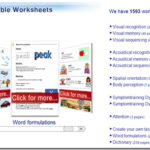
    The American Dyslexia Association offers more than 1500 free worksheets on its website. The worksheets follow the AFS-method , a very successful method to help children with dyslexia and dyscalculia. If a child has dyslexia or dyscalculia, it is not enough to work on the mistakes. The child also has to learn to be attentive all the time when reading, writing, and calculating. Furthermore, it is important to train the child’s perception to improve reading, writing, and calculating skills.

    Dyslexia, worksheets, free, parents, children, homeschooling, reading, writing, AFS-method


    Access the worksheets

  • New freebie: I spy … superheroes!

    New freebie: I spy … superheroes!

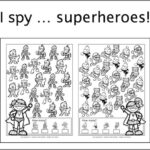
    Here is another “I spy…” freebie. Children simply love them. This time it is called “I spy … superheroes”. Print, color, count, and simply enjoy all the fun. At the same time, children train attention, visual perception, and fine motor skills.

    Grab this freebie here: I spy … superheroes

    More freebies

  • New freebie: I spy … Spring!

    New freebie: I spy … Spring!

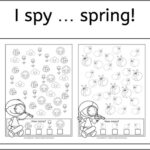
    Spring is in the air, so we thought it was about time for a new freebie. Give your children some coloring pencils and let them color and search. Then, they count how many they find of each object. Use this opportunity to talk about “more than…”, “less than…”, etc. This exercise trains attention, visual, and spatial perception, and fine motor skills – important skills for reading, writing, and arithmetic.

    Grab this freebie here: I spy … spring! (ca. 3,9 MB)

    More freebies