Category: Dyslexia

  • Even Older Kids Should Have Time to Read in Class

    Even Older Kids Should Have Time to Read in Class

    If the goal is to develop lifelong readers, students need time in class to practice—and learn to enjoy—reading.

    By Sarah Gonser  February 26, 2021

    When Marilyn Pryle, a teacher in Clarks Summit, Pennsylvania, began scheduling silent reading time for her ninth- and 10th-grade students during the first 10 minutes of each class, it became “one of the most profound and rewarding shifts in classroom teaching I have made in my career,” she writes for MiddleWeb.

    Now, instead of skimming entire books at the last minute, Pryle’s students “read, and can’t stop reading,” she writes. “They often finish their books in two weeks, or less. They want to know what will happen, so they read during study hall, at home, and during our classes.”

    It’s a shift that Pryle, who is an author and last year’s Pennsylvania Teacher of the Year, believes reinforces what many educators already know: if we want students to read—perhaps even grow to love reading—time for in-class reading needs to be prioritized in the school day. Far from being a waste of time, and in spite of intense pressures on teachers to meet academic requirements, when schools make the shift to incorporate in-class reading time, it can have a powerful, long-term impact on students’ reading and writing skills.

    Literacy experts like Kelly Gallagher, author of Readicide: How Schools Are Killing Reading and What You Can Do About It, have been hammering away at this issue for some time. “There are not enough books in schools,” says Gallagher, sounding a familiar refrain. “There’s not enough choice of books in schools. And there’s not enough time for kids to read in school. Those factors have to change.”

    To nurture a love of reading, students also need guidance learning how to find a wide variety of books they might like; exercises that teach them how to engage and think deeply about what they’re reading, at least sometimes; and plenty of low-stakes opportunities for reflection that reduce the pressure students feel around reading, removing it from the stressful realm of more homework and grading.

    Daily class time: In high school English teacher Chris D’Ippolito’s classroom, students read between 10 and 15 minutes at the beginning of class—and a few times a month, even longer blocks of time—a routine he says is critical for setting kids up as lifelong readers. “Giving students both choice and regular practice creates a classroom culture in which books are valued,” writes D’Ippolito. “Daily practice then becomes routine—even if students aren’t reading at home, they’re still getting the practice needed to develop a lifelong independent reading habit.”

    Try Book Clubs: Alongside her regular curriculum, Pryle organizes book clubs for her high school students, providing them with the opportunity to choose their own groups and the books they’ll read. She has a few simple rules: “The books must be a minimum of 150 pages, and each book must be one that’s new to everyone in the group,” writes Pryle, noting that, if necessary, teachers can evaluate students’ choices to ensure the books are appropriate.

    If a student struggles to find a group to join, Pryle steps in to help, asking the student about friends or acquaintances in the class. “Then I delicately talk to someone in that group, usually seeking out the person who seems the most mature and kind. So far, it has worked out.”

    Continue reading:

    https://www.edutopia.org/article/even-older-kids-should-have-time-read-class

  • Life Skills That Make a Difference

    Life Skills That Make a Difference

    By Jonathan Cohen, Ph.D. and Eve Kessler, Esq.
    Social, emotional, and ethical literacy may be more important than academic skills when it comes to achieving happiness and success • As a parent, you can help your child develop competencies in those areas • Use your child’s evaluation as a tool to improve in areas other than academics


    As parents of children with LD or ADHD, we often focus on their academic challenges. Research shows, however, that how children use information to solve real-life problems, manage their daily lives, and what type of learner they are may be better indicators of success than their cognitive skills. Grades and SAT scores may impact a student’s ability to get into college, but they are poor predictors of happiness or professional success.

    The real predictors of a child’s ability to learn, problem-solve, and interact successfully are his social, emotional, and ethical literacy—the same attributes that are the basis for adults to love, work, and participate in communities.

    All modes of literacy are grounded in the ability to decode, whether it’s letters or situations involving a person’s tone of voice and facial expression. Being able to decode complex information allows children to be creative problem solvers, flexible learners, and good decision makers.

    PROBLEM SOLVING

    Flexible problem solving is an important competency. As a parent, you are a powerful social, emotional, and ethical teacher and role model. Everyone has an array of strengths and challenges, and how you describe and discuss them is essential, both to yourself and to your child, who mimics your words and mirrors your actions.

    In a given day, you make approximately 11,000 decisions. How you go about solving problems shapes your life. Each moment offers a chance to model creative or rigid problem-solving strategies and put them in perspective: was that solution helpful or did it cause more problems?

    Children need to know that they are not the only ones who struggle or get stuck. How you talk about your problems and solutions can leave a profound impression on their developing minds.

    The ways you think and feel about yourself shape your child’s abilities and the way he sees himself. The life of a person who engages in positive self-talk will be quite different from the life of someone whose inner dialogue is: “I am dumb; I am worthless.” Therefore, as well as promoting cognitive abilities, you must purposively support social, emotional, and ethical capabilities. It is those skills that provide the foundation for pleasure and meaning in life.

    Continue reading:

    https://www.smartkidswithld.org/getting-help/raising-independent-kids/life-skills-make-difference-kids-ld-adhd/

  • Dyslexia Research Center Online Shop

    Dyslexia Research Center Online Shop

    Check out our online dyslexia and dyscalculia shop for educational tools like Mathe4matics and Letters2Words card games, and the EasyReading Card.

    http://dyslexics.com

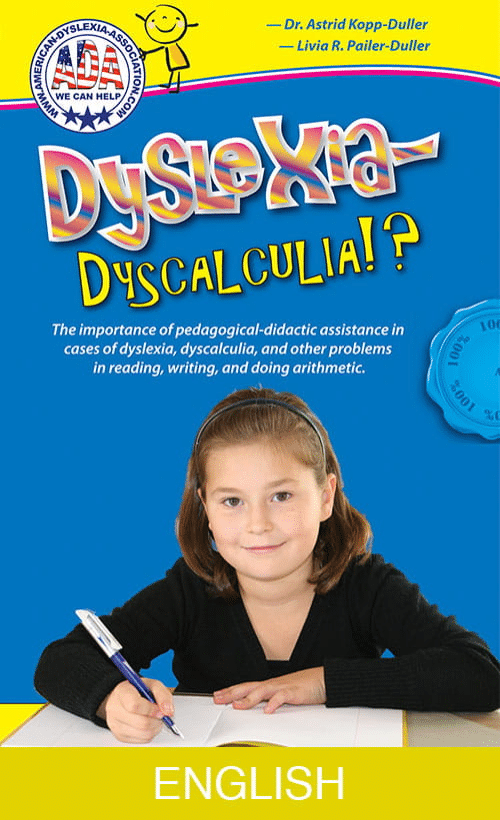
    Also featured in our online shop is Dyslexia-Dyscalculia!?, a publication authored by Dr. Astrid Kopp-Duller and Dr. Livia R. Pailer-Duller, which describes the necessity of intervention on a didactic level.

  • 9 Surprising Clues Of Dyslexia in Children

    9 Surprising Clues Of Dyslexia in Children

    Will Your Child Grow Out of His Reading Difficulty or Is It Dyslexia?

    Are you worried your child’s slow start to reading might indicate dyslexia?

    Is your older child struggling with reading, but you are not sure how serious it is?

    Should you act now or will your child’s reading difficulties most likely resolve naturally?

    We all know the key to helping dyslexia in children is early and intensive intervention.  If you can treat it early — in elementary school — you may short circuit a lot of frustration before bad habits are formed and while there is time to catch up.  Even in later grades, the sooner you know what you are dealing with, the better.

    About 40% of children struggle with reading at some point in their lives. It’s a complex skill that we are not born with.

    According to Yale, about a quarter of children who experience a slow start to reading will go on to be proficient readers as language processing skills mature naturally (boosting phonemic awareness) and vocabulary expands.  And so, yes, there is a risk of over-reacting to early reading problems.

    You don’t want to burden your child with programs or therapies he doesn’t need, possibly creating stress and anxieties in him by pursuing extra treatments that turn out to be unnecessary.

    However, Yale will also tell you that 15-20% of children do not grow out of their reading difficulties — they have a reading disability, loosely described as dyslexia, that will likely not resolve itself without outside help.

    If this is your child, you don’t want to sit idly if it turns out the reading problems are long-term in nature.

    The sooner you recognize the undeniable signs of dyslexia, the sooner you can take action. This may include pressing the school to at least recognize the issue and pursuing your own after-school remedies.

    If there is dyslexia in your family, you likely know there is a strong hereditary component to dyslexia and that you should act at the first sign of difficulty. Similarly, if your child has other diagnosed learning difficulties, you most likely have your answer. Reading is an amazing skill that is not easy to master, even for the most healthy of learners.

    But what if it seems just to be a reading problem?  How can parents distinguish a minor reading difficulty from dyslexia?

    Dyslexia: A Deep-Seated Reading Difficulty (That Probably Won’t Resolve Naturally)

    As an aside, dyslexia is not a condition or a disease.  There is no dyslexia gene or medical diagnosis.  Dyslexia in children is an educational evaluation arrived at through the collection of evidence, symptoms.

    The most important aspects of the dyslexia diagnosis are that the reading difficulty:

    • is not explained by other learning disabilities, and
    • will not likely resolve itself.

    Children with temporary reading difficulties need instruction, guidance and practice.  Children with dyslexia need more intensive treatment.

    Cognitive Delays Associated With Dyslexia

    Many children struggle with reading, so current reading ability is not always a reliable indicator. Your interest is what happens next — will your child go on to be a proficient and enthusiastic reader or will the reading troubles persist?

    Differentiating between a garden-variety reading difficulty and dyslexia comes down to what else is going on with your child. If there are no other apparent difficulties, and no hereditary issues, read on.  There very well could be cognitive difficulties under the surface that are impeding reading progress now and will continue to do so in the future.

    There are three types of cognitive difficulties that impede reading.  These are deep-seated difficulties that will not necessarily fade with maturity and need to be addressed if your child is to become a proficient reader.  They fall into three main categories:

    1. Language processing
    2. Working memory
    3. Attention issues

    Note, this list specifically excludes visual processing and other vision-related issues, which are no longer thought to be significant risk factors in dyslexia.  The predominant causes of dyslexia relate to language, cognitive delays in processing, working memory and/or focus that impede the ability to automatically connect text symbols on a page to language memory.

    Using This List Of Clues of Dyslexia in Children

    This list can help parents identify early signs of dyslexia (away from actual reading ability) by identifying markers or clues of the cognitive delays that are known to impede reading development and are most often associated with dyslexia in children.

    If your child is a struggling reader and one or more of the clues or symptoms below are evident, your child’s reading difficulty may not resolve itself.  The symptom suggests your child has a cognitive skill gap that is already impacting reading and is likely to continue impeding reading progress until it is treated.

    Alternatively, if your child has a reading difficulty and none of the symptoms listed below, there is a good chance he is one of the 25% who starts slowly but eventually masters reading.

    Clue #1. Difficulty Rhyming at 3-4 Years of Age

    This is a well-known dyslexia risk factor.  If you have done any research on dyslexia, this will likely not be surprising as you will be aware of it. We feel it is important to include, however, given its reliability in predicting dyslexia in children.  Rhyming is a good indicator of trouble ahead because it requires the same language processing skills needed in reading.

    Rhyming is the ability to process and manipulate language, language dexterity, which eventually leads to phonemic awareness and fluent decoding.  If your child struggles to match sounds in the middle or at the end of words, i.e. rhyming, it indicates a difficulty with processing and manipulating language. If left unresolved, it is a difficulty that will continue to impede reading progress through life.

    Clue #2. Balance or Coordination Issues

    • Late in learning to ride a bike
    • Struggles to catch a ball
    • Lacks spatial awareness on a sports field

    These are three different symptoms of the same underlying issue — sensory integration disorder that often manifests itself in learning as ADHD-PH (Predominantly Hyperactive).

    Learning to ride a bike requires balance.  If your child struggled to ride a bike “on time” (on average around 4-7 years of age), it may indicate a sensory integration issue.  Balance is a response to sensory inputs.  If those signals are out of sync, your child’s adjustments will be out of sync, making balance a challenge.

    Catching a ball requires good hand-eye coordination which, of course, requires sensory integration.  Similarly, spatial awareness — such as being able to manage your positioning on a sports field where people and the ball are constantly moving — also requires good sensory integration skills.

    Neuroscientists tell us “neurons that fire together wire together.” If sensory inputs are out of sync, even the tiniest little bit, there is noise in the brain that is disorienting, distracting, exhausting and an impediment to learning, which includes learning to read.

    Reading is a difficult skill to learn even with perfect attention skills.

    The lack of synchronicity of auditory and visual inputs creates timing issues that impede focus and make it difficult to engage.  Not only can this slow down the learning to read process, the extra effort required to read can make reading hard to do for any length of time, depriving your child of much needed reading practice.

    Therefore, if your child is a struggling reader and exhibits signs of sensory integration issues, reading could be a long term challenge.  In this case, an intervention that works on sensory integration, such as Interactive Metronome, might be appropriate.  In any case, it’s a clue that your child’s current reading  challenges may not resolve naturally.

    Continue reading:

    https://www.gemmlearning.com/blog/dyslexia/9-surprising-clues-of-dyslexia-in-children/

  • Scientists May Have Found the Real Cause of Dyslexia—And a Way to Treat It

    Scientists May Have Found the Real Cause of Dyslexia—And a Way to Treat It

    Dyslexia is often described as trying to read letters as they jump around the page. Because of its connections to reading difficulties and trouble in school, the condition is often blamed on the brain. But according to a new study published in Proceedings of the Royal Society B, the so-called learning disability may actually start in the eyes.

    As The Guardian reports, a team of French scientists say they’ve discovered a key physiological difference between the eyes of those with dyslexia and those without it. Our eyes have tiny light-receptor cells called rods and cones. The center of a region called the fovea is dominated by cones, which are also responsible for color perception.

    Just as most of us have a dominant hand, most have a dominant eye too, which has more neural connections to the brain. The study of 60 people, divided evenly between those with dyslexia and those without, found that in the eyes of non-dyslexic people, the arrangement of the cones is asymmetrical: The dominant eye has a round, cone-free hole, while the other eye has an unevenly shaped hole. However, in people with dyslexia, both eyes have the same round hole. So when they’re looking at something in front of them, such as a page in a book, their eyes perceive exact mirror images, which end up fighting for visual domination in the brain. This could explain why it’s sometimes impossible for a dyslexic person to distinguish a “b” from a “d” or an “E” from a “3”.

    These results challenge previous research that connects dyslexia to cognitive abilities. In a study published earlier this year, people with the condition were found to have a harder time remembering musical notes, faces, and spoken words. In light of the new findings, it’s unclear whether this is at the root of dyslexia or if growing up with vision-related reading difficulties affects brain plasticity.

    Continue reading article: https://www.dyslexia.me/?p=2283&preview=true

  • Dyslexia and Working Memory Go Hand in Hand—How to Help Students Remember More

    Dyslexia and Working Memory Go Hand in Hand—How to Help Students Remember More

    Brought to you by Learning Ally

    As teachers, we know that when students have certain abilities,
    they’re better prepared for school and life. Working memory is one of
    those things. We know it when we see it: Students are organized, know exactly what to do after you’ve given directions, and are able to follow in-depth discussions.

    On the flip side, there are students who need extra help to develop their working memory. As it turns out, working memory and dyslexia go hand in hand, and there’s a lot we can do to help students with dyslexia remember more.

    What is working memory?

    In short, our working memory helps us hold and use information. It’s the cognitive process we use to hold some information in our minds while we retrieve other information. It’s also involved with recalling information, from a set of directions to a story. We’re using our working memory across the day—completing step-by-step math problems, following a recipe after reading it, or doing tasks like identifying rhyming words or sounding out multisyllabic words.

    Our working memory is small; only a few bits of information will fit at any time. That’s why, when you’re working through a math problem, you may have to refer back to it a few times to retrieve the information you lost. That’s also why it’s so frustrating for kids who struggle with poor working memory—everything seems to be passing them by.

    Children with dyslexia have a higher rate of working memory concerns. The rate of poor working memory in students with dyslexia and other learning disabilities ranges from 20 to 50 percent , compared to 10 percent of students overall. So, it’s something that you’re likely to see in classrooms. Here’s how to help:

    1. Give students personal reference charts.

    Reduce the amount that students have to keep in their working memory with personal reference charts. This gives them the chance to actually think through higher-order tasks because they don’t have to take energy to recall basic information (math facts, vocabulary words, editing notations). It also helps them complete tasks faster because they aren’t relying solely on their memory to get information.

    Teacher tip: Work with students to identify what information they have trouble recalling and show them how to create a personal reference chart. This teaches them to use this strategy throughout their lives.

    2. Place anchor charts strategically.

    Anchor charts are, really, a whole-class visual reference sheet, but they can also clutter your walls and make it difficult for students to identify which information they need to use now. Consider having rotating anchor charts at a specific space in your room where you can post the anchor chart that students should be using for the task at hand.

    3. Embrace audiobooks.

    For students with dyslexia, audiobooks remove the difficulty of sounding out words. This takes the pressure off their working memory so they can understand the story or content. Using a solution like Learning Ally, which provides kids with audiobooks that have options like highlighted text, lets kids enjoy books without taxing their working memory.
  • How Testing Kids For Skills Can Hurt Those Lacking Knowledge

    How Testing Kids For Skills Can Hurt Those Lacking Knowledge

    Excerpted from THE KNOWLEDGE GAP by Natalie Wexler, published by Avery, an imprint of Penguin Publishing Group, a division of Penguin Random House, LLC. Copyright © 2019 by Natalie Wexler.

    By Natalie Wexler

    In 1987, two researchers in Wisconsin, Donna Recht and Lauren Leslie, constructed a miniature baseball field and installed it in an empty classroom in a junior high school. They peopled it with four-inch wooden baseball players arranged to simulate the beginning of a game. Then they brought in sixty-four seventh- and eighth-grade students who had been tested both for their general reading ability and their knowledge of baseball.

    The goal was to determine to what extent a child’s ability to understand a text depended on her prior knowledge of the topic. Recht and Leslie chose baseball because they figured lots of kids in junior high school who weren’t great readers nevertheless knew a fair amount about the subject. Each student was asked to read a text
    describing half an inning of a fictional baseball game and move the wooden figures around the board to reenact the action described.

    Churniak swings and hits a slow bouncing ball toward the shortstop, the passage began. Haley comes in, fields it, and throws to first, but too late. Churniak is on first with a single, Johnson stayed on third. The next batter is Whitcomb, the Cougars’ left-fielder.

    It turned out that prior knowledge of baseball made a huge difference in students’ ability to understand the text—more of a difference than their supposed reading level. The kids who knew little about baseball, including the “good” readers, all did poorly. And among those who knew a lot about baseball, the “good” readers and the “bad” readers all did well. In fact, the bad readers who knew a lot about baseball outperformed the good readers who didn’t.

    In another study, researchers read preschoolers from mixed socioeconomic backgrounds a book about birds, a subject they had determined the higher-income kids already knew more about. When they tested comprehension, the wealthier children did significantly better. But then they read a story about a subject neither group knew anything about: made-up animals called wugs. When prior knowledge was equalized, comprehension was essentially the same. In other words, the gap in comprehension wasn’t a gap in skills. It was a gap in knowledge.

    The implication is clear: abstract “reading ability” is largely a mirage constructed by reading tests. A student’s ability to comprehend a text will vary depending on his familiarity with the subject; no degree of “skill” will help if he lacks the knowledge to understand it. While instruction in the early grades has focused on “learning to read” rather than “reading to learn,” educators have overlooked the fact that part of “learning to read” is acquiring knowledge.

    Continue with article here:

    https://www.kqed.org/mindshift/54054/how-testing-kids-for-skills-hurts-those-lacking-knowledge

  • Dyslexic Thinkers Aren’t Disabled Thinkers

    Dyslexic Thinkers Aren’t Disabled Thinkers

    In the world of reading, we know oral language is mapped on to symbols we recognize as the alphabet.

    This is a sound-symbol relationship. When an individual struggles to grasp this relationship, the label of ‘dyslexia’ is often applied, implying a learning disability. This approach assumes everyone thinks and processes incoming information alike.

    What if this is not the case? An architect ‘sees’ a building before drafting a blueprint. An engineer imagines a bridge, visualizing the piers. These visual thinkers imagine a world in three dimensions. Those with dyslexia exhibit visual and dimensional thinking as a stronger mental process.

    Now, imagine a Kindergartener being introduced to flat lines on paper that are supposed to carry sounds that have no meaning until blended together into words. In the dyslexic world, if the letter ‘R’ was three dimensional, looking down from the top, it would be a bar; from below, two small squares. Without directionality to hold the letter in place, how it is supposed to look? Lines anchor two-dimensional letters in place but what holds three-dimensions?

    Technology is changing the mental landscape. In the 14th century, few people could read so gossip was the mode of communication. Fast forward to the 20th century, with books, radio, and television engaging the visual and auditory senses, and eventually, computers and smartphones, adding touch. Today’s student thinks in all three modalities. Imagine thinking in live-action holographs, and you’d have a better idea of the mental processing of a dyslexic thinker.

    How do we teach someone who sees the world in holographic images? We begin with dimensions using real objects. By naming them, we add language, using the entire word initially.

    Before dyslexic thinkers can recognize letters in their proper position on a line, they need to examine them in dimensional space. By using pliable materials to shape symbols for 360-degree viewing, young learners begin to recognize how to place a letter properly on a line. By beginning with named objects, the entire word is connected to dimensions. Dyslexic thinkers need to take words apart to discover patterns rather than assembling these from isolated letters and sounds.

    This object – picture – sound – symbol approach creates a bridge for dimensional thinkers to move into the two-dimensional word of print and text.  Building a mental library of objects with their whole word label creates a resource for using careful observation to detect common patterns and relationship with words which do not contain a visual image such as ‘not’ or ‘is’ or words we know as function words.

    Continue reading article:

    https://www.teachthought.com/literacy/dyslexic-thinkers-arent-disabled-thinkers/

  • The Ladybug Known as “Lil”

    The Ladybug Known as “Lil”

    ADA has endorsed another award-winning rhyming story picture book by Robert Z. Hicks, “The Ladybug Known as Lil”.  The story has the flavor of  the wild west in the pumpkin patch.  Ant bursts in the door of the Pumpkin Club to warn the bugs that aphids are invading the garden, and on their way to Pumpkin Town!

    Ladybug Lil, singer at the Pumpkin Club, rides her roach through the night to find sheriff Bugaroo to save Pumpkin town from the dreaded Aphid Gang.  Will the sheriff and his posse reach Pumpkin Town in time?

    Will Lil see her beloved Pumpkin Club destroyed by the invading Aphids?

    Told in rhyme, “The Ladybug Known as Lil” is good for early readers.  The THINGS TO LEARN section has photos and information about the real insects that are characters in the story.

    Questions and Answers test comprehension.

    “The Ladybug Known as Lil”‘s trophy joins Mr. Bob’s collection of awards for “Tommie Turtle’s Secret”, “Mouse in the Manger”, and “Danny the Dragon”, all of which have met ADA’s standards for formatting and quality.  

    Ashley Otis, the artist who illustrates Bob’s books, has done a beautiful job of bringing Ladybug Lil to life!

    Available on Amazon and online bookstores.