Tag: perception

  • Symbol sudokus for children

    Symbol sudokus for children

    Sudoku, symbol, children, parents, logical thinking, perception, dyslexia, dyscalculia

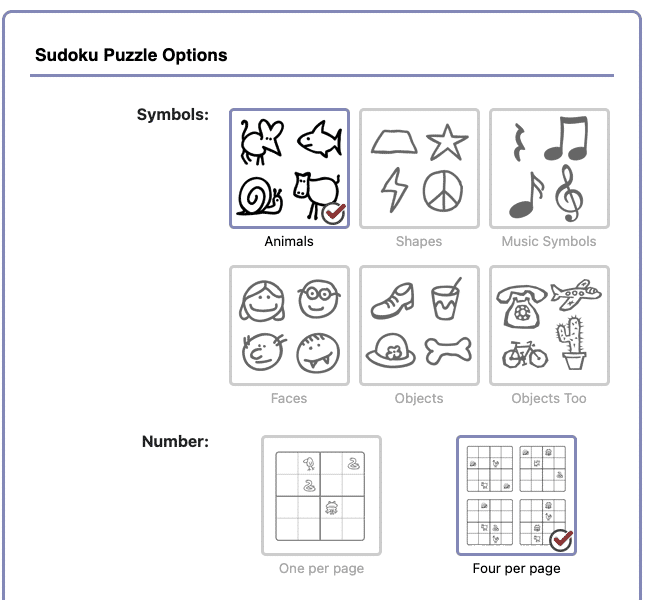
    Sudokus are everywhere: in about every shop to buy and on the internet as free printables or to play online . So why another post about sudokus? Because it is not easy to find good sudokus for children and it is even less easy to find sudokus with symbols. Worksheetworks.com, however, offers a free symbol sudoku generator . Simply choose the symbols, how many sudokus you want (one or four per page), choose the difficulty level and click “create worksheet”. You get a PDF which you can save or print. A solution and explanation of the solution are included.

    We like symbol sudokus a lot. Young children can solve them as well and are very proud for being able to do the same kind of puzzles as the adults. Older children like the extra challenge of drawing the symbols – this trains creativity and visual perception. What more can you wish?
    Access the symbol sudokus here

  • Animals and objects

    Animals and objects

    Animals and objects, perception, freebie, parents, children, dyslexia, dyscalculia

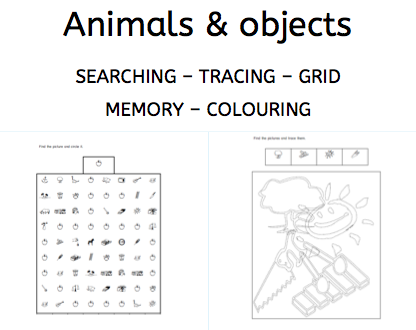
    A cold rainy day? Still 10 minutes to fill? Children with special educational needs? You simply cannot have enough worksheets. That’s why we offer you a file (24 pages) with animals and objects: searching, tracing, drawing, colouring, memory – all for free, of course! The exercices train attention, visual and spatial perception.
    DOWNLOAD
    We hope you enjoy them!

  • Open your ears!

    Open your ears!

    The American Dyslexia Association offers a different educational approach to help people with dyslexia and dyscalculia. This approach is called the AFS-Method, which is a multi-sensory method to help people who have difficulties with reading, writing and/or calculating. The “F” stands for “Function” which means the different sensory perceptions you need to learn reading, writing, and calculating. One important sensory perception is the acoustic area:

    • acoustic recognition: Can the child recognize different sounds?
    • acoustic memory: Can the child remember what he/she has heard?
    • acoustic sequencing: Can the child remember a sequence of sounds?

    We offer 12 sound sequences to train acoustic perception. Access them here. The audio clips have different degrees of difficulty. The child should recognize whether the sounds are the same or different, loud or soft, how many different sounds there are, and so on. According to the age and skills of your child, you can do the exercises with closed headphones. The headphones have the advantage that the child can completely focus on the sounds. The trainer or parent then also needs headphones and a dual adapter. If you do the exercises without headphones, then the child also hears the normal daily sounds around and learns how to filter out noise even better.
    We also made some worksheets to accompany these exercises, which you can download here: DOWNLOAD.
    Access the audio clips here.

  • Mazes

    Mazes

    Mazes have always fascinated humanity. Think about the Cretan Labyrinth from Greek mythology. But even today, mazes are very popular. In “The Goblet of Fire,” Harry Potter has to go through a maze to win the Triwizard Tournament. Once Harry finds the way through the maze, things turn out completely different from what was expected. But that is another story you’d better read yourself.
    Children are also fascinated by mazes. Therefore, mazes are perfect for training attention and perception. Here is a good way to do mazes with your children:

    • Give your children a maze.
    • First, the children should try to find the way ONLY using their eyes.
    • If that is too difficult, or if they found the way with their eyes, they should trace the way with their fingers.
    • If that works well, they should trace the way with a pen. They shouldn’t touch the walls of the maze.

    Important: Take care that the mazes are not too difficult, but also not too easy.
    We created some worksheets with mazes in varying levels of difficulty.

    DOWNLOAD

    Check out our other freebies

  • I wonder what it’s like to be dyslexic by Sam Barclay

    A beautiful, design led experience of what it feels like to struggle with reading.

    Introduction

    People all over the world struggle with reading for a variety of reasons, including dyslexia, lack of education and an unfamiliar language to name a few. People with reading difficulty are often capable of thinking in ways that others aren’t and as a result are capable of true greatness, yet these people are often misunderstood and treated unfairly as a result.

    Failing to encourage those with reading difficulties in a way that makes sense to them can limit (and in many cases damage) their ability to progress.

    Great effort has been made to provide tools aimed at improving a persons reading but very little has been done to give those around them an understanding of what it really feels like to struggle in such a way.

    About the book

    What it’s like to be dyslexic

    This book aims to provide the reader with a beautiful, design led experience of what it feels like to struggle with reading.

    For you

    Enjoy thumbing through the pages of this book with your favourite cup of coffee. Enjoy the books beautiful typographic theories that are sure to give you a completely different outlook on reading.

    Put it on your coffee table, stack it on your bookshelf or pass it on to a friend. If five people pick the book up in it’s lifetime, chances are that one of those five will impact positively on another persons life as a result, whether they know it or not.

    For your business

    As stated in the Equality Act 2010, disability discrimination legislation prohibits discrimination against disabled people in employment and in the provision of goods and services. This includes those with dyslexia.

    With or without legislation, many businesses require staff and customers to read a great deal – whether it be T&C’s, returns policies, reports, daily emails… the list goes on.

    Helping staff to truly understand what it might feel like for a colleague or customer to struggle with reading will greatly improve your business.

    For your school/college/university

    The impact of dyslexia is rarely seen in greater force than in education. Students that cannot learn to read have enormous difficulty reading to learn.

    If those around them – be it their teachers, parents or fellow students – can begin to understand what it feels like for them to be face to face with a page of text, the positive impact on their self esteem will be felt for the rest of their lives.

    What people are saying…

    “An excellent body of research and development that has successfully been translated into the final piece. Thoughtful and considered typography and layout that is quite simple. A joy to look at and read.”
    – The International Society of Typographic Design

    “This book demonstrates very clearly the range of trials and tribulations experienced by someone struggling to make sense of the written word. In my opinion this is a ‘must have’ resource for both parents and professionals wanting to support and understand the difficulties experienced by people trying to master the craft of reading especially in this information-rich world and when literacy achievements in this country are apparently at an all time low.” – Jeannie Low Ying (retired Assistant Principal Educational Pychologist)

    “This book should be put on the compulsory reading list for all training teachers in a bid to eradicate the ignorance that still exists towards Dyslexia” – Julie Roche (Deputy Head Principal)

    I need your help!

    With your help, this book can become available all over the world.

    More Information:

    http://www.kickstarter.com/projects/1150582455/i-wonder-what-its-like-to-be-dyslexic

    http://karenbarclay.com/everything-else/dyslexia-a-very-positive-thing-to-have-a-beautiful-book-and-a-nuffy-pecker-day/

  • Visual sequencing

    Visual sequencing

    Visual sequencing, perception, dyslexia, worksheets, parents, children

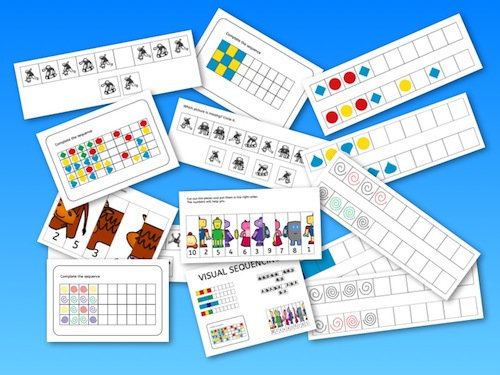
    Visual sequencing is the ability to organize visual impressions in a certain order. This is an important prerequisite for good writing, reading and arithmetic. Children who have difficulties with visual sequencing often exchange letters while writing or have difficulties with writing down numbers. Today we are offering a freebie containing various exercises to train visual sequencing.

    DOWNLOAD

    Check out our other freebies

  • App: Phonetic Birds

    App: Phonetic Birds

    Phonetic Birds, app, perception, ipad, acoustical perception, AFS-method, dyslexia, parents, children

    Finding good programs and worksheets to train acoustical perception is difficult. So we were very happy when we discovered the app “Phonetic Birds” in the app store. This app is designed to assist in improving audio discrimination and memory-sequencing. In 4 playfull mini games the player has to find pairs of birds, mimic melodies and organize birds from low to high or silent to loud.

    Highlights:

    • Adventure mode with 72 levels
    • Quick play mode for full control
    • Random play mode for endless fun
    • Motivating birds in unlimited colors
    • Save the progress for up to 6 players

    The app is designed by Marc Stockel, a special education teacher in Germany. Visit his website.

    The app is available in the app store and costs $ 2,99.

    Phonetic Birds, app, perception, ipad, acoustical perception, AFS-method, dyslexia, parents, children

  • MonsterZ – Rows and tracing

    MonsterZ – Rows and tracing

    MonsterZ, perception, visual perception, dyslexia, parents, children, school, homeschool, AFS-method

    Today’s freebie contains monsters waiting to be colored and traced. Look carefully and complete the rows using the correct colors. Trace the monsters in different colors. There are also monstercards to trace. Children can create a memory out of these cards – simply print them twice – or use them for other games. Have fun!

    DOWNLOAD

    MORE FREEBIES

  • Dino – Perception Training

    Dino – Perception Training

    Dino, perception, visual perception, spatial perception, dyslexia, dyscalculia, training, AFS-method, reading, writing, calculating, school


    Dino – Perception Training – that is today’s freebie: Arrange dinos from small to big, find the dino that is exactly the same, find pieces from a picture. These exercises train visual and spatial perception and attention – important skills for reading, writing and calculating.

    DOWNLOAD (6 MB – file may take a while to load)

    CHECK OUT OUR FREEBIES